The May Phone Call
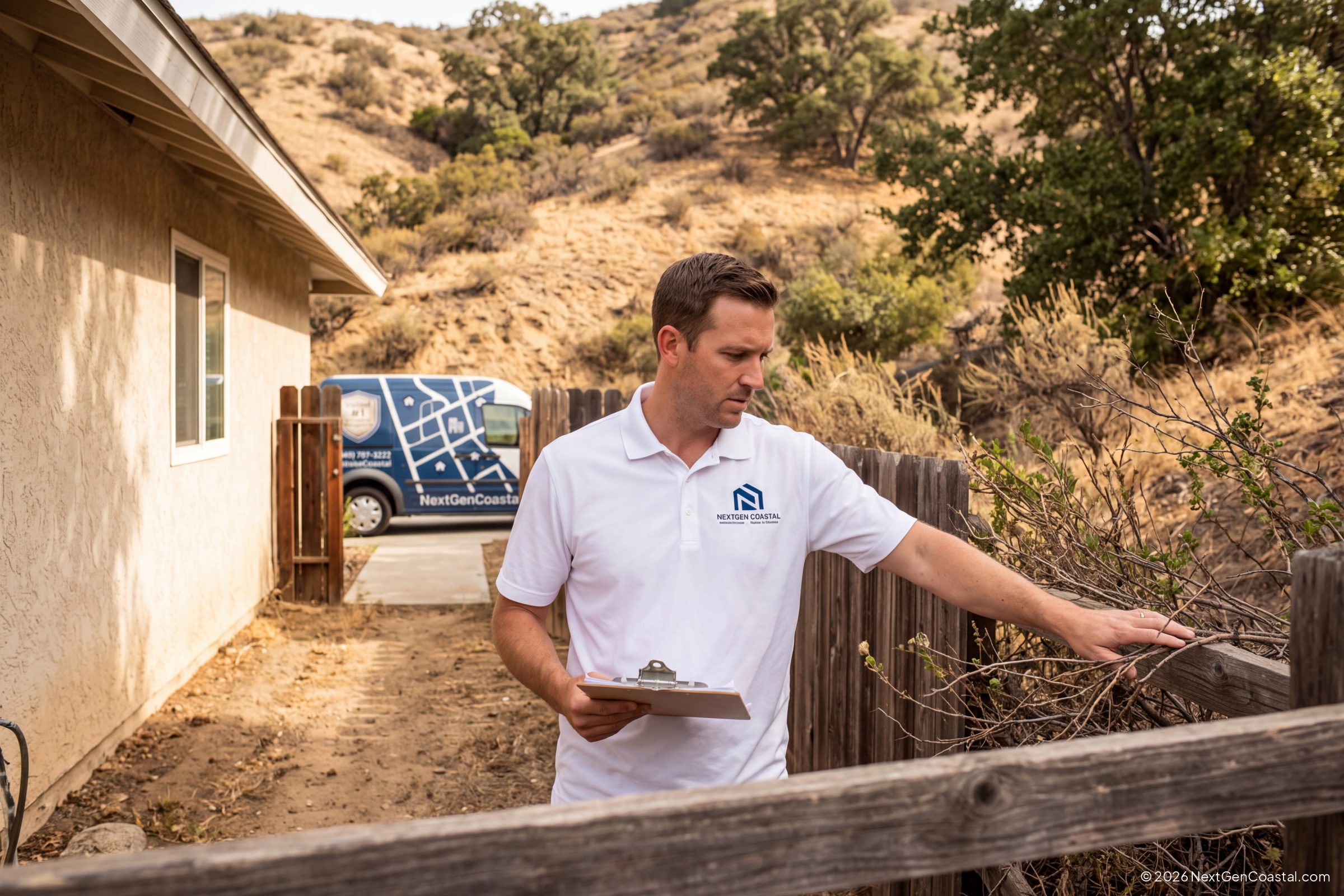
Every year around the first week of May, my phone starts doing the same thing. An owner with a hillside rental in Laguna or a canyon-rim duplex in San Diego forwards me a photo of a bright orange notice hanging on the gate. Sometimes it's from CAL FIRE. More often it's from the city fire department. The message is always some version of: clear the brush within 30 days or we'll do it for you and send you the bill.
Interactive Tool
Brush Clearance Area and Cost Estimator
Rough out the zone you are responsible for on your parcel and what a crew will charge to keep it clear.

Unincorporated land where CAL FIRE has fire protection duty.
One acre is 43,560 sq ft.
Use your own bids. Steep slopes and heavy chaparral cost more.
Most hillside rentals need a spring pass and a late-summer pass.
 Built by NextGen Coastal
 The owner's first question is usually 'is this real?' The second is 'isn't that the tenant's job?' The answers are yes, and no. Not in the way you're hoping.
I managed my own units for years before I joined NextGen Coastal, and I'll admit I once let a slope behind a fourplex go two seasons without a cleanup. Nobody fined me. I got lucky. Plenty of owners in the coastal hills don't, and since the January 2025 fires in Pacific Palisades and Altadena, nobody in Southern California fire enforcement is feeling lenient. So let's go through what the rules actually say, who they apply to, and where the liability sits when something burns.
SRA, LRA, and the Wrong Takeaway
First, some geography. California splits wildfire protection into two buckets. The State Responsibility Area, or SRA, is land where CAL FIRE has the legal and financial job of fighting wildfires. Think unincorporated county land, big open hillsides, the back side of the Santa Monica Mountains, most of the foothills above Santa Barbara. Everything else is Local Responsibility Area, or LRA, where your city or county fire department has the job.
Here's where owners get tripped up. The defensible space law most people have heard of is Public Resources Code section 4291. It requires 100 feet of clearance around any structure in the SRA. Owners read that, notice their rental sits inside city limits, and conclude CAL FIRE rules don't touch them.
They're half right. Section 4291 doesn't apply directly inside most coastal cities. But Government Code section 51182 copies the same 100-foot requirement onto every property in a Very High Fire Hazard Severity Zone inside the LRA. Same distance. Same zone structure. Different agency knocking on the door. And your local fire code almost certainly adds its own layer on top.
The severity zone maps matter more now than they used to. CAL FIRE released updated Fire Hazard Severity Zone maps for the LRA in phases during 2025, with the Southern California batch released in the first quarter. The new maps pushed a lot of coastal-hill parcels into Very High that weren't there before, and under Government Code 51179 cities had 120 days to adopt them. If you haven't looked up your rental on the current map, do that before you finish this article. CAL FIRE hosts a parcel lookup on its FHSZ page. It takes about a minute.
The practical rule for our region: if your rental sits on or near a slope with native vegetation anywhere in the coastal counties, assume the 100-foot rule applies until you can prove it doesn't.
The 100 Feet, Zone by Zone
Zone 2 accounts for 70 of the required 100 feet, but Zone 0's narrow 5-foot ring is where most homes actually catch fire.
View chart data
| Category | Zone width (feet) |
|---|---|
| Zone 0 (0-5 ft) | 5 |
| Zone 1 (5-30 ft) | 25 |
| Zone 2 (30-100 ft) | 70 |
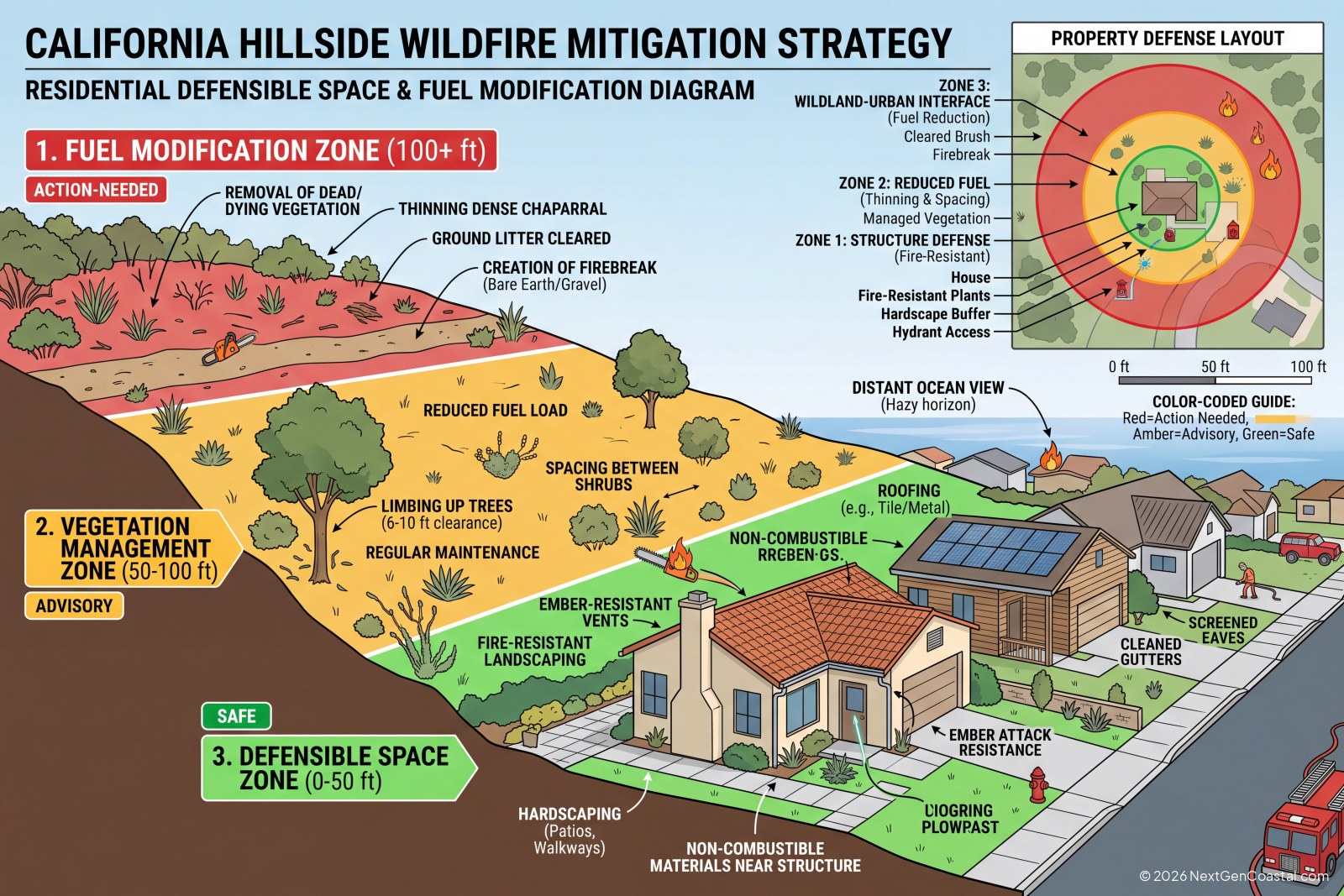
The 100 feet is not one uniform strip. The Board of Forestry breaks it into three zones, each with different rules. The diagram below is how I explain it to owners standing in a driveway.
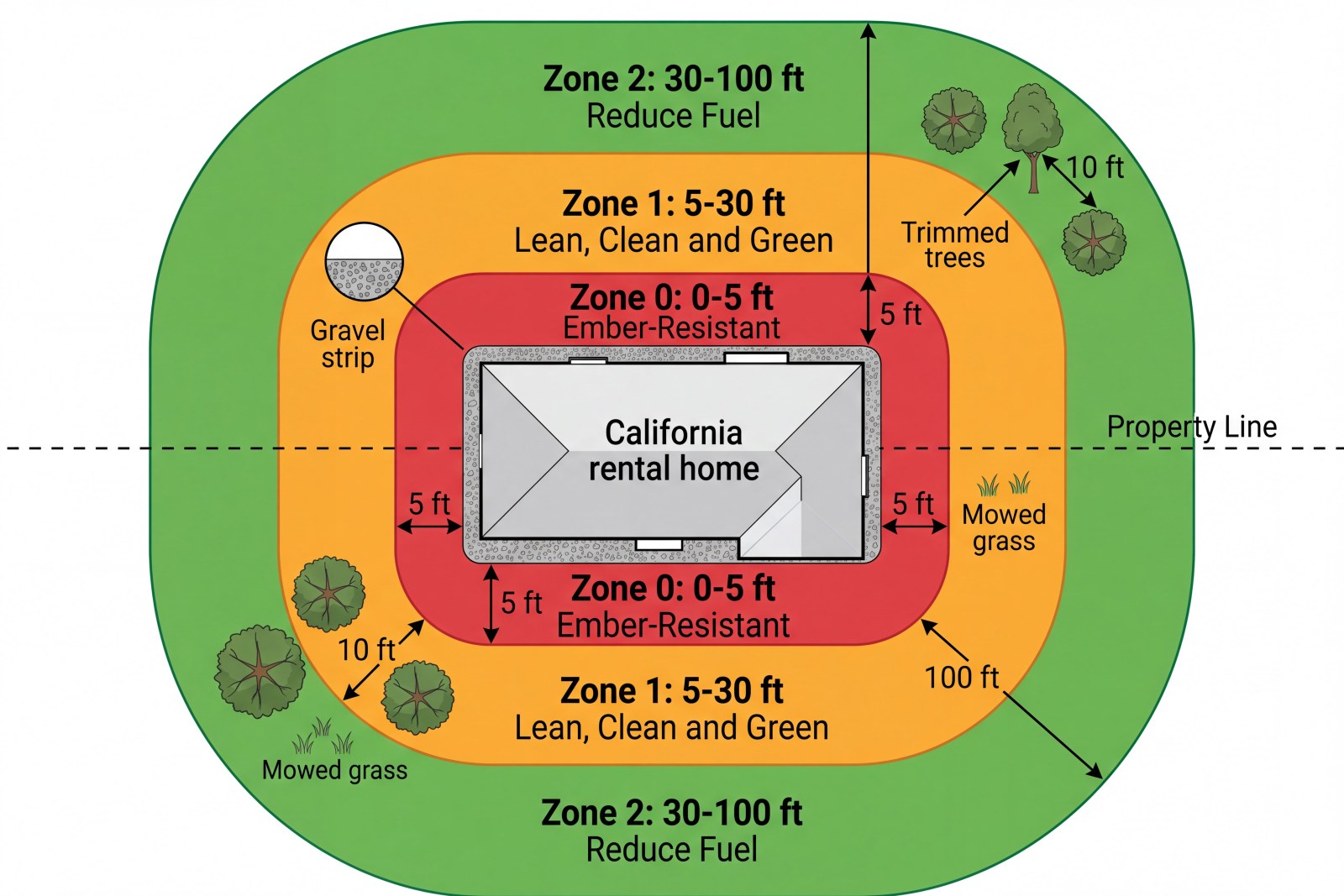
Zone 0: the first five feet
This is the ember-resistant zone, created by AB 3074 back in 2020. The idea is simple. Most homes lost in wildfires don't burn from a wall of flame. They burn from embers landing in bark mulch against the foundation, in a wood fence attached to the siding, in a pile of firewood under the deck. Zone 0 says: within five feet of the structure, nothing that can catch. Gravel or pavers instead of mulch. No juniper hugging the wall. No combustible fence tying into the house. Move the trash cans.
Honestly, this is where I'd hedge. As I write this, the Board of Forestry has been directed by the Governor to finish the Zone 0 regulations, and the plan has been for new construction to comply right away with a phase-in for existing homes. The exact effective dates have moved more than once. Check the Board's site before you rip out a tenant's planter bed. But the direction is not in doubt. The five-foot zone is coming for every rental in a Very High zone, so I'd rather you get ahead of it on your next turnover than scramble later.
Zone 1: five to 30 feet
CAL FIRE calls this the 'lean, clean and green' zone. Dead plants, dry leaves, and pine needles come out. Tree branches get trimmed so there's at least ten feet between canopies and ten feet from the chimney, per CAL FIRE's published guidance. Shrubs under trees come out so fire can't climb a ladder from the ground into the canopy. Anything stored outside, from patio cushions to a tenant's kayak, moves off the direct line to the house or goes inside.
Zone 2: 30 to 100 feet
The reduce-fuel zone. Grass mowed to four inches. Horizontal spacing between shrubs based on slope. Vertical spacing between the top of a shrub and the bottom of the tree canopy above it. Downed logs and stumps removed. You are not clearing the hillside to bare dirt. In fact bare dirt is often a slope-stability problem of its own on coastal lots. You're breaking up continuous fuel so a fire loses momentum before it reaches Zone 1.
One more thing worth knowing: the 100 feet stops at your property line. If your neighbor's slope is a fuel bed, that's their citation, not yours. But fire doesn't read parcel maps, so it's worth a friendly note to them in April.
What Each Coastal Jurisdiction Actually Requires
The City of Los Angeles requires double the clearance distance of every other coastal county in the region.
View chart data
| Category | Required clearance (feet) |
|---|---|
| City of Los Angeles | 200 |
| LA County / Malibu | 100 |
| Orange County | 100 |
| San Diego | 100 |
| Ventura County | 100 |
| Santa Barbara County | 100 |
State law sets the floor. Local fire codes raise it. This is where I see the most confusion, because an owner with a Newport Coast condo and a Malibu house is dealing with two different agencies, two different distances, and two different inspection calendars. Here's the short version by county. Confirm the current year's dates with the agency, because they shift.
Los Angeles City and County
The City of Los Angeles is the outlier. The LAFD Brush Clearance Unit enforces Los Angeles Municipal Code section 57.322, which requires clearance up to 200 feet from structures, double the state minimum, in the city's Very High zones. That covers Pacific Palisades, the Hollywood Hills, Bel Air, Mount Washington, and a long list of hillside neighborhoods most owners don't think of as wildland. Inspections typically begin around May 1 each year. If you fail and don't fix it, the city sends a contractor and adds a noncompliance fee and an administrative fee on top of the contractor's invoice, all of which land on your property tax bill.
Unincorporated LA County and the cities served by the County Fire Department follow the county fire code's 100-foot standard, with the fire chief able to require up to 200 feet where the hazard is extreme. Malibu is its own case. It has a city fire code and contracts with County Fire, whose Forestry Division runs the brush clearance program with inspections generally beginning in late spring.
Orange County
Most of coastal Orange County falls under the Orange County Fire Authority, which runs a vegetation management program and, for newer hillside developments, a fuel modification plan recorded against the tract. If you own in Newport Coast, Turtle Ridge, Talega, or anywhere along the Laguna Canyon corridor, there's a good chance your lot has a recorded fuel modification zone with a plant list you're required to follow. Your HOA usually maintains the common-area portion. You maintain the part on your parcel. Pull the fuel modification plan from OCFA or the HOA before you assume the association has it covered. Most owners don't realize the plan even exists until an inspector asks about it.
Laguna Beach is not in OCFA. It runs its own fire department and its own fuel modification program, and after the 1993 fire the city treats brush enforcement seriously. Much of the city is designated Very High. Laguna does its own inspections and can abate at the owner's cost under the municipal code. If you own a rental up Bluebird Canyon, Arch Beach Heights, or Top of the World, expect an inspection every year.
San Diego
The City of San Diego has the clearest local standard of the bunch. San Diego Municipal Code section 142.0412 splits the 100 feet into Brush Management Zone One, the 35 feet closest to the structure, and Zone Two, the next 65 feet. Zone One is essentially irrigated, low-fuel planting. Zone Two is thinned native vegetation, with plant cover reduced by half and dead material removed. Because San Diego's canyon system threads through so many neighborhoods, this applies to rentals in Clairemont, Tierrasanta, Scripps Ranch, University City, and Mission Hills, not just the East County foothills.
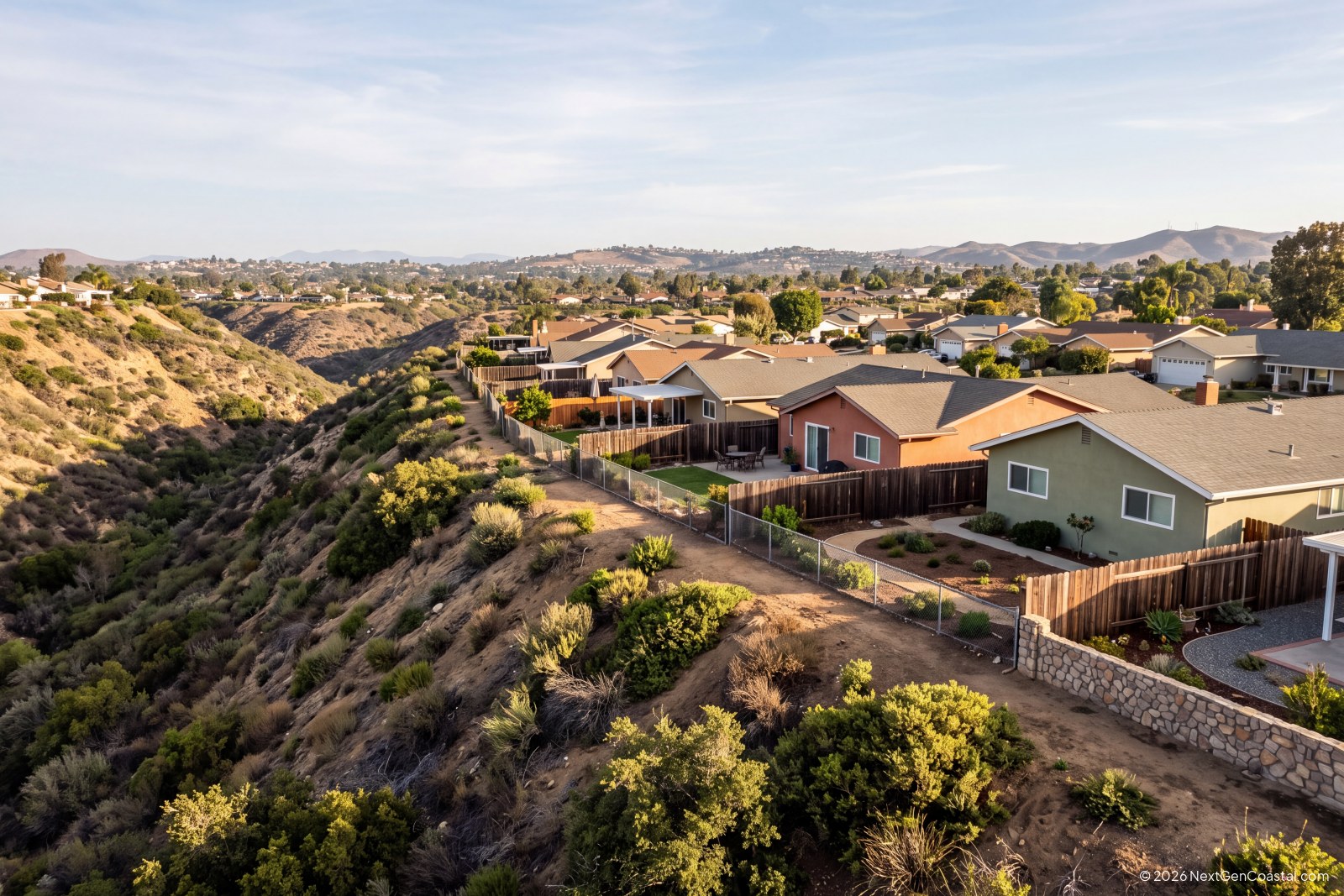
San Diego Fire-Rescue's brush management section does both complaint-driven and proactive inspections. A notice of violation gives you a deadline. Miss it and the city can perform the work and bill you, then lien the parcel if you don't pay. Coastal cities like Carlsbad, Encinitas, and Oceanside have their own fire departments and their own weed abatement ordinances, usually with a 100-foot standard and an annual mailed notice.
Ventura County
The Ventura County Fire Protection District runs the Fire Hazard Reduction Program, which covers the county and the cities it protects, including Ojai, Camarillo, Moorpark, Simi Valley, Thousand Oaks and Port Hueneme. The standard is 100 feet from structures, with a 10-foot strip along roads. Notices go out in spring, and the district publishes an approved-contractor list for owners who don't have a crew. The City of Ventura and Oxnard run their own departments. After the 2017 Thomas Fire burned into the Ventura hillsides, the city's enforcement got noticeably tighter.
Santa Barbara
Santa Barbara County Fire enforces defensible space in the unincorporated SRA and in the county's Very High zones, with Mountain Drive, Painted Cave, and Mission Canyon as perennial focus points. Montecito has its own fire protection district with a vegetation management program. The City of Santa Barbara designates a High Fire Hazard Area in its municipal code, with its own vegetation standards, and funds part of the work through the Wildland Fire Suppression Assessment District that shows up on Riviera and foothill tax bills. If you own above Foothill Road, budget for a clearance crew every year, not every other year.
Where the Liability Actually Lands
Now the question every owner asks: can I make this the tenant's problem?
You can assign yard maintenance to a tenant in the lease. Lots of single-family leases do, and Civil Code 1941.2 lets a tenant take on cleaning, trash, and similar upkeep. But brush clearance is different from mowing the lawn. Here's the rule of thumb: the fire agency's citation goes to the owner of record, no matter what the lease says. Public Resources Code 4291 and Government Code 51182 both put the duty on the person who owns, leases, controls, operates, or maintains the property. The agency will happily cite you and let you sort out reimbursement with your tenant later. Good luck with that.
Then there's the bigger exposure. If a fire starts on, or spreads through, your unmaintained property and damages the neighbor's, Health and Safety Code section 13007 makes the person who negligently allows a fire to escape liable for the damage. Section 13009 lets the fire agency recover its suppression costs from the same negligent party. Those bills are not small. Add a tenant injury on top and you're in ordinary premises-liability territory under Civil Code 1714, where the question is whether a reasonable owner would have known about the hazard and fixed it. An orange notice on the gate that you ignored is about the worst exhibit a plaintiff's lawyer could hope for.
Most owners don't realize that a brush clearance notice puts them on record. Once you've received it, you know about the hazard, legally speaking. Everything that happens next is measured against what you did about it.
Habitability cuts the same way. Health and Safety Code 17920.3 lists fire hazards among the conditions that make a building substandard, and a tenant can raise that in a rent-withholding or repair-and-deduct dispute. I've never seen a tenant do it over brush alone. I have seen it as one line item in a longer complaint, and it sticks.
So what does a sensible lease clause look like? A few things I put in every hillside single-family lease:
- The tenant keeps Zone 0 and Zone 1 clear of stored combustibles, dead leaves, and debris, and doesn't plant anything within five feet of the structure without written permission.
- The owner handles the annual brush clearance and any slope work, with a contractor, on a stated schedule. On our managed properties, that's us.
- The tenant allows access for clearance crews and fire inspections with reasonable notice, and moves vehicles and belongings off the work area.
- The tenant reports any fire agency notice to the owner or manager within 24 hours and doesn't remove it from the door.
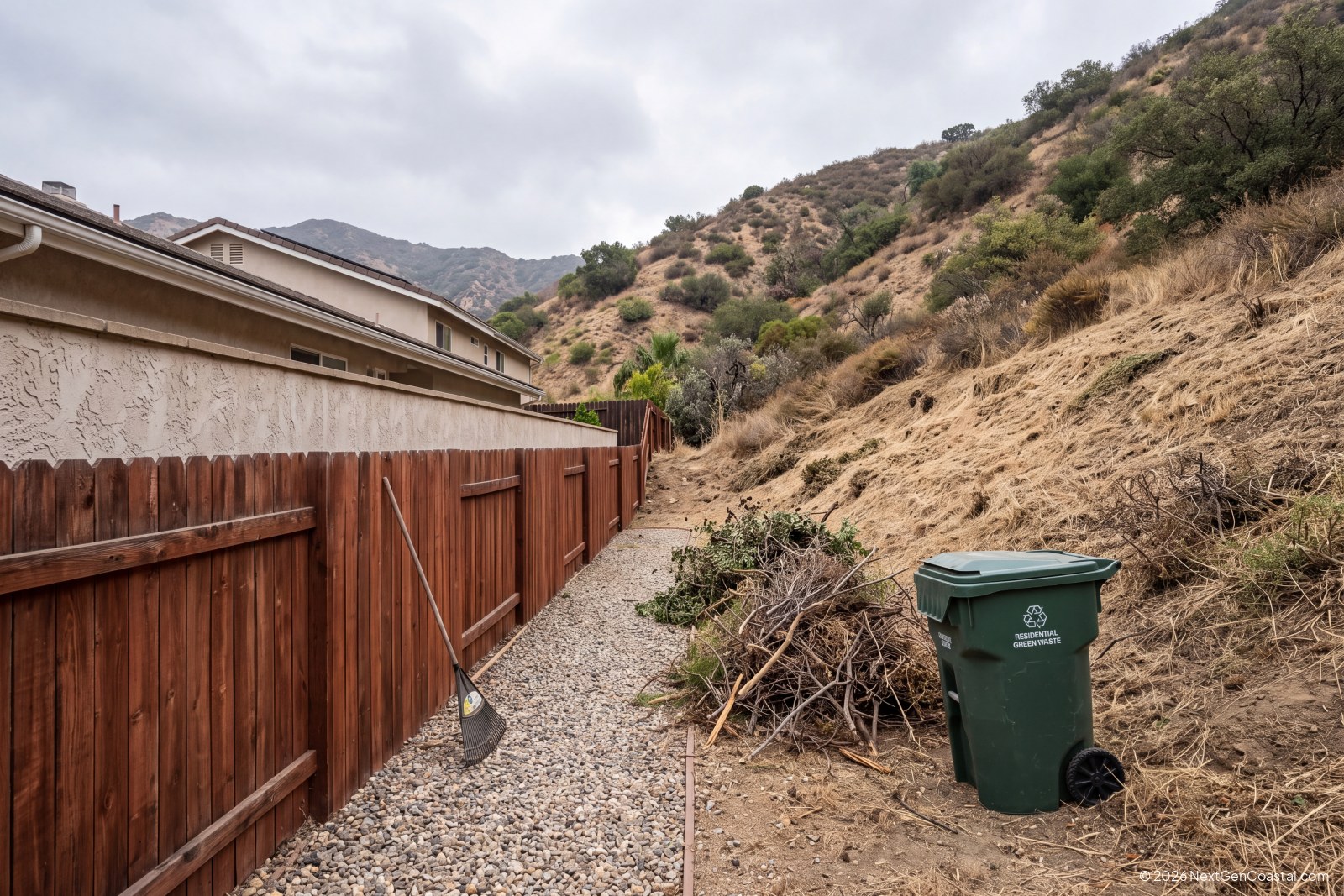
On the access piece, remember Civil Code 1954. You need 24 hours' written notice to enter the dwelling, and while a crew working the back slope is arguably outside the dwelling unit, I give notice anyway. It costs nothing and it avoids the argument. Get it in writing, keep the contractor's invoice and before-and-after photos, and you'll have a paper trail if an inspector or an insurer ever asks.
Insurance: Your Carrier Is Now Your Inspector
Five years ago the fire department was the only party checking your brush. Today your insurance carrier is checking harder, and it has a much bigger stick.
Non-renewals in the coastal hills have been brutal. Carriers use aerial imagery to flag vegetation near structures and may decline to renew. Owners who end up on the California FAIR Plan pay more for a policy that covers less, then need a separate difference-in-conditions policy for the liability and water coverage the FAIR Plan leaves out. Run the math on that before you decide the brush crew is too expensive.
Two state rules help. Under the Insurance Commissioner's Safer from Wildfires regulation, admitted carriers have to give premium discounts for specific mitigation steps, including a cleared Zone 0, ember-resistant vents, and maintained defensible space, and they have to tell you your wildfire risk score and how to improve it. Second, after a declared emergency, Insurance Code 675.1 blocks carriers from non-renewing homes in and adjacent to the fire perimeter for one year. That moratorium kicked in for large areas of LA and Ventura Counties after the January 2025 fires. It buys time. It doesn't fix the underlying problem.
Practical takeaway: when you finish your clearance each year, photograph it, date the photos, and send them to your agent. Ask in writing whether you qualify for a mitigation discount. Half the owners I work with had never asked before we started doing it for them.
After a Fire: Leases, Rent, and Just Cause
I hope you never need this section. Read it anyway.
If the unit is destroyed, Civil Code 1933 says the lease ends when the thing being rented is destroyed. No notice needed on either side. You return the security deposit within 21 days under Civil Code 1950.5, same as any other move-out, and you cannot deduct for damage the fire caused. If the unit is damaged but standing, Civil Code 1932 lets the tenant vacate and stop paying if the damage makes the unit unfit, or stay with a rent reduction if only part of the premises is unusable. Check your lease first. Some have a casualty clause that spells this out.
Two more rules apply after a declared emergency. Penal Code section 396 caps rent increases at 10 percent above the pre-emergency price for existing and newly listed rentals in the affected counties, normally for 30 days and often extended by executive order. After the 2025 LA fires, price-cap extensions were implemented for extended periods. Advertising a smoke-damaged unit at a quarter above its prior rent is a crime, and the LA City Attorney filed cases to prove it. And if you plan to gut and rebuild an occupied unit that survived, the AB 1482 substantial-remodel just-cause pathway still requires permits, work that can't be done with the tenant in place for at least 30 days, written notice describing the work, and relocation assistance equal to one month's rent.
A One-Page Compliance Calendar
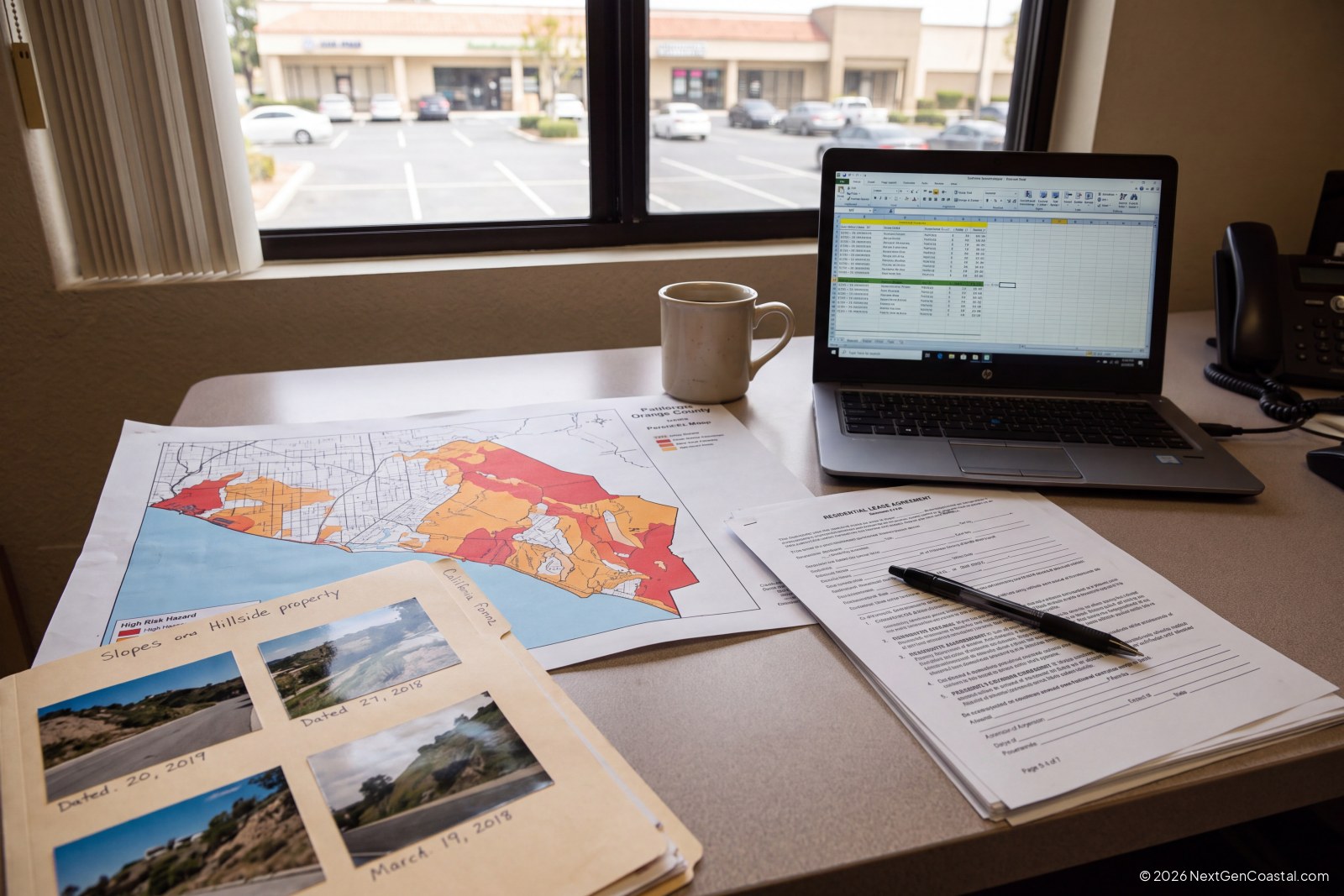
Look, most of this fits on a single page. Here's the calendar I run for every hillside rental we manage.
- January to February: look up each parcel on the current Fire Hazard Severity Zone map and confirm which agency inspects it. Pull any recorded fuel modification plan from the HOA or fire authority.
- March: get contractor bids. Crews book up fast once the notices go out. Have the tenant clear stored items from Zone 0.
- April: do the clearance. Photograph everything with a date stamp. Send photos to your insurance agent and ask about the mitigation discount.
- May to June: inspection season. Tell the tenant an inspector may come by and to forward any notice to you the same day.
- August to September: a second mow and dead-material pass before Santa Ana season. Grass that was green in April is fuel by now.
- Turnover, any month: swap bark mulch for gravel in the first five feet, replace the combustible fence section tied to the house, and update the lease clause.
If you read one thing twice in this article, make it this: the agencies want you to clear the brush, not pay the fine. Every fire department I've dealt with will extend a deadline for an owner who calls, explains, and shows a signed contractor agreement. Silence is what gets you abated and liened. The calculator at the top of this page will give you a rough sense of the area you're on the hook for and what it costs to keep clear. Plug in your numbers, get two bids, and put the first one on the calendar for March.
Frequently Asked Questions
Can I make my tenant responsible for brush clearance in the lease?
How do I find out if my rental is in a Very High Fire Hazard Severity Zone?
What happens if I ignore a brush clearance notice?