The Statutory Architecture of Civil Code §1941 Through §1942.5
The California tenant's self-help repair remedy sits inside a short run of code sections that were drafted, for the most part, in 1872 and rebuilt in 1970, and the sequence matters because each section conditions the next. Civil Code §1941 imposes the affirmative duty: a lessor of a building intended for human occupation must put it into a condition fit for that occupation and must repair all subsequent dilapidations that render it untenantable, subject only to the tenant's own obligations. §1941.1 supplies the definition of untenantable by enumerating the conditions whose absence triggers the duty; §1941.2 lists the tenant's reciprocal obligations; and §1942 delivers the remedy, permitting the tenant, after notice and a reasonable time, to make the repair and deduct the cost from the rent. Sections 1942.1 through 1942.5 then wall off the remedy from contractual waiver, create evidentiary presumptions in unlawful detainer, bar rent demands on certain cited properties, and penalize retaliation.
Interactive Tool
California Repair-and-Deduct Exposure Calculator
Test a tenant's deduction against the statutory cap, the two-occurrence limit, and the thirty-day presumption in Civil Code §1942.

§1942(b) presumes a reasonable time has elapsed after the 30th day.
Plumbing, hot water, heat, electrical, weatherproofing, locks, sanitation, floors and railings.
 Built by NextGen Coastal
 For context, the common-law overlay is older in effect than the current statute. In Green v. Superior Court (1974) 10 Cal.3d 616, the Supreme Court recognized an implied warranty of habitability in every residential lease and held that a tenant may raise the landlord's breach as an affirmative defense to an eviction for nonpayment; Code of Civil Procedure §1174.2 later codified the procedure by which a court sets a reduced rental value and permits the tenant to retain possession upon paying it. The practical consequence is that repair and deduct is only one of three tenant responses to a habitability defect, and it is the most tightly bounded of the three.
- Repair and deduct under §1942: statutory, self-executing, capped at one month's rent per occurrence and two occurrences per twelve months.
- Rent withholding under Green: common-law, uncapped, but the tenant assumes the risk of an unlawful detainer judgment if the court finds no substantial breach.
- Vacating under §1942(a): the tenant may instead quit the premises and be discharged from further rent and from the balance of the lease term.
The conditions enumerated in §1941.1 are specific, and a landlord's first analytical task in any deduction dispute is to test the claimed defect against them. The statute lists effective waterproofing and weather protection of roof and exterior walls, including unbroken windows and doors; plumbing and gas facilities maintained in good working order; a water supply capable of producing hot and cold running water connected to an approved sewage system; heating facilities in good working order; electrical lighting and wiring in good working order; premises and common areas kept clean, sanitary, and free from debris, filth, rubbish, garbage, rodents, and vermin; adequate receptacles for garbage; floors, stairways, and railings in good repair; and the locking hardware specified in §1941.3, including a deadbolt with a throw of not less than thirteen-sixteenths of an inch on each main swinging entry door. Health and Safety Code §17920.3 supplies a parallel, and in some respects broader, list of substandard conditions that code enforcement officers apply. A defect that appears nowhere on that list, and that does not otherwise render the unit unfit under the Green standard, is not a lawful basis for a §1942 deduction.
What the Tenant Must Establish Before Deducting
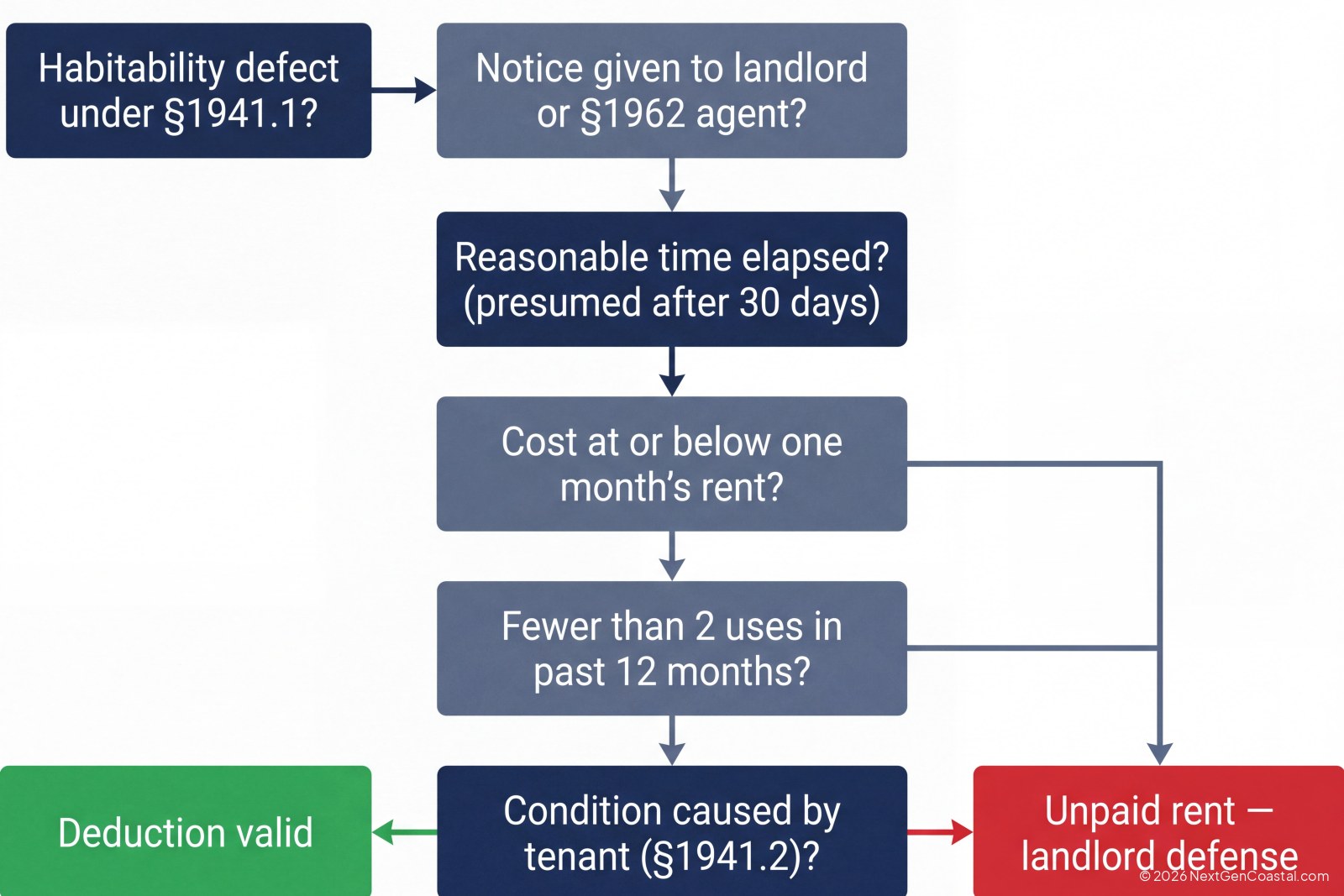
Because §1942 is a self-help remedy, no court reviews the deduction before it is taken; review arrives only if the landlord treats the shortfall as unpaid rent and litigates. That timing places the burden of analysis on the landlord at the moment the reduced payment arrives, and the analysis is a checklist of elements the tenant must be able to prove.
- A dilapidation that renders the premises untenantable within §1941.1, or that otherwise breaches the implied warranty.
- Notice to the landlord, which the statute permits to be oral or written, delivered to the owner or to the agent designated under §1962 for service of notices.
- Neglect by the landlord to repair within a reasonable time. Section 1942(b) supplies a one-directional presumption: a tenant who acts after the thirtieth day following notice is presumed to have waited a reasonable time, but the statute is silent on shorter intervals, and a failed heater in January or a gas odor may justify a far shorter period.
- A cost of repair that does not exceed one month's rent.
- No more than two invocations of the remedy in any twelve-month period.
- No causation by the tenant's own breach of §1941.2, which §1942(c) makes an absolute bar.
- An expenditure actually incurred, reasonable in amount, and directed at the dilapidation identified in the notice.
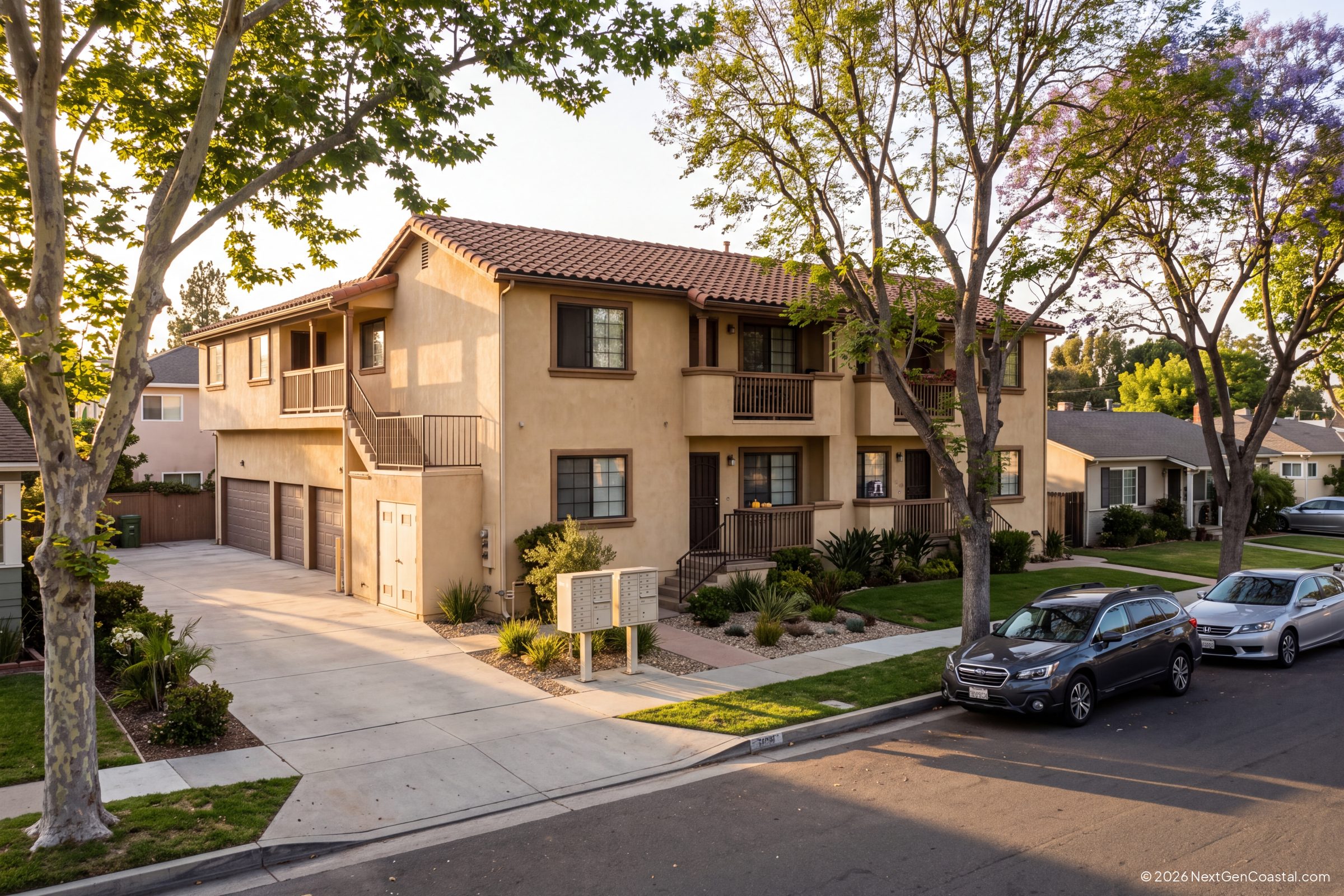
Consider an illustrative scenario, offered as a hypothetical rather than a client matter. A tenant in a fourplex in Tustin, paying $2,850 per month, reports on the third of the month that the water heater has failed. The owner, who manages the building personally, replies by text that he will look into it, then travels for two weeks. On the twenty-fourth day the tenant hires a plumber, pays $1,900 for a replacement 40-gallon unit, and remits $950 with a copy of the invoice on the first of the following month. Every element is arguably satisfied except reasonable time, and the tenant acted six days short of the thirtieth-day presumption. Whether twenty-four days without hot water is a reasonable period is a question of fact on which most triers would side with the tenant; hot water is an enumerated condition and the owner's response was inert. The owner who serves a three-day notice for $1,900 in that posture has purchased a retaliation claim, not a rent recovery.
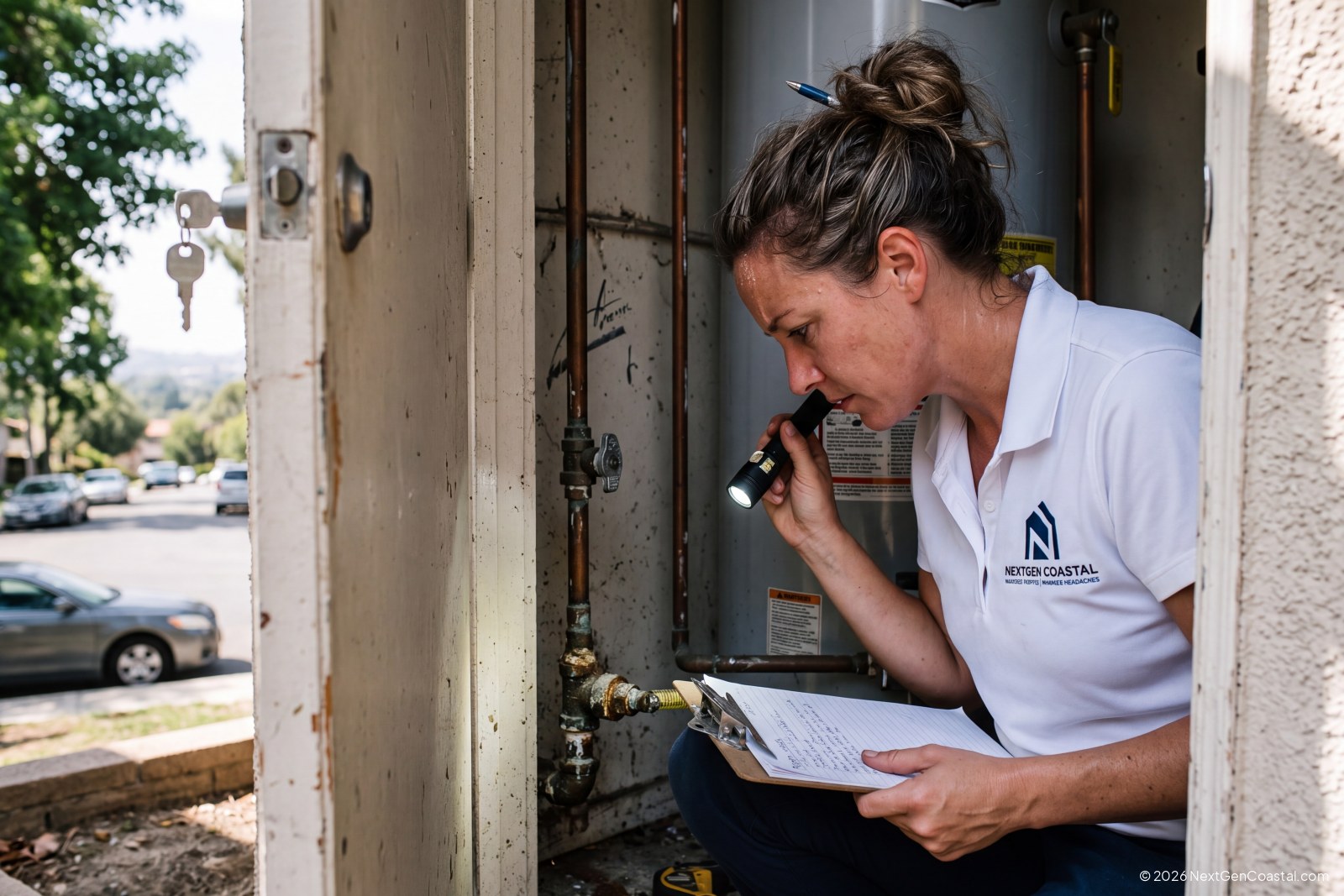
The picture changes if the tenant paid $3,400 for a tankless upgrade, or if the plumber's invoice reveals that the failure traced to a tenant-installed water softener, or if the owner's records show that a plumber was scheduled for day fifteen and turned away at the door. Each of those facts maps to a defense, and the defenses are worth stating individually because a landlord who cannot name the defense being asserted tends to litigate a habitability dispute as a personality dispute.
Eight Defenses Available to the Landlord
The condition is not a habitability dilapidation
The most frequent defect in tenant deductions is subject-matter: a failed dishwasher, a non-functioning garage door opener, cosmetic cracking in a stucco finish, a dripping irrigation valve, or a broken ceiling fan. None appears in §1941.1, and none ordinarily renders a dwelling unfit. The landlord may still owe the repair as a matter of the lease, and an appliance furnished under the lease is a contractual obligation the tenant may enforce through other means, but the §1942 deduction is confined to tenantability. The distinction between a lease covenant and a habitability covenant belongs in the first sentence of any response letter.
Notice was defective or misdirected
Section 1942 requires notice to the landlord; a remark to a gardener or a note left for a neighbor does not satisfy it. Civil Code §1962 requires the landlord to disclose in the lease, or post conspicuously, the name, street address, and telephone number of the person authorized to manage the premises and of the owner or agent authorized to receive service of process and notices. A landlord whose lease designates a management portal or an office address as the channel for maintenance requests has a strong position when a tenant claims to have given notice by some other route, and a landlord who failed to make the §1962 disclosure has a correspondingly weak one, because the section deems the person who has been collecting the rent to be the owner's agent for service of notices.
A reasonable time had not elapsed
The thirty-day figure in §1942(b) is frequently misread as a safe harbor for the landlord; it is not. It is a presumption in the tenant's favor that attaches after day thirty, and it does not imply that day twenty-nine is reasonable for the landlord. The defense is therefore fact-specific. The landlord must show diligence: an acknowledgment of the request, a vendor engagement, a scheduled entry, a parts order with a lead time, or a permit application where one was required. Diligence documented contemporaneously is persuasive. Diligence reconstructed after the deduction arrives is not.
The tenant caused the condition
Section 1942(c) withholds the remedy where the dilapidation resulted from the tenant's violation of §1941.2, which obligates the tenant to keep the premises clean and sanitary, dispose of refuse, use fixtures properly, avoid damaging or defacing the property, and occupy rooms for their intended purposes. Civil Code §1929 separately makes the tenant liable for damage caused by want of ordinary care. A clogged drain traced to grease disposal, a heater failure traced to a blocked return, or a pest condition traced to accumulated garbage falls outside the remedy entirely, and the landlord may both refuse the deduction and charge the repair.
The deduction exceeds the cap or exhausts the remedy
The remedy is limited to one month's rent per occurrence and two occurrences in any twelve-month period, and both limits are jurisdictional in the sense that a deduction outside them is simply unpaid rent to the extent of the excess. A tenant who spends $4,100 on a $3,000 unit may deduct $3,000 and must recover the balance, if at all, through a small claims action for breach of the warranty. A tenant who has already deducted twice in the trailing twelve months has no statutory remedy for a third defect regardless of its severity, though the common-law withholding remedy remains available and the landlord's underlying duty is unaffected.
Access was tendered and refused
A landlord cannot neglect a repair the tenant prevented. Civil Code §1954 authorizes entry to make necessary or agreed repairs upon reasonable written notice, which the statute presumes to be twenty-four hours, during normal business hours. A landlord who served a compliant entry notice, arrived with a vendor, and was refused, or who received a tenant's written demand that all work be scheduled around an impractical calendar, has a documented answer to the neglect element. The entry notices, and the vendor's record of the refused appointment, are the evidence.
The repair was not performed, not reasonable, or not the repair noticed
The statute contemplates a cost actually incurred to remedy the dilapidation. An invoice from a relative, a deduction with no invoice, a charge for an upgrade rather than a repair, or an expenditure directed at a defect never included in the notice is challengeable on its face. Business and Professions Code §7048, as amended by AB 2622 effective January 1, 2025, exempts from contractor licensure only work whose total cost is under $1,000 and that requires no building permit; a $1,900 water heater replacement performed by an unlicensed handyman is unlawful work, and while §1942 does not expressly condition the deduction on licensure, the landlord may fairly contest the reasonableness of paying for it, and may inherit a separate permit problem, since water heater replacement requires a permit in most Southern California jurisdictions.
The obligation was lawfully allocated to the tenant
Section 1942.1 voids any agreement waiving or modifying the tenant's rights under §1941 or §1942 with respect to an untenantable condition, but it expressly permits the landlord and tenant to agree that the tenant will improve, repair, or maintain all or stipulated portions of the dwelling as part of the consideration for the rental. The exception is narrow and is construed narrowly. A single-family lease in which the tenant assumes yard irrigation and filter changes in exchange for a rent concession is enforceable; a lease clause purporting to make the tenant responsible for the roof is not. The allocation must be specific, must be supported by consideration, and cannot reach conditions that render the premises unfit.
Four Statutory Clocks That Govern the Dispute
The 180-day retaliation-presumption window is six times longer than the tenant's own 30-day reasonable-time clock, leaving landlord exposure open long after a deduction is resolved.
View chart data
| Category | Days |
|---|---|
| Entry Notice (§1954) | 1 |
| Reasonable-Time Presumption (§1942(b)) | 30 |
| Abatement Bar (§1942.3–.4) | 35 |
| Retaliation Presumption (§1942.5) | 180 |
Every repair-and-deduct dispute is, at bottom, a dispute about elapsed time, and four intervals in the code determine who holds the advantage at each stage.
- 24 hours under §1954: the presumptively reasonable written notice period for landlord entry to make repairs. The landlord who is inside this window with a vendor has not neglected anything.
- 30 days under §1942(b): the point after which the tenant's repair is presumed to have followed a reasonable time.
- 35 days under §1942.3 and §1942.4: where a public officer has inspected and issued written notice to abate, and the condition persists more than thirty-five days beyond that notice without good cause, the landlord is presumed in breach in any unlawful detainer and is barred from demanding or collecting rent, increasing rent, or serving a three-day notice for the affected unit.
- 180 days under §1942.5(a): the period following a tenant's complaint, repair-and-deduct, or agency report during which a rent increase, service reduction, or eviction is presumptively retaliatory if the tenant is not in default.
The thirty-five-day bar deserves emphasis because it is the interval most likely to be reached inadvertently. Once an inspector from Costa Mesa Code Enforcement, the Los Angeles Housing Department, or San Diego's Code Enforcement Division has issued a written notice, the landlord's private assessment of severity becomes irrelevant; the officer's notice fixes the condition as substantial, and §1942.4(b) exposes a landlord who nonetheless demands rent to actual damages, special damages of not less than $100 and not more than $5,000, and the tenant's attorney fees. In the City of Los Angeles, the same inspection can route the property into the Rent Escrow Account Program under Los Angeles Municipal Code §162.00 et seq., which the Housing Department reports reduces rent on the affected units by 10 to 50 percent until the citation is cleared.
The thirty-day presumption tells the landlord when the tenant's clock has run. The thirty-five-day bar tells the landlord when the landlord's own rent has stopped being collectible. Operators tend to watch the first and get surprised by the second.
Good cause under §1942.3 and §1942.4 is the landlord's answer to the thirty-five-day interval, and it is where coastal properties diverge from the rest of the state, as the discussion below of permit-dependent repairs explains. The legislature did not define good cause; the courts treat it as a question of whether the delay was attributable to circumstances outside the landlord's reasonable control and whether the landlord pursued the repair with diligence throughout. A pending coastal development permit, a backordered component, or a tenant's refusal of access can each qualify, but only if the file shows continuous effort.
Retaliation Exposure and the AB 1482 Overlay
A rent demand made after a code-enforcement abatement bar carries a higher statutory-damage ceiling than a retaliatory notice under §1942.5.
View chart data
| Category | Maximum penalty per violation |
|---|---|
| §1942.4(b) Special Damages (abatement bar) | $5,000 |
| §1942.5 Punitive Damages (retaliation) | $2,000 |
The gravest error a landlord can make in response to a deduction is to treat the shortfall as ordinary nonpayment and serve a notice to pay or quit for the full amount. Two independent problems follow. First, a notice under Code of Civil Procedure §1161(2) must state the precise amount due; a notice demanding rent the tenant lawfully deducted overstates the debt and is void, and the unlawful detainer built on it fails regardless of the merits of the habitability dispute. Second, §1942.5 makes the notice itself an act of retaliation if served within 180 days of the tenant's good-faith exercise of the remedy, exposing the landlord to actual damages, punitive damages of not less than $100 and not more than $2,000 for each retaliatory act where the landlord acted with fraud, oppression, or malice, and attorney fees to the prevailing party. Subdivision (d) of the same section separately prohibits retaliation for any lawful and peaceable exercise of rights, without a time limit.
The AB 1482 framework, codified at Civil Code §1946.2 and §1947.12, compounds the exposure for covered properties. Nonpayment remains an at-fault just cause, but only for rent actually owed, and a landlord who proceeds on a defective notice has also served a defective just-cause statement. SB 567, effective April 1, 2024, added enforcement provisions under which a tenant, a city attorney, or the Attorney General may seek injunctive relief and, for certain violations, treble damages. Within the local just-cause regimes of Santa Monica, the City of Los Angeles, and the City of San Diego under its 2023 Tenant Protections Ordinance, the analysis is the same and the penalties are frequently larger. The correct posture is to accept the payment tendered, respond in writing within the month identifying the specific defense asserted, and, if the excess is genuinely owed, pursue it as a rent claim after the dispute is documented rather than as an eviction while it is live.
Coastal Complications: Permits, Salt, Mold, and Associations
Repairs that require a coastal development permit
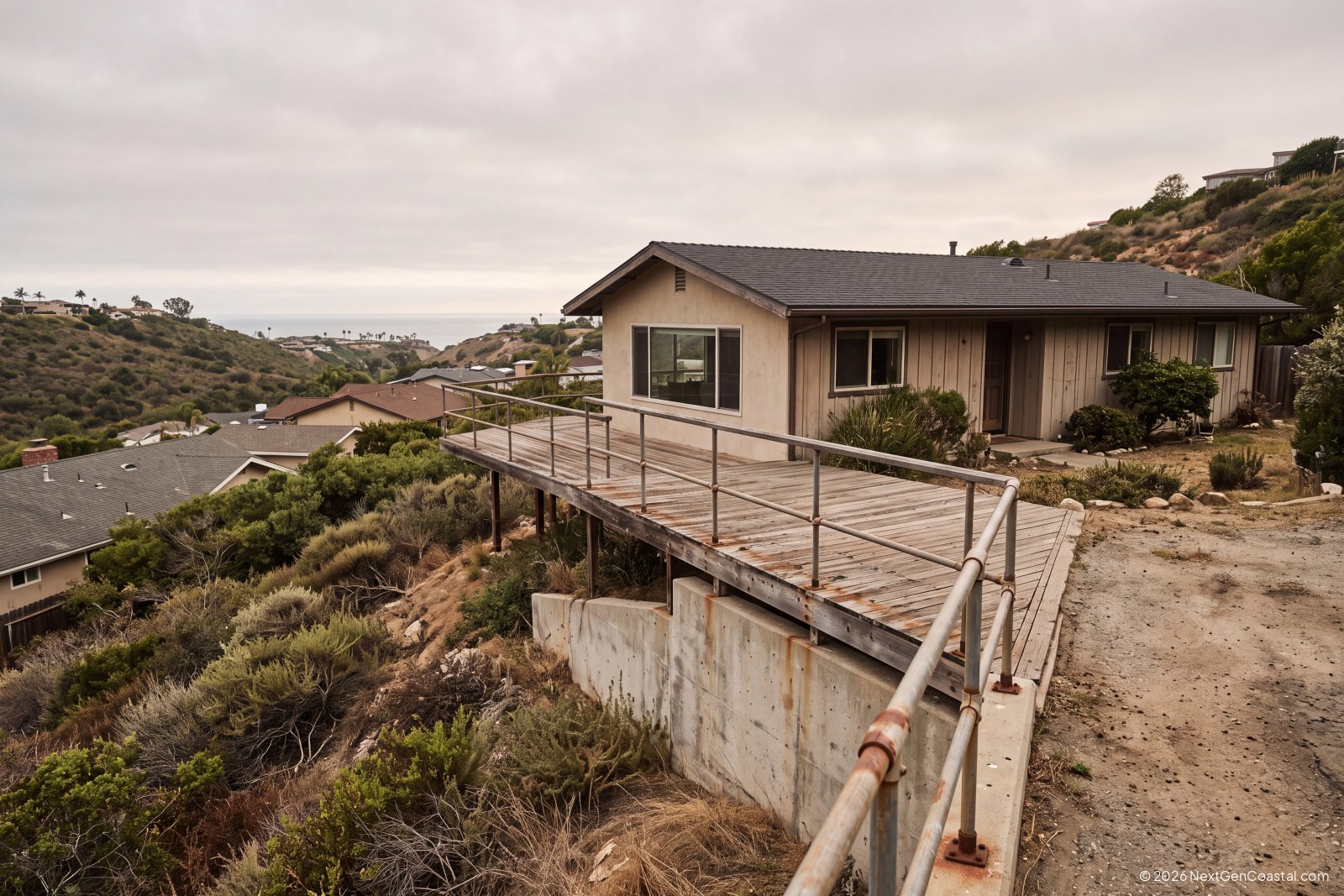
Within the coastal zone, a repair that would take a week in Riverside can take a season. Public Resources Code §30610(d) exempts from the coastal development permit requirement repair or maintenance activities that do not enlarge or expand the object repaired, but Title 14, California Code of Regulations §13252 carves out the exceptions that matter to a bluff-top or beachfront landlord: repair or maintenance of a seawall, revetment, or similar shoreline structure; substantial work on any structure located on a beach, in a wetland, or within fifty feet of the edge of a coastal bluff; and replacement of fifty percent or more of a structure. Within OC's coastal zone, and across San Diego County's Local Coastal Programs, a failed retaining wall, a compromised bluff-top deck, or a stairway to the sand may therefore be a §1941.1 dilapidation the landlord cannot lawfully repair without a permit, and the Commission's appeal jurisdiction, which under PRC §30603 reaches development within 300 feet of the inland extent of any beach or of the mean high tide line, can extend the timeline further.
The habitability duty does not pause while the application is pending. What the permit does is furnish good cause for the delay under §1942.3 and §1942.4, and evidence that the reasonable time under §1942 has not run, provided the landlord filed promptly, pursued the application without lapse, and implemented interim protective measures such as temporary shoring, a fenced exclusion zone, or, where the condition is severe enough, a rent reduction offered before the tenant demanded one. According to the agenda packet for any given Commission hearing, the applicants who prevail on repair-and-maintenance items are those whose files show that sequence.
Salt, moisture, and the mold notice rule
Coastal building envelopes fail differently. Salt-laden marine air accelerates corrosion of window hardware, exterior electrical fixtures, HVAC coils, and the very deadbolt hardware §1941.3 prescribes, and the persistent marine layer sustains the interior moisture that produces mold. Since January 1, 2016, following SB 655, visible mold growth in an amount that endangers health is a substandard condition under Health and Safety Code §17920.3(a)(13), and Civil Code §1941.7 provides that the landlord is not obligated to repair a mold dilapidation until the landlord has notice of it, or if the tenant is in violation of §1941.2. That notice rule is both a shield and an obligation: the landlord who inspects semi-annually, documents ventilation and moisture conditions, and responds to the first report with a remediation vendor has a defensible file, while the landlord who learns of the mold from a deduction invoice has already lost the reasonable-time argument.
Homeowners association common areas
A condominium landlord in Dana Point or Carlsbad faces a triangular problem when the dilapidation sits in a common area. Under Civil Code §4775 of the Davis-Stirling Act, the association is responsible for repairing common area and the owner for the separate interest unless the governing documents allocate otherwise; but the tenant's landlord is the owner, not the association, and §1941 runs from the owner to the tenant without regard to who controls the roof or the plumbing riser. The owner cannot answer a deduction by pointing at the board. The owner's defense is diligence toward the association: a written demand to the manager, an appearance at the next board meeting, and, where the board stalls, the enforcement mechanisms of Civil Code §5975, all documented in parallel with the tenant correspondence. The deduction the tenant takes against the owner becomes the measure of the owner's damages against the association.
Short-term rentals and the transient exclusion
Civil Code §1940(b) excludes from the tenancy chapter transient occupancy in a hotel, motel, or similar lodging, and a guest in a permitted short-term rental in Newport Beach under Newport Beach Municipal Code Chapter 5.95, a home-share in Santa Monica under Santa Monica Municipal Code Chapter 6.20, or a licensed unit under San Diego's Short-Term Residential Occupancy ordinance is generally outside the §1942 remedy for the duration of a stay under thirty days. The exclusion is not self-executing, however; it is tied to the transient character of the occupancy, and an STR guest who remains beyond thirty consecutive days acquires the status of a tenant with the full set of §1941 rights. Operators who extend stays to fill shoulder-season gaps should recognize that the thirty-first night changes the legal relationship.
The Security Deposit Is Not a Counterweight
A landlord who accepts a deduction sometimes attempts to recover it at move-out by charging the repair against the deposit. Civil Code §1950.5 forecloses that approach. The deposit may be applied only to unpaid rent, cleaning, repair of damage caused by the tenant beyond ordinary wear and tear, and restoration of items the lease allows; a repair the landlord was obligated to make under §1941 is not tenant-caused damage, and charging it is a bad-faith retention exposing the landlord to statutory damages of up to twice the deposit under §1950.5(l). Two recent amendments raise the stakes. AB 12 capped the deposit at one month's rent for tenancies commencing on or after July 1, 2024, with a narrow exception for small natural-person owners, so there is less to charge against. And AB 2801 requires, for tenancies beginning on or after July 1, 2025, photographs of the unit immediately before or at move-in, and for all tenancies from April 1, 2025, photographs before and after any repair or cleaning charged to the deposit, delivered with the itemized statement. The photographic record that AB 2801 now compels is the same record that proves or disproves a §1941.2 causation defense, and the landlord who builds it for one statute has built it for the other.
A Documentation Protocol That Makes the Defenses Provable
Every defense above is a factual defense, and each fails without a record. The protocol that follows is what a managed portfolio of any size should be able to produce for any unit within an hour of a deduction arriving.
- A single designated maintenance channel, identified in the lease and consistent with the §1962 disclosure, that timestamps every request and every response.
- Written acknowledgment of each habitability-category request on the day it is received, stating the intended vendor and target date.
- Retained §1954 entry notices, with vendor confirmation of each attempted entry and a contemporaneous note of any refusal.
- Dated photographs at intake, at vendor visit, and at completion, organized by unit, which now double as the AB 2801 record.
- For permit-dependent repairs, the permit application receipt, all agency correspondence, and a log of interim protective measures.
- For association-controlled components, the written demand to the manager and the board response, kept in the same file as the tenant correspondence.
- A rolling twelve-month ledger of any §1942 deductions per unit, so the two-occurrence limit can be tested on sight.
- A written, non-hostile response to every deduction within the same rent period, naming the defense or accepting the deduction, so that the file shows a landlord engaged with the statute rather than with the tenant.
The tenant who deducts properly has done the landlord a modest favor: the repair is made, the cost is capped, and the dispute is confined to a single month's ledger. The tenant who deducts improperly has handed the landlord a defense, but only a landlord with a file can pick it up. The audit worth performing this quarter is not of the tenants but of the lease's §1962 disclosure, the maintenance intake channel, and the entry-notice archive, because those three documents decide most §1942 disputes before either party consults counsel. The calculator above tests the arithmetic of any pending deduction against the statutory cap, the occurrence limit, and the thirty-day presumption; the file tests everything else.
Frequently Asked Questions
Can a California landlord require that repair-and-deduct notice be given in writing?
Does a pending coastal development permit excuse a landlord from the thirty-five-day bar in §1942.4?
If a tenant deducts for a common-area defect in a condominium, can the owner pass the deduction to the homeowners association?