The lease I used for years had four illegal clauses in it
When I bought my first building, I inherited the seller's lease. It was eleven pages, it looked official, and I used it for almost three years without reading it closely. It had a two-month deposit for furnished units. It had a flat $150 late fee. It had a line saying the tenant waived any claim related to mold. And it said rent could only be paid through the online portal.
Interactive Tool
California Security Deposit Exposure Check
Compare what you collected to the Civil Code 1950.5 cap, and see what a bad-faith finding could cost.

Applies to most operators, including any owner with more than two properties or more than four units total.
Pet deposits and 'cleaning deposits' count toward the cap. Nothing can be labeled non-refundable.
 Built by NextGen Coastal
 Four clauses. All four are unenforceable in California today, and two of them were unenforceable back then. Nobody sued me over them. I got lucky. Plenty of owners don't.
Here's what I've learned since, first from my own units and now from the front line at NextGen Coastal: most illegal lease clauses get copied, not written. They come from an older lease, from another state's form, from a commercial lease, from a template somebody's cousin sent over. The clause looked reasonable, so it stayed.
This guide is the audit I wish I'd run in year one. It covers the statewide rules every California operator lives with, and then the layer on top that only shows up when your property sits near the water: public access easements, HOA rules that try to outrank state law, and short-term rental ordinances that change block by block. I'll cite the code sections so you can check my work. Honestly, the fix for most of this is a red pen and an afternoon.
Security deposit clauses that are void in 2026
Start here, because this is where the money is and where the law changed most recently. California Civil Code 1950.5 governs residential deposits. Under recent legislation, the cap is one month's rent. Furnished or unfurnished, doesn't matter. The old two-month and three-month tiers are gone.
There's one exception. If you're a natural person (or an LLC made up of natural persons) who owns no more than two residential rental properties with no more than four units total, you can still collect two months. That exception disappears if the tenant is a service member. Most of the owners I work with don't qualify, and a lot of them think they do. Count your units before you rely on it.
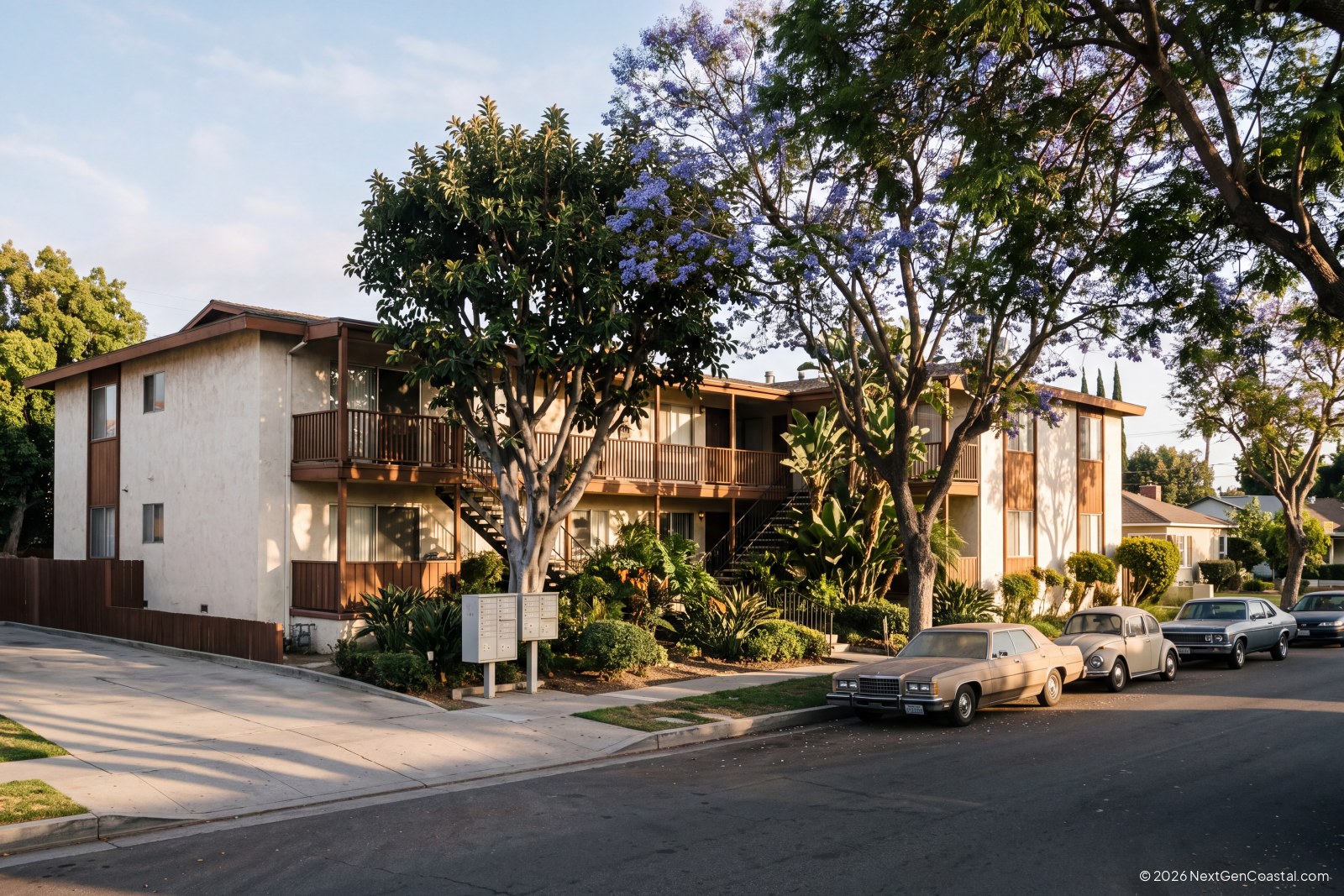
The deposit clauses I still see when leases come through our intake:
- "Security deposit: two months' rent" on a furnished unit, with no small-owner exemption behind it.
- "Non-refundable cleaning fee" or "non-refundable pet deposit." Section 1950.5(m) says no deposit can be called non-refundable. A pet deposit is just deposit, and it counts toward the one-month cap.
- "Tenant forfeits the entire deposit upon early termination." The statute lists what you can deduct: unpaid rent, cleaning to the move-in standard, damage beyond ordinary wear, and restoring items the lease required. Automatic forfeiture isn't on the list.
- "Deposit will be returned within 30 days." The deadline is 21 days after the tenant leaves, with an itemized statement. Your lease can't stretch it.
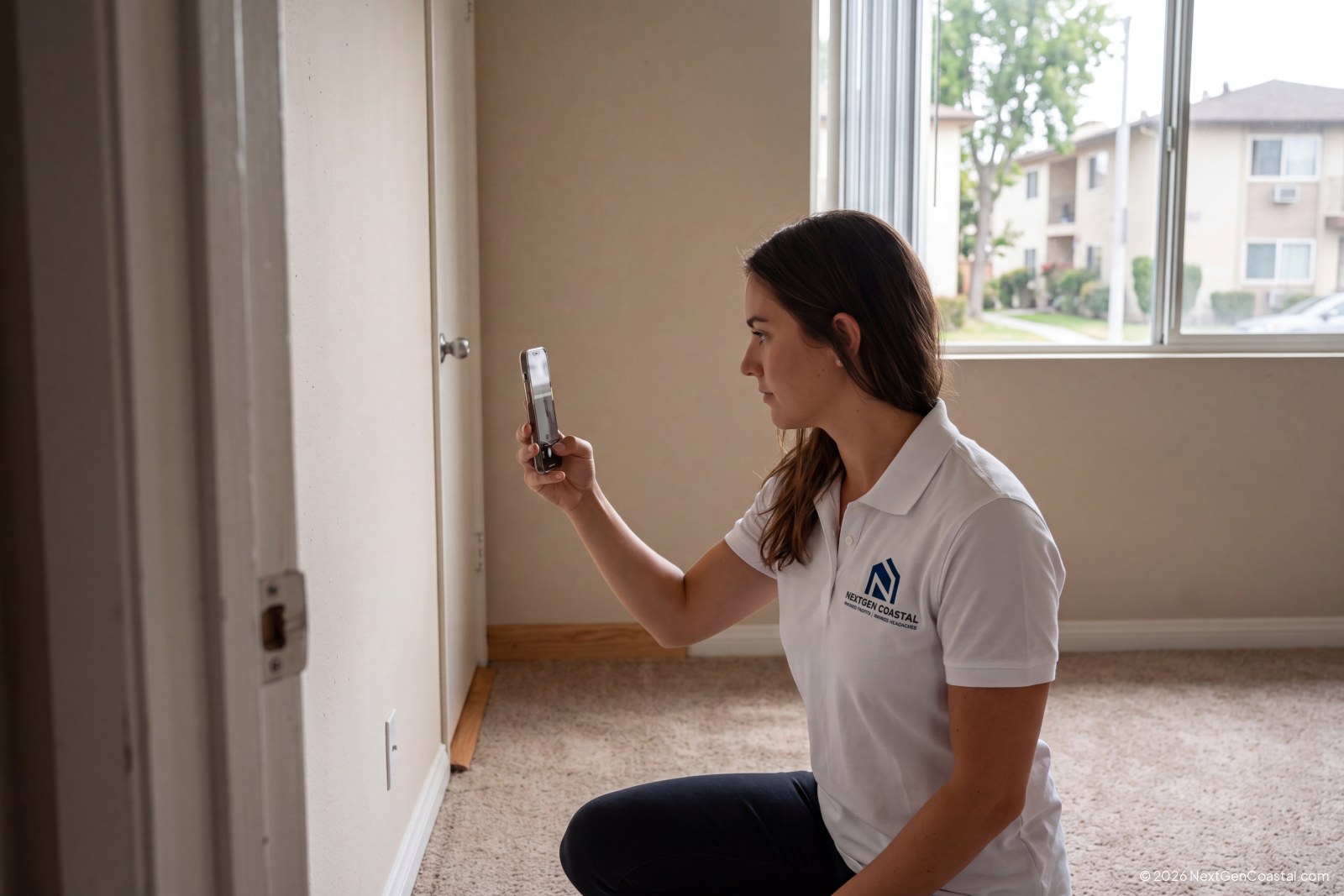
- "Landlord may deduct for repainting and carpet cleaning." Recent California law requires that you can deduct for these only when they're needed to bring the unit back to its move-in condition, and you need photos to prove it.
That last one deserves a second look. Recent legislation requires photos of the unit before or at move-in, plus photos after move-out and after any repair you deduct for. Those photos go to the tenant with the itemization. If your lease still promises a fixed deduction schedule ("$250 carpet cleaning regardless of condition"), it conflicts with the statute and it will lose.
A quick note on Civil Code 1950.7, because I get asked about it. That section covers commercial deposits, and it allows terms you can't use on a residential unit. I've seen it cited in residential leases because somebody copied a retail form. If your lease references 1950.7 and the unit has a bedroom in it, that's your first sign the whole document needs a read-through.
Run the math on your current deposits before you do anything else. If you collected more than the cap from a tenant who moved in after recent law changes, you're holding money you had no right to collect, and every month it sits there is another month of bad-faith argument for the other side.
Rent, late fees, and payment clauses
AB 1482 pins allowable annual rent increases to 5% plus CPI, but never lets the total exceed 10%, regardless of local inflation.
View chart data
| Category | Maximum allowed annual rent increase (%) |
|---|---|
| Statutory floor (5% + 0% CPI) | 5% |
| Statutory ceiling (hard cap) | 10% |
These are less dramatic than deposit clauses and they cause more day-to-day friction. Three rules cover most of it.
You can't require online-only rent
Civil Code 1947.3 says a landlord has to accept at least one form of payment that is neither cash nor electronic funds transfer. In plain terms, you must take a check or money order if the tenant wants to pay that way. A clause that says "rent must be paid through the resident portal" is void. Recent California law also prohibits charging a fee when the tenant pays by check. Our own portal is good and most tenants use it. We still accept checks, because the law says so.
Flat late fees are a coin flip in court
A late fee in California has to be a reasonable estimate of what the late payment actually costs you. That's the liquidated-damages rule in Civil Code 1671, and courts have held that owners must tie flat fees to real costs. A modest percentage of rent, backed by a note on your actual bank and administrative costs, is defensible. A $150 flat fee on an $1,800 unit with no backup is not. Get it in writing why the number is what it is, and keep that note in the file.
Notice fees and rent caps
Recent California law also eliminated so-called "notice fees." You can't charge the tenant for serving a three-day pay-or-quit. Some older leases bake in a $50 or $75 charge for that. Strike it. And if the property is covered by AB 1482 (Civil Code 1947.12), any clause allowing an annual increase above 5% plus CPI, capped at 10%, is void for that tenancy no matter what the lease says.
One more that surprises people: the auto-renewal clause. Civil Code 1945.5 requires an automatic renewal provision to appear in at least eight-point boldface type, and the lease has to call the tenant's attention to it. Miss that formatting and the tenant can walk away from the renewal. Most owners don't realize the renewal language is the weakest paragraph in their lease.
Waiver clauses: the ones that void themselves
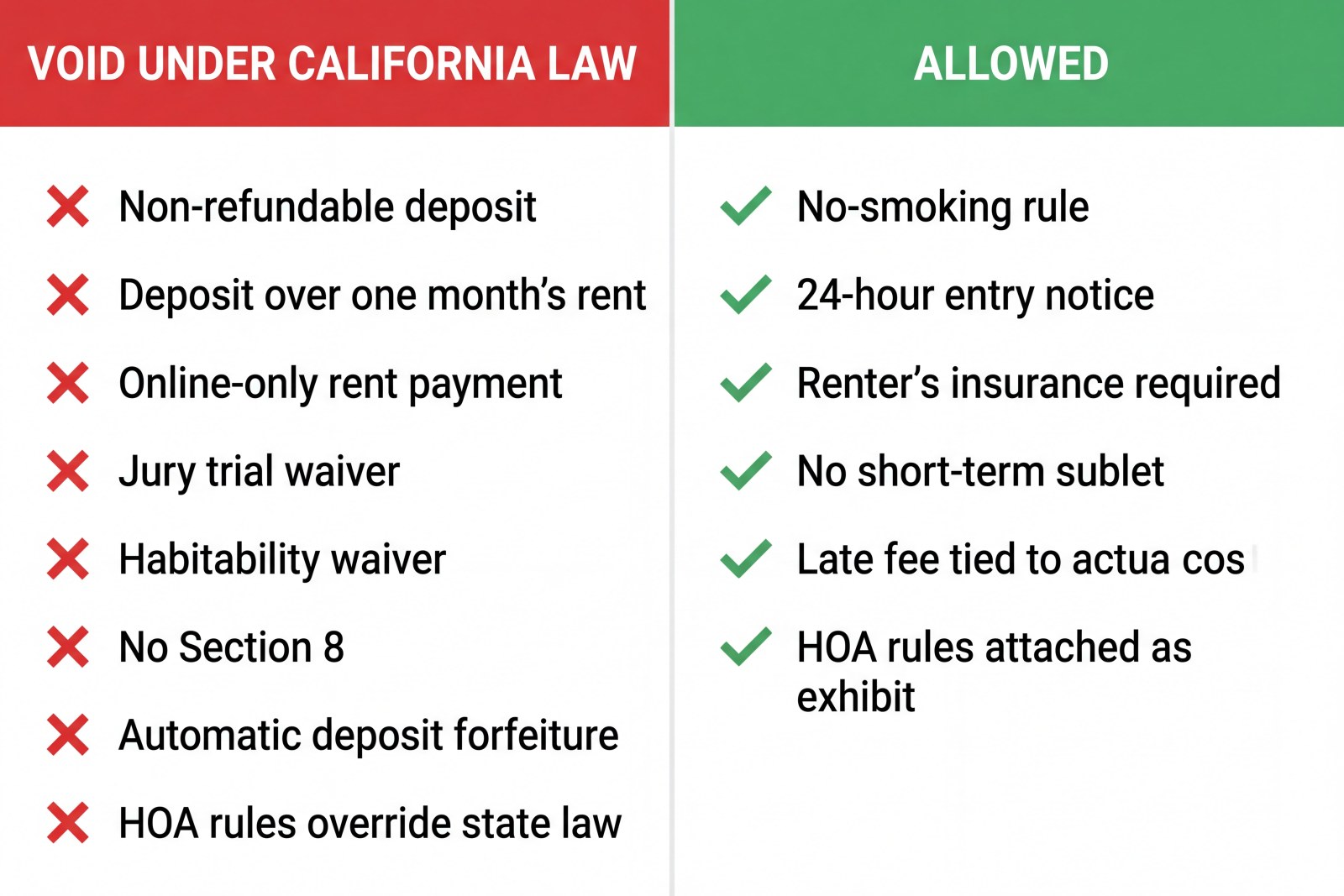
Here's the rule of thumb: if a clause asks the tenant to give up a right the state gave them, it's void. That's Civil Code 1953. It lists the categories directly. A tenant can't waive their rights around security deposits, notice, habitability, the right to sue, or the procedures of a lawsuit. You can write the clause. The tenant can sign it. It still counts for nothing.
Where I see this most:
- "Tenant accepts the unit as-is and waives all claims regarding condition." Civil Code 1942.1 makes a habitability waiver void, unless it's a genuine repair-for-rent agreement where the tenant gets something for taking on the work.
- "Tenant waives trial by jury." California courts have held that pre-dispute jury waivers are generally not enforceable in residential leases.
- "Landlord may enter at any reasonable time." Civil Code 1954 requires 24 hours' written notice for non-emergency entry, and it names the reasons you can enter. An open-ended entry clause doesn't expand that list.
- "Landlord may change locks or remove belongings if rent is 10 days late." That's a self-help lockout. Civil Code 789.3 prohibits this practice and sets legal penalties.
- "No Section 8" or "no housing vouchers." Since 2020, source of income is a protected class under California law. The clause is a fair-housing violation on its face.
- "Tenant agrees not to contact code enforcement." Civil Code 1942.5 already bars retaliation for complaints. Putting it in writing turns a defense into an exhibit.
Just-cause language belongs in this group too. Civil Code 1946.2 (part of just-cause eviction law) can't be waived, and any clause that tries is void. But there's a flip side operators miss. If you're claiming the single-family exemption, the lease has to include the specific exemption notice from the statute, in the statutory wording. No notice, no exemption. I check for that paragraph in every lease that comes into our portfolio.
The coastal layer: access, HOAs, and short-term rental rules
Everything above applies from Barstow to Balboa. Now the part that only bites when the property is near the water.
Public access easements and the 'private beach' line
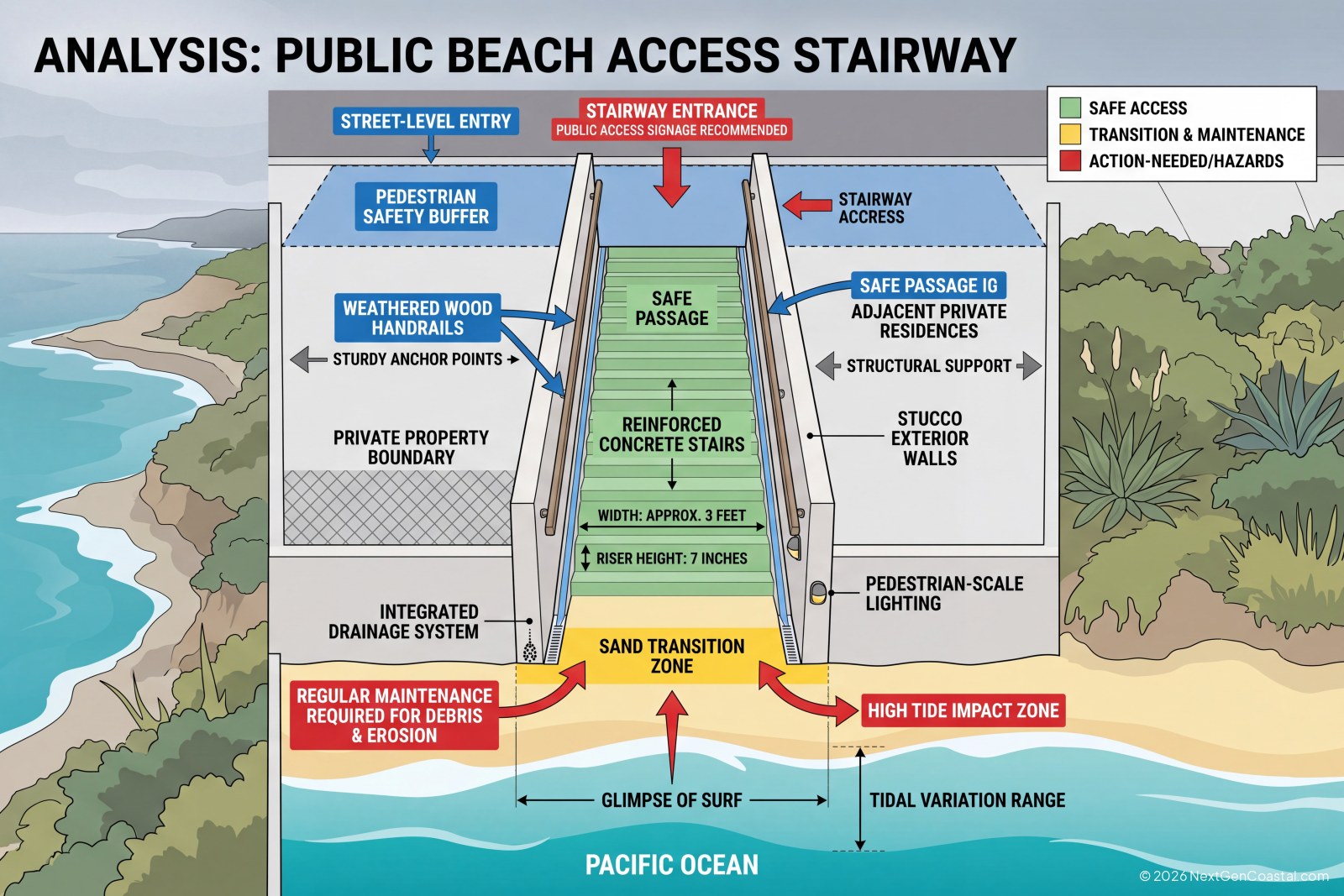
A surprising number of oceanfront and bluff-top lots carry a recorded public access easement. Vertical accessways run from the street to the sand. Lateral easements run along the beach in front of the house, usually seaward of a line the Coastal Commission set when the home was permitted or remodeled. Those easements are in the title report. They don't show up in the listing photos.
The lease problems come in two flavors. The first is the clause that oversells: "Tenant shall have exclusive use of the private beach area." If a lateral easement runs across that sand, you've just promised something you don't own. The tenant who finds strangers on 'their' beach has a straightforward misrepresentation argument.
The second is the clause that tries to hand off liability: "Tenant is responsible for preventing public access across the property" or "Landlord makes no representation regarding easements and tenant assumes all risk." Neither works the way the drafter hoped. Under the Coastal Act, blocking a dedicated accessway is a violation by whoever controls the property, and the Commission enforces against the owner. A disclaimer in a lease doesn't move that exposure to the tenant. It just guarantees the tenant will testify that you told them to put up the 'private' sign.
What actually works: disclose the easement in the lease, attach the recorded document or the Commission's access map, and tell the tenant what's public. Get it in writing. A tenant who knows the deal on day one doesn't call you on day thirty.
HOA override clauses
Condo and planned-community rentals along the coast almost always come with a stack of CC&Rs, and owners love the clause that says "in the event of any conflict, the Association's rules shall govern." I understand the impulse. The HOA fines the owner, not the tenant, so the owner wants the tenant on the hook.
Two problems. First, an HOA rule can't outrank a state statute, so the override clause silently imports whatever the CC&Rs say about entry, guests, pets, or deposits, and wherever those conflict with the Civil Code, the clause is void under 1953. Second, the override often claims things the HOA itself can't do anymore. Recent California law limits how associations can cap long-term rentals, prevent short-term rentals entirely, and handle accessory dwelling units. An older CC&R that says "no rentals" may be unenforceable on that point, and an owner whose lease incorporates it by reference has just written an unenforceable clause into their own contract.
The clean version: attach the current rules and regulations as an exhibit, have the tenant sign an acknowledgment that they received them, and make HOA fines a separate charge under the lease with the fine notice attached. Keep them out of the deposit. Fines aren't on the list of allowed deductions in 1950.5, and I've watched deposit disputes get lost on exactly that point.
Short-term rental clauses, city by city
The clause I get asked about most: "Tenant may not sublet or list the unit on any short-term platform." That one's fine. Keep it. The problems run the other direction, where the lease permits something the city bans, or where the owner uses a 'lease' to dress up a vacation rental.
- Santa Monica allows hosted home-sharing only, with registration, under local ordinance. Whole-unit vacation rentals are prohibited. A lease that lets a tenant list the unit while they travel authorizes a violation, and the city attorney's office there is active in short-term rental enforcement.
- Newport Beach requires a short-term lodging permit and restricts the number of permits issued. No permit, no legal short-term rental, regardless of what the lease says.
- San Diego operates a short-term rental licensing system with tiered requirements. Whole-home rentals require a local license, and the licensing terms vary by neighborhood. The host of record must be the owner or a long-term tenant with the owner's written permission.
The thing all three cities share: a stay of 30 days or more creates a tenancy with full state-law protections. A 'vacation rental agreement' for 45 days is a residential lease, with deposit rules, just-cause rules and everything else in this article attached. I see owners try to write around that with 29-day rolling agreements, and the second one in a row is a tenancy no matter what the header says. The Coastal Commission has a say here too, because short-term rental rules inside the Coastal Zone are part of a city's Local Coastal Program and need Commission certification. This is why each city's ordinances look different.
How these clauses actually get enforced
Nobody from the state audits your lease. Enforcement comes from three directions, and you should know which one is most likely for your property.
Tenants, mostly in small claims. California's small-claims limit covers nearly every deposit dispute. Under 1950.5(l), a tenant who proves bad-faith retention can get statutory damages of up to twice the deposit, on top of the deposit itself. Judges read the lease. A clause that promised a $250 flat carpet charge, or called the pet deposit non-refundable, does the tenant's work for them.
When a judge strikes a void clause, the clause stays in the file. It becomes evidence of what you asked for. I'd rather have a short lease with nothing to explain than a long one with a paragraph I have to apologize for.
City attorneys, in the coastal cities with their own ordinances. Local tenant harassment ordinances and just-cause rules are enforced actively in major California cities. Local city attorneys can bring cases, and tenants can sue under these ordinances. A lease clause that misstates the just-cause rules is the first exhibit in that case.
The Coastal Commission, on access. This one's rare, but it's significant when it lands. The Commission's enforcement unit responds to complaints about blocked accessways. If a tenant, at your instruction, blocks a public stairway, the notice goes to you.
Attorney's fee clauses deserve a mention here. Plenty of leases say the tenant pays the landlord's legal fees if the landlord wins. Civil Code 1717 makes that clause reciprocal automatically. If the tenant wins, you pay theirs. The clause is legal, but it's a bet, and in deposit cases it's usually a bad one. A bad-faith deposit finding costs you double the deposit plus a morning in court, and the fee clause you wrote can add the tenant's lawyer to the bill.
Fix it this month
Look, none of this requires a lawyer for the first pass. It requires you to read your own lease with the code sections open in another tab. Here's the order I'd go in:
- Check your lease first for the deposit clause. Compare the amount to one month's rent and confirm whether you actually qualify for the small-owner exception.
- Search the document for 'non-refundable,' 'forfeit,' 'waive,' and 'as-is.' Every hit needs a second look.
- Confirm the payment clause allows checks and that no fee attaches to check payment or notice service.
- Pull your late fee and write one paragraph explaining how you arrived at the number. If you can't, lower it.
- If you're claiming the single-family exemption from just-cause eviction law, paste in the statutory notice language word for word.
- For coastal properties, pull the title report and look for recorded access easements. Disclose them in the lease and attach the document.
- For HOA properties, replace any override clause with an exhibit of the current rules and a signed acknowledgment.
- For anything inside the Coastal Zone, confirm the short-term rental rules for that specific city before writing any clause that permits or restricts short stays.
Existing tenants on a bad lease don't need a new lease. A void clause is void whether or not you fix it; the fix protects you on the next signing and takes the exhibit out of the file. For month-to-month tenants you can serve a change of terms with 30 days' notice under Civil Code 827, and I'd use that to fix the deposit and payment language at minimum. Refund anything over the cap with a written note explaining why. The refund check is the cheapest part of this whole process.
When we take over a property, the lease review is the first thing we do, before we've collected a single rent check. Most of the time we find two or three of the clauses above. Nobody's embarrassed. The owner gets a marked-up copy, a replacement lease, and a note on which tenants need a change-of-terms notice. If you'd rather run the audit yourself, start with the deposit calculator at the top of this page. It will at least tell you whether the first check you need to write is a refund.
Frequently Asked Questions
If my lease has an illegal clause, is the whole lease void?
Can I charge a two-month deposit on a furnished coastal rental in 2026?
My oceanfront lease says the tenant gets exclusive use of the beach. Is that a problem?