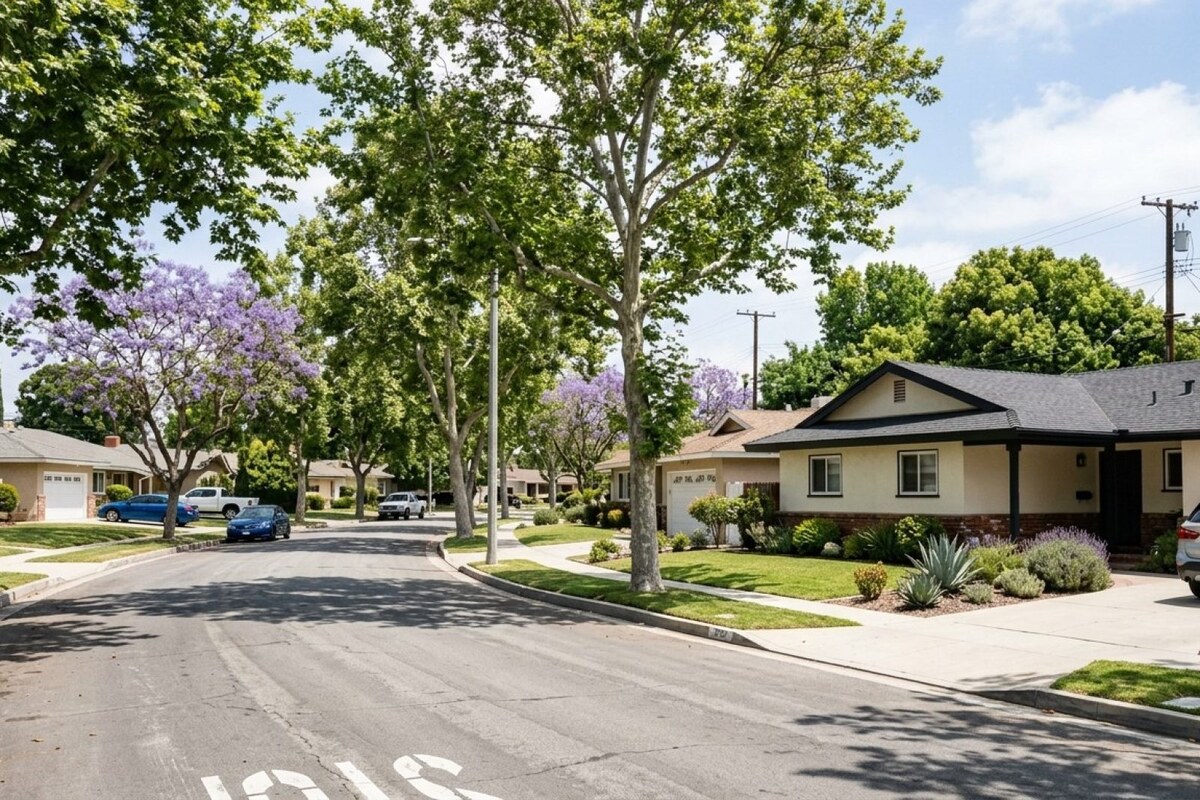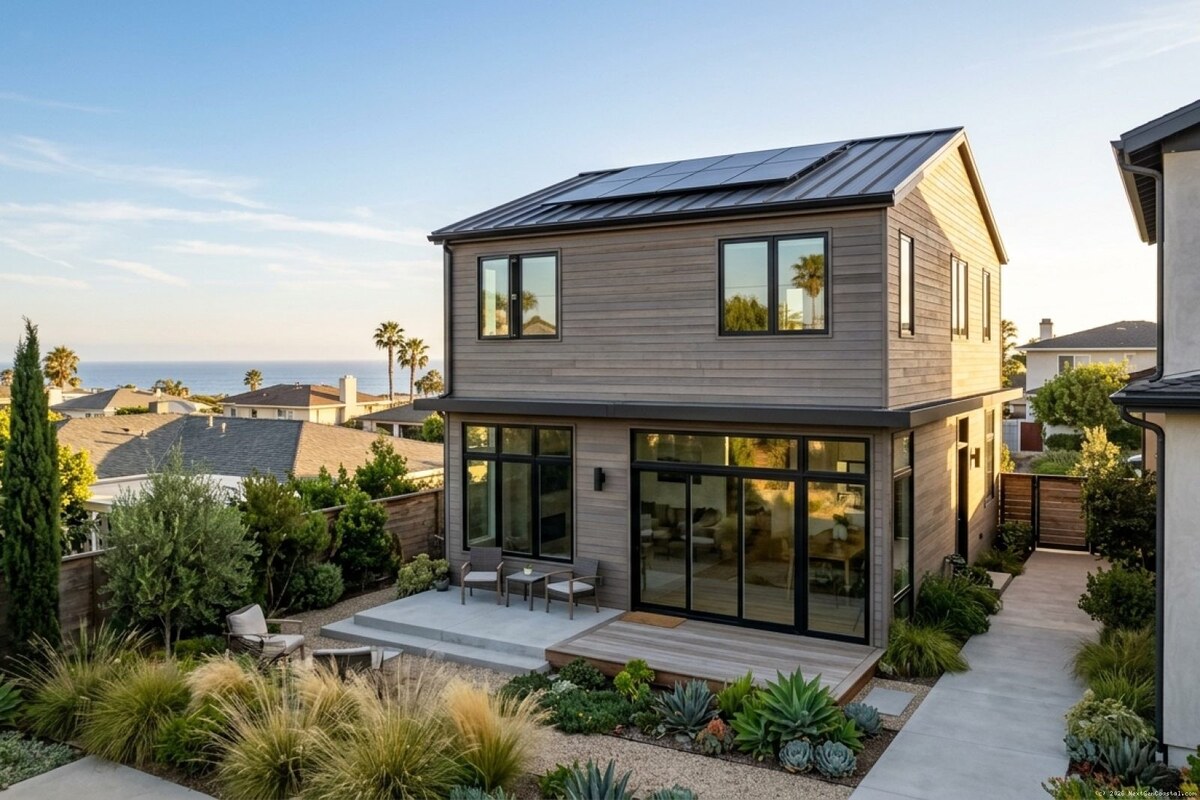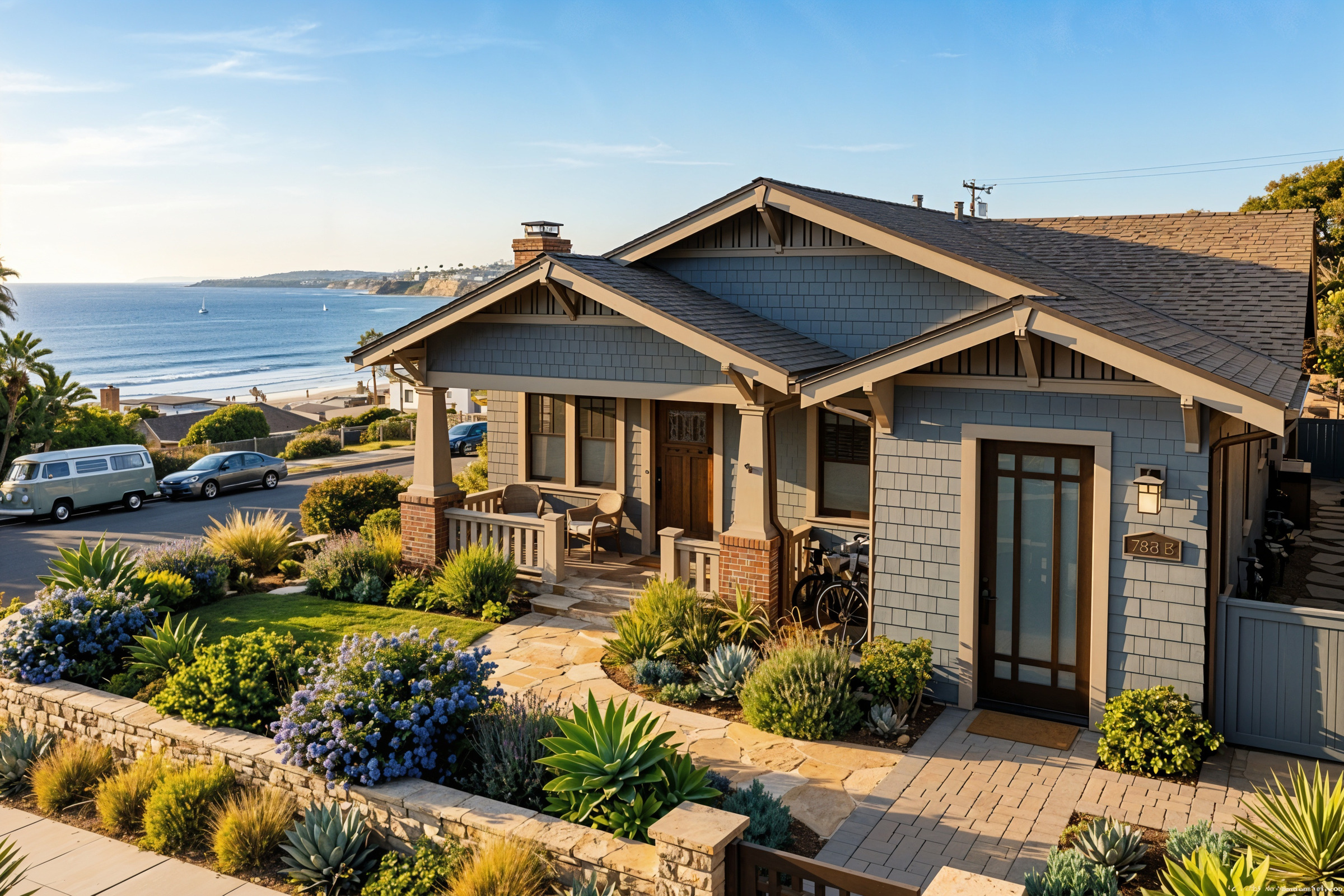
Junior Accessory Dwelling Units in coastal San Diego offer property owners one of the few remaining opportunities to add rentable square footage without triggering the full complexity of new construction. A JADU conversion repurposes existing interior space, state law caps it at 500 square feet, into an independent unit with its own efficiency kitchen and exterior entrance. No new foundation, no setback variance, no parking study. For owners in La Jolla, Pacific Beach, Ocean Beach, or Coronado, the appeal is straightforward: you generate rental income from space you already own, often at a fraction of the cost of building a detached ADU.
What complicates the picture is the California Coastal Commission. Properties inside the Coastal Zone fall under a separate permitting regime that layers coastal development review on top of the ministerial JADU approval your city otherwise grants within sixty days. The question becomes whether your interior conversion triggers a coastal development permit at all, and if it does, how long the process takes and what findings you need to satisfy.
Understanding JADU Basics and AB 2221 Framework
AB 2221, effective January 2021, codified JADUs as ministerial approvals under Government Code § 65852.22. Cities must approve conforming applications; there is no discretionary design review, no conditional use permit, no environmental study under CEQA. The statute defines a JADU by seven characteristics, all of which your project must satisfy:
- Maximum 500 square feet of conditioned interior space
- Contained entirely within the walls of an existing or proposed single-family residence
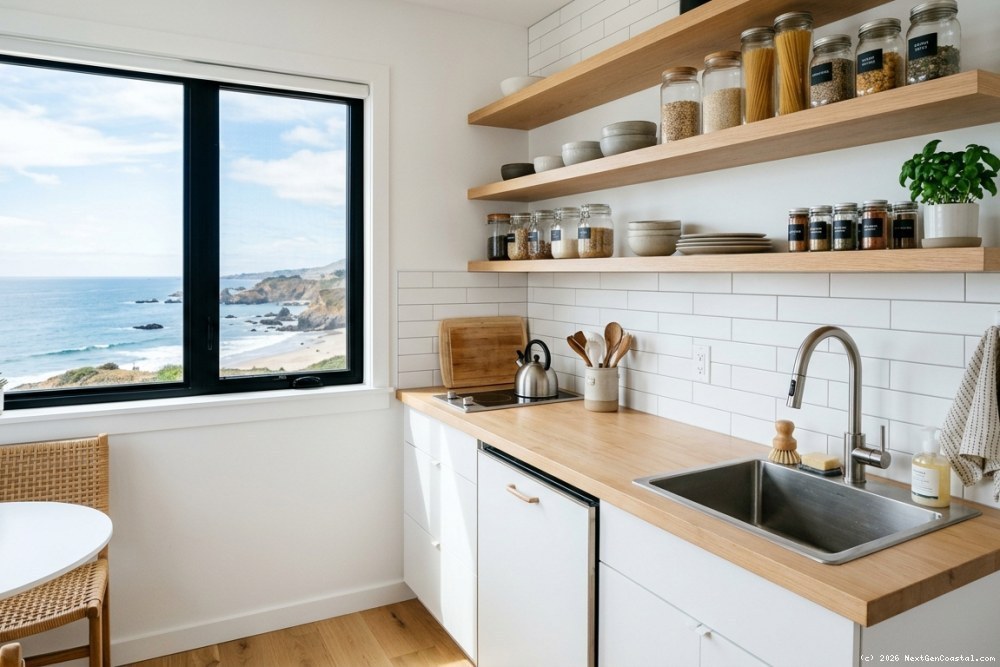
- Equipped with an efficiency kitchen (sink with a diameter or width of at least fifteen inches, cooking facility with appliances, food storage with a countertop)
- May share sanitary facilities with the primary dwelling
- Separate exterior entrance, either existing or newly created
- Owner occupancy of either the JADU or the primary unit, recorded as a deed restriction
- No additional parking required under Gov. Code § 65852.2(e)(1)(D)
- No setback requirements beyond those imposed on the primary residence.
- No parking requirements.
The sixty-day approval clock and the CEQA exemption are the provisions that make JADUs attractive in markets where discretionary permits routinely stretch past twelve months. Cities treat the application as a building permit with a floor-plan check: does the layout comply, does the deed restriction get recorded, does the owner sign the occupancy affidavit.
The Coastal Zone Exception
State ADU law does not override the California Coastal Act. Public Resources Code § 30600 gives the Coastal Commission jurisdiction over development within the Coastal Zone, which in San Diego extends roughly one thousand yards inland from mean high tide (the boundary varies by topography and follows the certified Local Coastal Program maps). AB 2221 explicitly preserves CCC authority; the statute's ministerial mandate applies to local land-use discretion, not to coastal resource review.
In practice this means your JADU application splits into two tracks. The city processes the ministerial JADU approval (floor plan, deed restriction, occupancy affidavit) on the sixty-day timeline. Separately, you apply for a coastal development permit if your project triggers one. The city will not issue a certificate of occupancy until both approvals are in hand.
CCC Jurisdiction in San Diego Coastal Communities
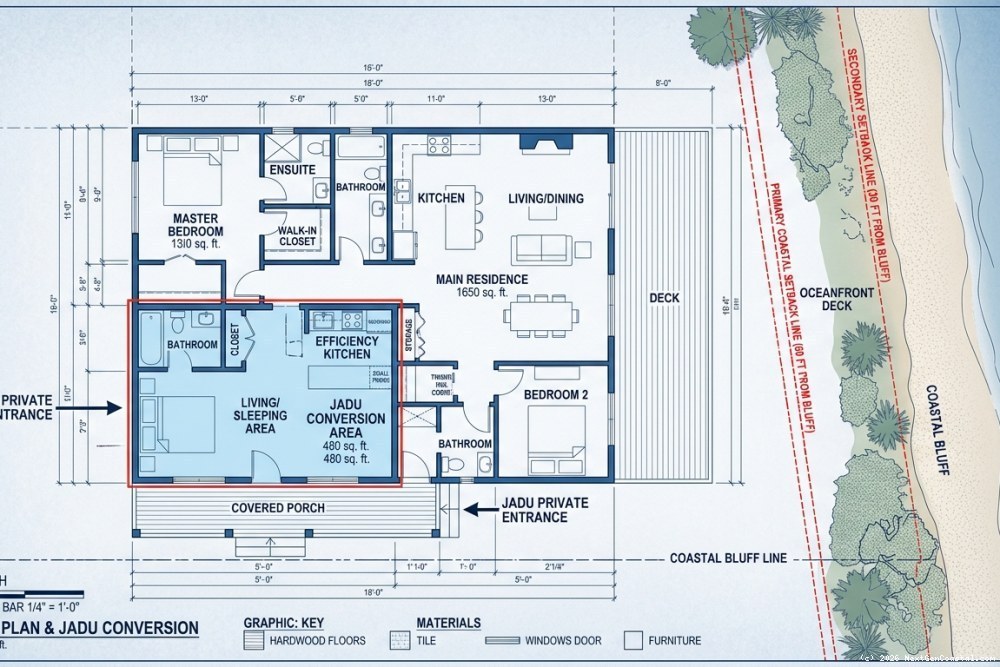
San Diego County's seventy-six miles of coastline fall under multiple permit jurisdictions. Most incorporated cities have certified Local Coastal Programs, which delegate permit authority to the city but preserve CCC appellate review. Unincorporated areas and a few specific development categories require direct CCC application.
Certified Local Coastal Program Areas
The following cities hold delegated coastal permit authority under certified LCPs:
- City of San Diego (La Jolla, Pacific Beach, Ocean Beach, Mission Beach, Peninsula)
- Coronado
- Imperial Beach
- Encinitas
- Solana Beach
- Del Mar
- Carlsbad
- Oceanside
If your property falls within one of these jurisdictions, you submit the coastal development permit application to the city planning department. The city processes it according to LCP policies. Certain decisions remain appealable to the CCC (projects between the first public road and the sea, projects affecting public access, wetland-adjacent development), but initial permitting occurs locally. Appeal periods run ten working days at the local level, then ten working days to the Commission.
CCC Retained Jurisdiction Areas
Unincorporated coastal parcels without certified LCPs require direct CCC application. In San Diego County this affects scattered coastal communities that remain unincorporated. The CCC San Diego Coast District office in San Diego handles these files. Processing timelines are longer, the Commission meets monthly, and contested items can carry over multiple hearing cycles.
Even in certified LCP cities, projects on tidelands, submerged lands, or public trust parcels trigger direct CCC review regardless of the city's delegated authority.
Coastal Development Permit Requirements for JADUs
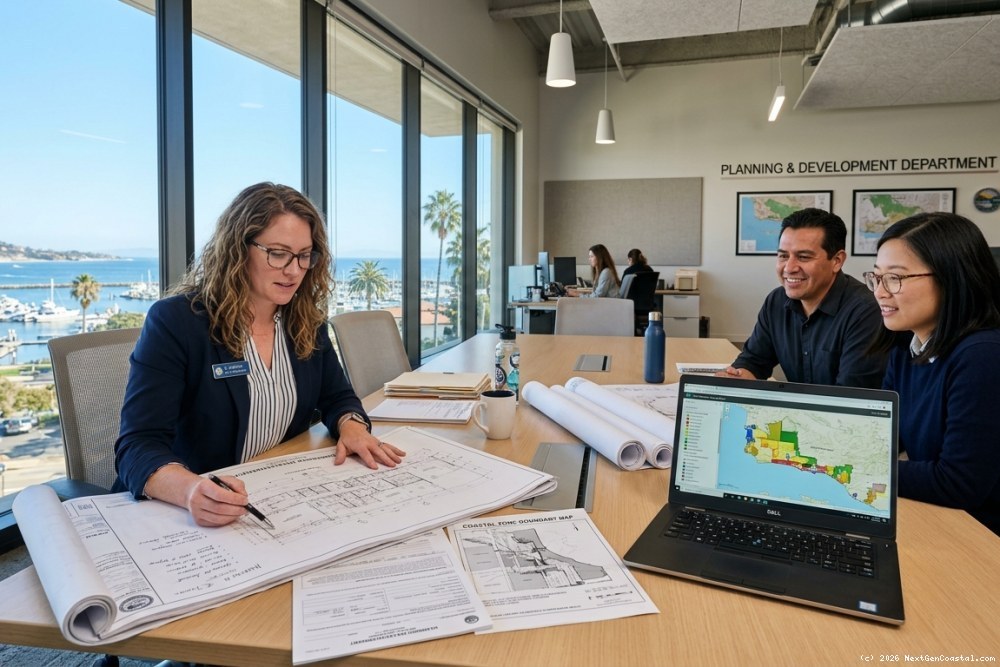
Whether your JADU conversion requires a coastal development permit depends on the scope of physical work, the property's location relative to coastal resources, and the categorical exclusions codified in 14 CCR § 13250.
Categorical Exclusions and Exemptions
Section 13250 excludes certain single-family improvements from coastal permit requirements. The exclusions most relevant to JADU conversions are:
- Interior alterations that do not increase the building footprint
- Exterior alterations that increase floor area by no more than ten percent or 500 square feet, whichever is less
- Improvements to existing structures not located on a beach, not located on a shoreline, and not within fifty feet of the edge of a coastal bluff
The exclusions do not apply if the development:
- Occurs on a beach or shoreline
- Occurs within fifty feet of a coastal bluff edge
- Extends seaward of the existing structure
- Results in gross floor area increase exceeding the ten-percent or 500-square-foot cap
- Increases risk from geologic, flood, or fire hazard
- Adversely affects public access or scenic resources
- Involves risk from coastal hazards, erosion, wave action, bluff retreat.
A JADU conversion three blocks inland in Pacific Beach, with no exterior modification beyond a door swap, will often qualify for categorical exclusion. The same project in a blufftop home in La Jolla Shores, fifty feet from the bluff edge, will not.
When a Coastal Development Permit Is Required
Most JADU projects that involve any exterior work require a coastal development permit. Common triggers:
- New exterior door or modification to an existing opening (even if the door is simply relocated within the same wall plane)
- Exterior stairway, landing, or access path
- Trenching for utilities or drainage connections
- Any work within the coastal setback area defined by the LCP
- Properties on or adjacent to coastal bluffs, beaches, wetlands, or ESHA
- Modifications to structures identified as contributing to coastal character or located in historic districts
- Utility connections requiring trenching or exterior work that may trigger coastal development permit review.
The separate exterior entrance required by state JADU law is the provision that most frequently triggers coastal permit requirements. Creating or modifying that entrance constitutes exterior alteration, even if the JADU itself occupies purely interior space.
City of San Diego JADU-CDP Process
San Diego encompasses the largest share of coastal JADU-eligible properties in the county. The city's certified LCP divides the coastal zone into community plan segments, each with specific development policies.
Coastal Overlay Zones and Development Standards
The certified LCP incorporates the following community plans as coastal segments:
- La Jolla: The La Jolla Community Plan and La Jolla Shores Planned District Ordinance govern bluff setbacks (typically forty feet from the bluff edge, though the precise measurement varies by erosion rate and geotechnical factors) and view corridor protection.
- Pacific Beach: The Pacific Beach Community Plan emphasizes beach character and pedestrian access to the shoreline.
- Ocean Beach: The Ocean Beach Precise Plan includes design guidelines for structures visible from the beach or public rights-of-way.
- Peninsula (Point Loma): The Peninsula Community Plan addresses bluff stability and coastal hazard zones along Sunset Cliffs.
Each segment may impose requirements beyond base zoning:
- Coastal bluff setbacks measured from the bluff edge (definitions vary; some LCPs measure from the top of the bluff face, others from the landward extent of unstable bluff material)
- Height limits more restrictive than inland zones (often thirty feet in coastal overlay areas)
- Design review for compatibility with coastal architecture (materials, roof pitch, fenestration patterns)
- View corridor analysis if the property lies within a mapped public view corridor
- Native or drought-tolerant landscaping requirements to reduce runoff and protect bluff stability
- Coastal bluff setbacks, typically 40 feet from the bluff edge, though the distance varies by jurisdiction and erosion rate.
- View corridor protection, often codified in local coastal programs to preserve public sight lines to the ocean.
- Native landscaping requirements, coastal sage scrub, maritime succulents, or other species listed in the certified Local Coastal Program.
Application Submittal and Review Timeline
The combined JADU and coastal development permit process in San Diego follows five stages:
Pre-application consultation. Schedule a meeting with city planning staff to review the project scope, confirm whether a coastal permit is required, and identify LCP policies that apply to your property. Staff will tell you whether the project is categorically excluded, whether it requires a noticed public hearing, and what technical studies (geotechnical, biological, drainage) you need to submit. This consultation is not optional for coastal projects; LCP overlay provisions are property-specific, and assumptions about categorical exclusion frequently prove incorrect.
Application preparation. Prepare a combined submittal package that includes the JADU application (floor plans, efficiency kitchen detail, deed restriction form, owner-occupancy affidavit) and the coastal development permit application (site plan, elevations, coastal resource impact analysis, technical reports). The coastal resource analysis addresses the five Coastal Act policies: public access, recreation, marine resources, land resources, and development. For a typical JADU conversion the analysis focuses on public access (does the project interfere with shoreline access or street parking?) and land resources (bluff stability, ESHA buffers, visual resources).
Completeness review. Staff conducts a completeness check within thirty days of submittal. Incomplete applications receive a correction notice listing specific deficiencies. The substantive review clock does not start until the application is deemed complete.
Substantive review. Once complete, the application enters staff review. For a ministerial JADU paired with a routine coastal permit (no public hearing, no bluff stability issues, no ESHA adjacency), processing typically takes sixty to one hundred twenty days. Projects that require noticed hearings, geotechnical peer review, or biological surveys stretch to one hundred eighty days or longer.
Decision and appeal period. Most JADU-CDP applications receive staff-level approval without a hearing. The decision is subject to a ten-working-day local appeal period. If no local appeal is filed, certain categories of coastal permits enter a ten-working-day CCC appeal period. During the appeal window the permit is not final; construction cannot begin.
Design Review Considerations
Coastal communities in San Diego apply design review to protect coastal character. For JADU conversions, review focuses on:
- Exterior entrance design (does the new door match the architectural style of the primary residence?)
- Window and door placement (does the new layout disrupt the facade rhythm or create blank walls visible from public view corridors?)
- Materials and colors (does the exterior finish match the existing siding, stucco, or trim?)
- Landscaping around the new entrance (does it screen the entry from the street while maintaining coastal vegetation such as native grasses or succulents?)
- Lighting (does the fixture design and placement minimize glare into public view corridors or sensitive habitat?)
- Exterior entrance design compatible with existing architecture, matching roof pitch, siding material, trim details.
- Window and door placement that does not disrupt the building facade rhythm or introduce asymmetries visible from public viewsheds.
- Material and color consistency with the primary residence, same siding profile, paint palette, roofing material.
- Landscaping that screens new entrances while maintaining coastal vegetation, no invasive species, no high-water-demand ornamentals.
- Lighting that minimizes impacts on coastal viewsheds and wildlife, downward-cast fixtures, amber spectrum, motion sensors where appropriate.
Properties within designated historic districts, or properties with structures over forty-five years old, may require historical resource evaluation under CEQA even if the JADU itself is CEQA-exempt. The coastal permit triggers separate historical review if the structure is identified as a contributor to coastal character.
Special Considerations for Coastal Bluff and Hazard Properties
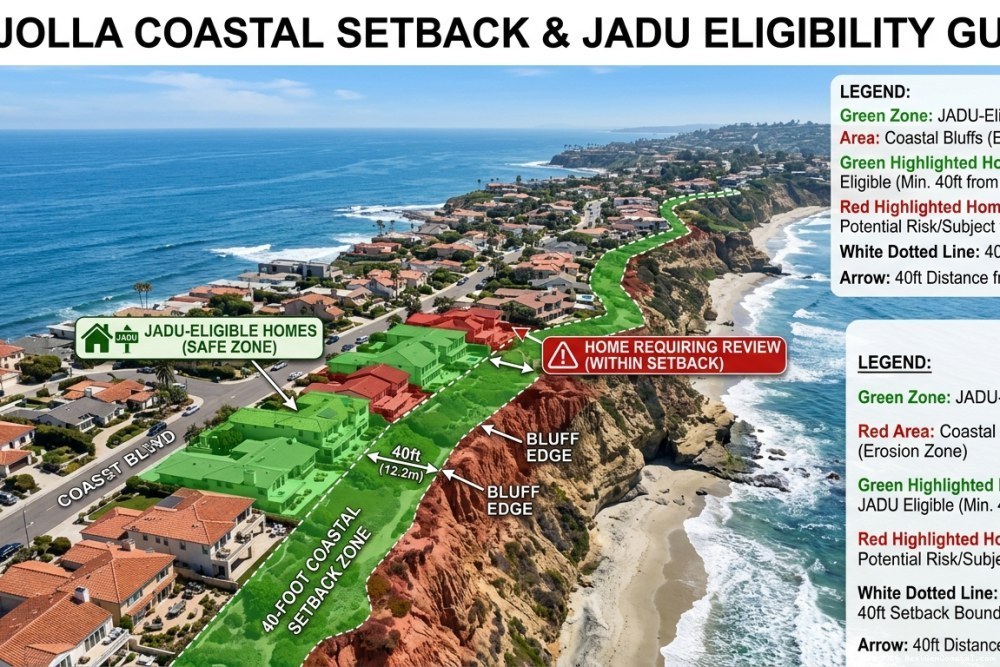
JADU conversions on bluff properties in La Jolla, Sunset Cliffs, or Solana Beach face heightened review. Erosion, wave action, and groundwater all affect bluff stability, and the Commission scrutinizes projects that increase occupancy or water use near unstable geologic features.
Geotechnical Analysis Requirements
Properties within bluff setback areas require geotechnical investigation that demonstrates:
- Bluff stability under current conditions, expressed as a factor of safety (typically 1.5 for static loading)
- Historical erosion rate derived from aerial photography, survey monuments, or published studies (the CCC maintains erosion rate data for major bluff segments)
- Projected bluff retreat over a seventy-five-year economic life for the structure
- Confirmation that the proposed development will not accelerate erosion through altered drainage, increased runoff, or landscape irrigation
- Groundwater and subsurface drainage impacts
- Bluff stability analysis with factor-of-safety calculations, typically requiring ≥1.5 for static conditions and ≥1.1 for seismic.
- Erosion rate determination based on historical data, aerial photo sequences, LIDAR surveys, or the best available geologic record.
- 75-year economic life projection for structures, the standard horizon under most Local Coastal Programs for bluff-top development.
- Confirmation that development will not accelerate erosion, no additional runoff, no removal of stabilizing vegetation, no grading that increases slope angle.
Even though a JADU does not expand the building footprint, the addition of plumbing fixtures, a kitchen sink, and potentially a washing machine increases water use and wastewater generation. Geotechnical reports must address whether the additional water load affects bluff stability through changes in soil moisture, perched groundwater, or drainage patterns.
Bluff Setback Compliance
Most coastal LCPs require structures to maintain a setback from the bluff edge, measured as the greater of forty feet or a distance equal to the bluff height. A ninety-foot bluff requires a ninety-foot setback; a thirty-foot bluff requires a forty-foot setback. Because JADUs occupy existing structures, conforming buildings automatically satisfy the setback.
Legal nonconforming structures built before current setback requirements took effect present a different question. The CCC and local jurisdictions evaluate whether the JADU conversion constitutes an intensification of nonconforming use. Adding a rental unit increases occupancy, which increases the number of people at risk in a bluff-failure event. Some jurisdictions treat this as a change of use that triggers setback compliance; others allow the conversion if the geotechnical report demonstrates adequate stability for the seventy-five-year horizon.
Public Access and Coastal Resource Protection
The Coastal Act prioritizes public access and resource protection. JADU applications must demonstrate consistency with these policies, even for minor interior conversions.
Public Access Analysis
Coastal development permits require findings that the project will not interfere with public access. For JADU conversions, the analysis considers:
- Whether the property contains or abuts a public access easement, lateral beach access path, or vertical access stairway
- Impact on street parking in beach-adjacent areas (state law prohibits parking requirements for JADUs, but the coastal permit evaluates whether increased occupancy affects public beach parking availability)
- Visual access from public vantage points (does the exterior entrance or associated landscaping block a public view corridor?)
- Consistency with public access policies in the certified LCP
Properties between the first public road and the sea face heightened scrutiny. In these locations, demonstrating that the JADU maintains or enhances public access may require mitigation such as a recorded access easement, parking management plan, or design modifications that preserve sightlines.
Environmentally Sensitive Habitat Areas and Wetlands
Properties adjacent to Environmentally Sensitive Habitat Areas under Public Resources Code § 30107.5 or coastal wetlands under § 30121 must demonstrate that development will not degrade habitat values. San Diego coastal areas with ESHA designations include:
- Torrey Pines State Natural Reserve and adjacent coastal sage scrub
- Los Peñasquitos Lagoon
- San Dieguito Lagoon
- Batiquitos Lagoon
- Tijuana River Estuary
- Maritime succulent scrub remnants in La Jolla and Point Loma
- Various coastal sage scrub and maritime succulent scrub areas, often mapped as Environmentally Sensitive Habitat Areas under the California Coastal Act.
JADU projects within ESHA buffer zones (typically one hundred feet for wetlands, fifty to one hundred feet for upland ESHA depending on the habitat type and LCP provisions) may require biological surveys, buffer zone analysis, and mitigation measures. Mitigation often includes native landscaping to reduce runoff, lighting restrictions to avoid impacts on nocturnal species, and drainage controls to prevent pollutant discharge into sensitive areas.
Permit Strategy Optimization
Design decisions made early in project planning determine permitting complexity and timeline.
Project Scoping to Minimize Coastal Impacts
Consider these strategies:
Use existing openings. If the structure has a side or rear door that can serve as the JADU entrance, converting that existing opening avoids the exterior alteration that triggers most coastal permits. Verify with planning staff that the configuration satisfies the separate-entrance requirement under local JADU interpretation (some jurisdictions allow a shared landing or vestibule; others require complete separation from the primary unit's entry path).
Interior-only approach. Purely interior conversions that involve no exterior modification, no new door, no window enlargement, no exterior utility runs, often qualify for categorical exclusion if the property is not within fifty feet of a bluff edge or on the beach. This approach works best for properties with existing side or rear access.
Drainage and utility planning. Route new plumbing and electrical service to existing lines within the building footprint. Avoid trenching in coastal setback areas or near sensitive resources. Connecting to the primary unit's sewer lateral inside the foundation eliminates the need for exterior excavation.
Bluff-setback awareness. For properties near bluffs, locate the JADU in the portion of the residence farthest from the bluff edge. This minimizes geotechnical concerns and demonstrates a conservative approach to bluff hazard.
Professional Team Assembly
Coastal JADU projects benefit from experienced professionals:
- Coastal land use consultant: Specialists in CCC and LCP policy prepare coastal resource analyses, attend pre-application meetings, and respond to staff comments. Fees typically range from $3,000 to $8,000 depending on project complexity.
- Architect with coastal experience: Designers familiar with coastal design review produce plans that satisfy functional requirements and LCP character policies. Expect $5,000 to $12,000 for JADU design and permit-ready drawings.
- Geotechnical engineer: For bluff or hazard-area properties, qualified geotechnical professionals prepare reports that meet CCC technical standards. Bluff stability reports cost $3,000 to $8,000; more complex sites with subsurface exploration and slope stability modeling run $8,000 to $15,000.
- Coastal engineer: Properties subject to wave action, coastal flooding, or severe erosion may require coastal engineering analysis of wave runup, scour, or flood risk. These studies cost $5,000 to $12,000.
Timeline Expectations and Planning
Realistic timeline planning for coastal JADU projects:
- Pre-application phase: two to four weeks for initial consultation and project scoping
- Application preparation: four to eight weeks for plan preparation, technical studies, and application assembly
- Completeness review: two to four weeks for city staff completeness determination
- Substantive review: eight to sixteen weeks for staff review, revisions, and decision preparation
- Appeal period: four weeks for local and CCC appeal periods to expire
- Total timeline: five to eight months from project initiation to final permit for routine projects; eight to twelve months for complex sites with geotechnical peer review, biological surveys, or design modifications
Projects that go to CCC hearing (either through direct CCC jurisdiction or on appeal) add three to six months, as Commission calendars are scheduled months in advance and contested items often carry over multiple meetings.
Common Pitfalls and How to Avoid Them
Frequent mistakes in coastal JADU permitting and how to avoid them.
Pitfall 1: Assuming Categorical Exclusion Applies
Many owners assume that because the JADU occupies existing interior space, it is categorically excluded from coastal permits. This assumption fails when:
- The property is within fifty feet of a coastal bluff
- Exterior modifications (new door, window enlargement, exterior stairs) exceed categorical exclusion thresholds
- The structure is on a beach or shoreline
- The local LCP contains more restrictive provisions than the statewide categorical exclusions
Conduct a thorough categorical exclusion analysis with planning staff before assuming CDP exemption. Obtain written confirmation if staff determines the project is excluded.
Pitfall 2: Overlooking Owner-Occupancy Deed Restriction
State JADU law requires owner occupancy of either the JADU or the primary residence, enforced through a deed restriction recorded against the property title. Coastal jurisdictions strictly enforce this requirement. The restriction runs with the land; future buyers inherit the occupancy obligation.
If owner occupancy is incompatible with your investment strategy (for example, you plan to rent both units), a standard ADU is the better option. ADUs require new construction or a detached structure, which increases cost but removes the owner-occupancy constraint.
Pitfall 3: Underestimating Historic Resource Review
Many coastal neighborhoods contain structures over forty-five years old or properties within designated historic districts. Interior alterations to historic structures can require extensive documentation and design modifications to preserve character-defining features.
Research property age and historic designation early in planning. For properties built before 1980, budget for potential historical resource evaluation, which may include a historical report ($2,000 to $5,000) and design revisions to preserve historic materials or spatial organization.
Pitfall 4: Ignoring Appeal Risk
Approved coastal development permits face appeal periods during which third parties or the CCC can challenge decisions. Projects that generate neighborhood opposition or raise coastal resource concerns face higher appeal risk. An appeal to the CCC delays final permit issuance by three to six months and may result in modified conditions or project denial.
Design projects that clearly demonstrate coastal policy consistency. For potentially controversial projects, consider proactive community outreach to address concerns before formal opposition develops. Attend neighborhood association meetings, distribute project information to adjacent owners, and respond to questions transparently.
Financial Analysis: Coastal JADU Economics
Despite permitting complexity, coastal JADUs offer compelling financial returns.
Development Costs
Construction dominates the cost structure; coastal-specific studies and contingency add fifteen to twenty-five percent compared to a non-coastal JADU.
View chart data
| Category | Low estimate | High estimate |
|---|---|---|
| Design & permitting | $8k | $15k |
| Construction | $45k | $90k |
| Contingency | $7k | $15k |
| Coastal studies | $10k | $25k |
| All-in project range | $60k | $120k |
Coastal properties incur additional costs for geotechnical reports ($3,000 to $8,000), biological surveys ($2,000 to $5,000), and coastal land use consulting ($3,000 to $8,000) depending on site conditions. Bluff properties with subsurface exploration push geotechnical costs to $8,000 to $15,000.
Rental Income Potential
La Jolla commands the highest coastal JADU rents; Ocean Beach anchors the range across four beach-proximity markets.
View chart data
| Category | Monthly low | Monthly high |
|---|---|---|
| La Jolla | $2,200 | $2,800 |
| Coronado | $2,000 | $2,600 |
| Pacific Beach / Mission Beach | $1,800 | $2,400 |
| Ocean Beach | $1,700 | $2,200 |
Annual gross rental income of $21,600 to $33,600 provides attractive returns on $60,000 to $120,000 invested capital. Simple payback periods range from three to six years before considering property value appreciation or tax benefits from depreciation.
Property Value Impact
Cumulative gross rental income crosses invested capital between 1.8 years (best case) and 5.6 years (worst case), before factoring property value uplift.
View chart data
| Category | Years to payback |
|---|---|
| Best case (La Jolla / low build) | 2 |
| Mid case (typical coastal project) | 3 |
| Worst case (OB low rent / high build) | 6 |
Beyond rental income, JADUs increase underlying property value. Buyers value the income potential and the development entitlements already secured (the coastal permit is transferable; the deed restriction runs with the land but does not prevent sale). In our experience, coastal San Diego properties with permitted JADUs command premiums over comparable properties without income units, though the premium varies by submarket and depends on comparable sales data at the time of transaction.
Future Regulatory Landscape
California's ADU regulatory environment continues evolving.
SB 897 and Coastal ADU Streamlining
SB 897 (effective January 2023) requires the CCC to adopt regulations streamlining coastal development permits for ADUs and JADUs. The Commission is developing these regulations to balance ADU production with coastal resource protection. The statute directs the CCC to identify categories of ADU and JADU projects that can be approved ministerially or with abbreviated review.
Anticipated streamlining provisions may include:
- Expanded categorical exclusions for ADUs and JADUs that meet specific siting and design criteria
- Expedited review timelines for qualifying projects (potentially thirty to sixty days instead of the current sixty to one hundred twenty days)
- Standardized conditions of approval that reduce case-by-case analysis
- Clarified standards for bluff setback and hazard area projects, potentially allowing conversions in existing conforming structures without full geotechnical peer review
Property owners planning coastal JADU projects should monitor CCC regulatory development. The Commission posts draft regulations and hearing schedules on its website; final adoption is expected in late 2026 or early 2027. New streamlining provisions may significantly reduce permitting timelines and costs for projects that fall within the defined categories.
Local LCP Updates and ADU Policies
San Diego coastal jurisdictions are updating LCPs to incorporate ADU and JADU policies consistent with state law while maintaining coastal resource protection. The City of San Diego certified LCP amendments in 2024 that establish clearer pathways for coastal ADU and JADU approval, including specific findings for projects in bluff setback areas and streamlined design review for projects that match existing architectural character. These updates reduce uncertainty in the permitting process and provide applicants with objective standards.
Implementation Roadmap
Permit processing and appeal periods account for the largest share of the twelve- to fourteen-month timeline in CCC jurisdiction.
View chart data
| Category | Weeks |
|---|---|
| Phase 1 · Feasibility assessment | 4 |
| Phase 2 · Team assembly | 2 |
| Phase 3 · Design & application prep | 8 |
| Phase 4 · Permit processing & appeals | 24 |
| Phase 5 · Construction & occupancy | 16 |
For coastal San Diego property owners ready to pursue JADU conversion, a strategic roadmap:
Phase 1: Feasibility assessment (weeks one through four)
- Verify the property is within the coastal zone and identify permit jurisdiction (certified LCP area or direct CCC jurisdiction)
- Review local LCP provisions applicable to the property location (obtain the community plan segment and zoning overlay maps from the city planning department)
- Assess the existing residence for suitable JADU conversion space (five hundred square feet or less, potential for efficiency kitchen, existing or feasible separate entrance)
- Identify potential coastal resource issues (bluff proximity measured from property survey or assessor's map, ESHA adjacency, public access easements)
- Conduct preliminary financial analysis (construction cost estimate, rental income projection, payback calculation)
Phase 2: Professional team assembly (weeks four through six)
- Engage an architect with coastal project experience (request references for prior JADU or ADU projects in the coastal zone)
- Retain a coastal land use consultant if complex issues are identified (bluff setback, ESHA buffer, historic resource)
- Arrange a geotechnical engineer if the property is in a bluff or hazard area (confirm the engineer is familiar with CCC technical standards for bluff stability reports)
- Schedule a pre-application consultation with planning staff (bring preliminary floor plans and site plan to the meeting)
Phase 3: Design and application preparation (weeks six through fourteen)
- Develop JADU design that minimizes coastal impacts (use existing openings, avoid exterior alterations in setback areas, route utilities to existing lines)
- Prepare technical studies (geotechnical report, biological survey, drainage plan)
- Complete application forms and supporting documentation (JADU application, coastal development permit application, coastal resource impact analysis)
- Assemble complete application package (verify checklist with planning staff before submittal)
- JADU application form and owner-occupancy deed restriction, recorded with the county recorder.
- Site plan showing existing and proposed conditions, scaled to permit review standards.
- Floor plans indicating JADU layout and efficiency kitchen, sink, cooking appliance, counter space under 500 square feet total.
- Elevation drawings showing exterior modifications, new doors, windows, any facade changes.
- Coastal resource impact analysis, required if the parcel lies within the Coastal Zone appeal jurisdiction or environmentally sensitive habitat area.
- Geotechnical report for bluff-top or hazard-area properties, addressing slope stability and setback adequacy over a 75-year horizon.
- Drainage and utility plans, demonstrating that runoff will not accelerate erosion or degrade sensitive habitat.
Phase 4: Permit processing (weeks fourteen through thirty-eight)
- Submit application and respond to completeness review (address deficiencies within thirty days to avoid application expiration)
- Address staff comments and revisions (expect one to two rounds of revisions for coastal projects)
- Obtain permit decision (staff approval for routine projects, planning commission hearing for projects with public access or ESHA issues)
- Navigate appeal periods (ten working days local, ten working days CCC for appealable decisions)
- Obtain permit decision, approval, conditional approval, or denial, typically within 60 days for ministerial JADUs, longer if a coastal development permit is required.
- Navigate appeal periods, ten working days to the local appeal body, then another ten to the Coastal Commission if the project lies in the appeal jurisdiction.
Phase 5: Construction and occupancy (weeks thirty-eight through fifty-four)
- Obtain building permits (submit coastal development permit approval with building permit application)
- Complete construction (typical JADU construction timeline is twelve to sixteen weeks)
- Pass final inspections (building, electrical, plumbing, mechanical)
- Record deed restriction (city will not issue certificate of occupancy until deed restriction is recorded)
- Market and lease JADU (verify tenant screening complies with fair housing requirements)
- Obtain building permits, incorporating any conditions from the coastal development permit or local discretionary approval.
- Complete construction, coordinating inspections and addressing any field changes that require permit amendment.
- Record the owner-occupancy deed restriction with the county recorder, referencing the permit number and JADU address.
This twelve- to fourteen-month timeline from initial feasibility to tenant occupancy reflects realistic expectations for coastal JADU projects that require both ministerial JADU approval and coastal development permit review.
Conclusion
Coastal San Diego JADU conversions represent a high-value strategy for single-family property owners in premium beach markets. The California Coastal Commission adds permitting complexity beyond standard inland JADU projects, but the financial returns and property value enhancement justify the effort for well-planned conversions.
Success requires understanding the intersection of state JADU law (ministerial approval, sixty-day timeline, owner-occupancy deed restriction), local coastal programs (community plan policies, design review, bluff setbacks), and CCC coastal resource policies (public access, ESHA protection, geologic hazard). Property owners who approach coastal JADU development with realistic timeline expectations (five to eight months for routine projects, eight to twelve months for complex sites), experienced professional guidance (coastal architect, land use consultant, geotechnical engineer), and strategic project design (minimize exterior alteration, use existing openings, avoid work in setback areas) will move through the permitting process efficiently.
As California refines ADU regulations and the CCC develops streamlined coastal ADU procedures under SB 897, the pathway for coastal JADU approval will become clearer. For San Diego coastal property owners, the opportunity to evaluate JADU potential and position properties for this value-add strategy is immediate. The combination of strong rental demand, limited new construction in coastal zones, and state legislative support for ADU production creates favorable conditions for coastal JADU investment over the next five to ten years.
- Develop JADU design minimizing coastal impacts, reduced grading, native landscaping, permeable surfaces where feasible.
- Prepare technical studies, geotechnical, biological, visual impact, drainage, as required by the Local Coastal Program or city planner.
- Complete application forms and supporting documentation, including the owner-occupancy affidavit and any Coastal Commission supplemental questionnaires.
- Assemble complete application package and submit to the planning department, paying the filing fee and any required deposit for third-party review.
Frequently Asked Questions
Do I need a coastal development permit for a JADU conversion in San Diego?
How long does coastal JADU permitting take in San Diego?
What are the main coastal resource concerns for JADU conversions?
Can I build a JADU on a coastal bluff property in La Jolla?
What's the difference between CCC jurisdiction and local coastal program jurisdiction?
How much does a coastal JADU conversion cost in San Diego?