
The Evolution from Manual to Machine Learning
Traditional guest screening meant credit checks, ID uploads, and scrolling through Airbnb reviews. If you managed ten units on the coast, you'd spend maybe twenty minutes per booking request during summer turnover. That adds up to forty hours a month just verifying strangers.
AI platforms like Autohost, Superhog, and Safely cut that timeline to seconds. They pull guest data the instant a reservation comes in, whether through Airbnb, VRBO, or your direct booking site. The algorithms chew through more information than any human could review in an afternoon.
What gets analyzed:
- Credit history and payment records from multiple financial institutions
- Eviction filings and landlord disputes pulled from county courts
- Rental history across platforms, including Airbnb star ratings and VRBO feedback
- Booking behavior patterns like last-minute requests or mismatched party sizes
- Device fingerprints that catch guests using VPNs or juggling multiple accounts
- Public social media activity correlated with property damage risk
- Geolocation checks to see if stated location matches digital footprint
- Cross-platform rental history, we pull Airbnb reviews, VRBO ratings, and any traditional lease record if they've rented long-term before
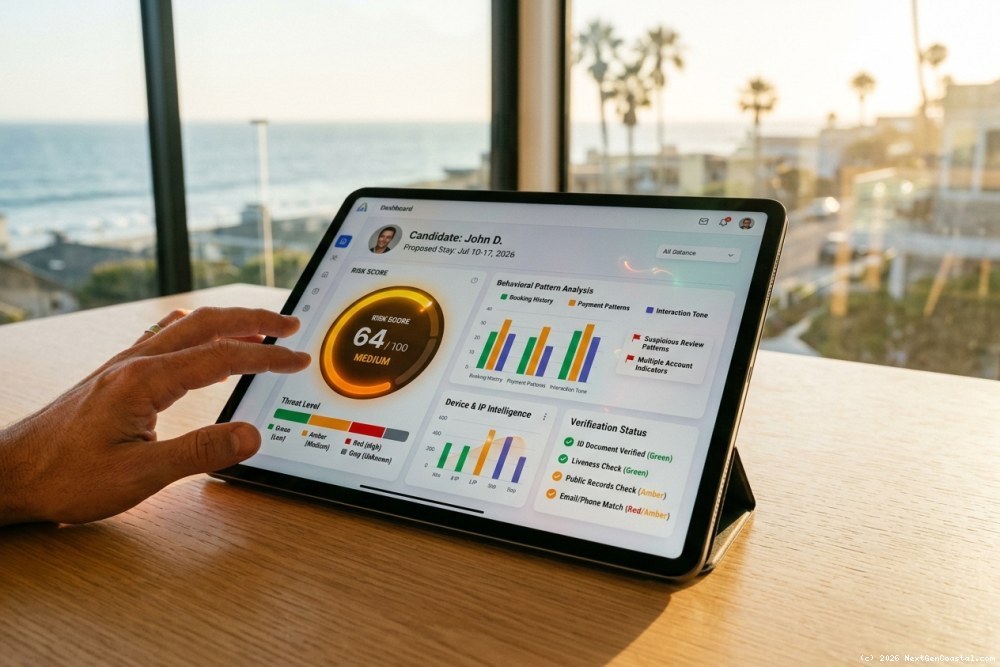
You get a risk score back. Usually zero to one hundred, or color-coded green through red. The system explains why it flagged someone. An operator I know in Corona del Mar had the AI catch a guest with a 720 credit score and five-star reviews. The problem? Friday check-in, eighteen-person party size, local IP address, stated reason "destination wedding." That pattern shows up in unauthorized event bookings that trash coastal properties.
The 2026 Platform Landscape
The market's consolidated around a handful of platforms. Each one has strengths depending on your portfolio size and where you list.
Autohost: The Integration Specialist
Operators running twenty-plus units tend to pick Autohost because it connects natively with Guesty, Hostaway, and Lodgify. Every booking gets screened automatically. No manual uploads. The company says its model trained on millions of vacation rental stays, so it's good at catching party risk and commercial misuse.
For Orange County beach properties, the geofencing feature matters. It flags bookings where the guest lives within fifty miles of your rental. Local reservations make up a small slice of total bookings but cause a lot of party damage in beach markets. Autohost also watches for pass-through bookings, where someone books under their name and immediately hands it off to another person. That's a common fraud move.
Pricing runs two to four dollars per reservation if you've got more than ten units. Annual contracts bring the rate down. It pays for itself if it stops one major damage incident.
Superhog: The Insurance Play
Superhog bundles damage protection with screening. It assigns each guest a trust score, then assumes financial risk for the bookings it approves.
This works well for luxury coastal homes where your security deposit won't cover a real disaster. Operators managing oceanfront properties worth four to eight million dollars in Laguna Beach told me the integrated insurance protects against catastrophic scenarios like a guest causing structural damage or creating liability exposure.
The screening piece uses biometric facial recognition to match government IDs against selfies. It cross-checks guests against fraud and financial crime watchlists. You'll pay eight to fifteen dollars per booking depending on property value, but that includes the insurance layer.
Safely: The Airbnb Native
Airbnb bought Safely in 2023. If you list primarily on Airbnb, screening happens inside the platform's Host tools. Risk scores show up right next to booking requests.
The algorithm taps Airbnb's internal data: messaging tone, search behavior, account age, cross-platform activity. It catches guests who spin up new accounts to dodge bad reviews or platform bans. Safely also monitors for review manipulation patterns.
The downside is Airbnb exclusivity. VRBO bookings and direct reservations need a different solution. Pricing bundles into Airbnb's Host protection programs at one to two dollars per reservation.
Chekin: The European Import
Chekin launched in the US last year with a compliance angle. Its model trained on European vacation rental data, where guest registration laws run stricter. Cities like Dana Point and San Clemente now require mandatory guest registration, so the compliance automation actually saves work.
Chekin sends guests a pre-arrival link to upload ID documents. The AI verifies authenticity, extracts data, and auto-submits registration forms to local authorities. The screening component analyzes similar risk factors to competitors but adds that compliance layer.
You'll pay three to five dollars per reservation, less if you sign an annual contract. The compliance piece justifies the cost in jurisdictions with strict registration rules.

What the Algorithms Actually Detect
Understanding what trips the flags helps you make smarter decisions when the system recommends a decline. These models don't just tick boxes. They find patterns across multiple data layers.
Behavioral Red Flags
Machine learning spots booking anomalies humans miss. A guest who normally stays in budget motels suddenly books a high-end beach house? That's a pattern break. The AI doesn't auto-decline, but it flags for review because dramatic upgrades sometimes precede damage claims or fraud.
Communication style gets analyzed too. Guests who dodge platform messaging, push to move conversations off-site, or ask weird questions about security systems all trigger behavioral warnings. The AI reads message sentiment and language patterns. Excessive friendliness, unexplained urgency, vague answers about trip purpose.
Booking timing signals risk. Last-minute weekend reservations from local IP addresses score high for party scenarios. Bookings made months ahead with detailed property questions suggest real vacation intent.
Identity and Financial Signals
The system cross-checks identity data to catch inconsistencies. Name on booking doesn't match the credit card? Stated age conflicts with ID documents? Profile photo looks like stock imagery? All of those trigger verification requests.
Financial signals go past credit scores. Algorithms analyze payment method risk. Prepaid cards and virtual credit card numbers score higher than traditional cards linked to established bank accounts. They also watch for fraudulent card use patterns.
For luxury coastal properties, the AI flags bookings where nightly rate represents an unusually high chunk of the guest's apparent income (inferred from employment data and credit files). Modest income booking a luxury week-long stay isn't an automatic decline, but the mismatch warrants extra verification.
"The most sophisticated bad actors know how to game individual screening criteria, fake IDs, purchased reviews, stolen credit cards. What they can't fake is the correlation pattern across multiple data points. That's where machine learning delivers value human reviewers simply can't match."
Social and Digital Footprint
This piece is controversial, but platforms say it predicts party risk. Algorithms scan public social media profiles (when linked to booking accounts) for damage correlates: recent event promotion posts, large group photos tagged at party venues, accounts with big followings that monetize by hosting events at rental properties.
The AI doesn't moralize. It identifies statistical correlations. Guest posts beach sunset photos and restaurant tips? Different score than someone whose recent activity shows event promotion. For a high-value property, that distinction matters.
Digital footprint analysis also catches suspicious account patterns. Recently created profiles, minimal activity accounts, stock or AI-generated profile photos, follower ratios suggesting bot networks.
Implementation Strategy for Coastal Portfolios
Subscribing to a platform isn't enough. You need to calibrate risk thresholds, wire it into your workflow, and stay compliant with fair housing laws.
Setting Risk Thresholds
Most platforms let you customize what risk score triggers auto-approval, manual review, or auto-decline. For coastal properties, a three-tier setup works:
- Green (0–30 risk score): Auto-approve. Verified identity, strong rental history, no behavioral flags. Most booking requests for well-marketed coastal properties land here.
- Yellow (31–65 risk score): Manual review. The AI found concerns but not deal-breakers. You or your VA review specific flags and make the call. This tier catches a decent chunk of requests.
- Red (66–100 risk score): Auto-decline or require extra verification (government ID upload, higher security deposit, signed rental agreement). Multiple high-risk indicators. Smaller percentage of requests but concentrated risk.
Thresholds should shift with property value and season. Peak demand periods when you're getting premium rates? You can afford to be selective, declining yellow-tier bookings you'd accept during shoulder season.

Integration with PM Systems
Your screening platform should feed straight into your property management software. No double-entry. Every booking screened. The workflow looks like this:
- Guest submits booking request via Airbnb, VRBO, or direct booking engine
- Request auto-triggers AI screening through API integration
- Risk score and flags pop up in PM system dashboard within sixty seconds
- Green-tier bookings auto-approve and send confirmation emails
- Yellow-tier bookings notify you for manual review
- Red-tier bookings trigger automated decline message or verification request
- All screening data logs to guest record for future reference
This requires API support in your PM system. Guesty, Hostaway, Lodgify, and Streamline all connect natively to major screening platforms. Legacy systems without API support mean manually copying booking data into the screening tool, which kills the efficiency gain.
Fair Housing Compliance
AI screening must comply with Fair Housing Act requirements. You can't discriminate based on race, color, national origin, religion, sex, familial status, or disability. The problem is some AI models accidentally create disparate impact, where neutral-sounding criteria disproportionately affect protected classes.
An algorithm that heavily weights credit scores might decline more applicants from certain demographics, even though you never intended discrimination. To reduce that risk:
- Use platforms that run regular disparate impact testing and publish results
- Avoid screening criteria unrelated to tenancy risk (social media political views, religious affiliation, family size beyond occupancy limits)
- Document business justification for each criterion (e.g., "We flag local bookings because data shows higher damage rates for same-area guests")
- Keep records showing you apply screening standards consistently across all applicants
- Offer an appeal process for declined guests to submit additional information
California housing discrimination laws run stricter than federal standards, especially around familial status. An AI model flagging bookings with children or large families could violate state law unless the concern is occupancy limits clearly stated in your listing (e.g., "Maximum 6 guests" for a three-bedroom property).
The Economics of AI Screening
AI screening delivers net savings by preventing damage incidents and eliminating manual screening labor.
View chart data
| Category | Annual Impact ($) |
|---|---|
| Baseline Costs | Baseline |
| Damage Prevention | Significant savings |
| Time Savings | Labor reduction |
| Chargeback Reduction | Dispute savings |
| AI Platform Cost | Platform fees |
| Net Benefit | Positive ROI |
Does AI screening pencil out for coastal operators? The math depends on what problem guests actually cost you.
Take a five-unit coastal portfolio. Mix of two- and three-bedroom properties in Huntington Beach and Dana Point. Without AI screening, you'll see multiple damage incidents per year, several minor cleaning issues, significant monthly time spent manually vetting guests, and occasional chargebacks or payment disputes.
AI screening for that portfolio runs roughly eight to twelve thousand dollars annually (three to four dollars per reservation times two hundred to two hundred fifty bookings). Platforms report they reduce damage incidents significantly and eliminate manual screening time. Net savings can be substantial, plus you get your time back for other work.
ROI improves with property value. For luxury oceanfront homes where one incident can cause major damage, AI screening pays for itself by stopping a single problematic booking.
What AI Screening Can't Do
These systems have real limitations you need to understand.
The Data Availability Problem
AI models only work with accessible data. First-time vacation rental guest? No rental history to analyze. International traveler? US credit bureaus may have no file. Guest who doesn't use social media or maintains minimal digital presence? Behavioral analysis has nothing to work with.
Platforms handle this differently. Some assign moderate risk scores to data-sparse guests and require manual review. Others offer alternative verification like video calls, employment checks, or higher security deposits. But fundamentally, the AI struggles to predict risk for guests with minimal digital footprints.
The Sophisticated Bad Actor
Professional fraudsters and event promoters adapted to AI screening. They know the flags. They use aged accounts with positive reviews, book from residential IP addresses, communicate professionally through platform messaging, avoid linking social media to booking profiles.
The AI catches unsophisticated bad actors with obvious red flags. It struggles more with organized groups renting properties for unauthorized purposes because their booking behavior mimics legitimate guests until arrival.
The False Positive Challenge
Overly aggressive screening costs revenue. A platform flagging too many bookings for manual review creates operational burden and delays that push guests to book elsewhere. Declining legitimate guests based on algorithmic false positives hurts your listing performance metrics on Airbnb and VRBO.
Platforms are improving. False positive rates dropped in recent years. But they're not zero. You need to manually review flagged bookings rather than blindly trusting the AI, especially during high-demand periods when declining a legitimate guest means lost revenue.

What's Coming in 2026–2027
The AI screening space keeps evolving. Several developments will likely hit coastal operators over the next eighteen months.
Predictive Damage Scoring
Current platforms assess risk at booking time. Next generation monitors throughout the stay, adjusting risk scores based on real-time behavior. Integration with smart home systems means the AI could know if security cameras get disabled, if noise levels suggest a party, if door sensors show unusual entry patterns, if utility usage indicates unauthorized occupancy.
This enables dynamic intervention. The system alerts you to emerging problems while there's still time to prevent major damage. Some platforms are testing this feature now, with broader rollout potentially coming soon.
Blockchain Identity Verification
Several platforms are exploring blockchain-based identity systems where guests create verified digital identities that persist across platforms. Once verified through biometric authentication and document checks, the guest's identity token works for instant approval at participating properties.
This could solve the data availability problem for first-time renters and international guests. It also creates a portable reputation system where rental history and reviews follow guests across platforms, making it harder for bad actors to escape negative feedback by switching services.
Insurance Integration
The line between screening and insurance keeps blurring. Platforms are exploring partnerships with insurers to offer dynamic pricing on damage protection based on AI risk scores. Low-risk guest pays less for coverage. Higher-risk guest pays more or must purchase coverage as a booking condition.
This shifts risk from operators to insurance companies while maintaining revenue. You could accept higher-risk bookings if guests agree to buy enhanced damage protection, turning potential declines into confirmed reservations with downside protection.
Implementation Checklist for OC Coastal Operators
Ready to deploy AI screening for your coastal portfolio? Follow this sequence:
- Audit your current screening process: Document time spent, damage incident frequency, costs. This establishes your baseline for ROI measurement.
- Evaluate platform fit: Request demos from major platforms. Test with trial periods if available. Prioritize platforms integrating with your existing PM system.
- Set initial risk thresholds conservatively: Start with higher auto-decline thresholds to minimize false positives while you calibrate the system.
- Train your team: Make sure whoever handles bookings understands how to interpret risk scores and flags. Create decision trees for common scenarios.
- Monitor performance: Track decline rates, false positive frequency, damage incident changes. Adjust thresholds regularly based on data.
- Document everything: Maintain records of screening decisions and outcomes for fair housing compliance and continuous improvement.
- Integrate with other systems: Connect screening data to your smart locks, noise monitors, security cameras for full guest management.
Initial setup takes ten to fifteen hours including platform selection, integration, team training. Ongoing management requires two to three hours monthly to review performance and adjust settings.
The Competitive Advantage
AI guest screening became standard infrastructure for professional coastal operators. Platforms that seemed experimental in 2023 are now widely adopted. Operators relying on manual screening face higher damage costs, more operational burden, greater liability exposure.
For Orange County coastal properties, where nightly rates justify the investment and property values demand protection, the question is which platform fits your portfolio and workflow best. The technology matured to where ROI is clear, integration is straightforward, benefits of adoption are significant.
Operators who thrive in the increasingly competitive coastal rental market embrace property technology not as a replacement for human judgment but as a force multiplier. Use AI to handle data-intensive screening work while you focus on guest experience, property positioning, portfolio growth.
- Multiple significant damage incidents per year, each one costing you real money in repairs and lost booking revenue while the unit sits offline
- Several minor damage incidents that still mean calling a cleaner back or patching drywall between guests
- Significant monthly time spent manually screening guests and vetting their profiles before you approve the booking
- Occasional chargebacks or payment disputes that pull you into resolution calls with the platform or your merchant processor
Frequently Asked Questions
How accurate are AI guest screening platforms for vacation rentals?
What's the typical cost of AI screening per booking for Orange County coastal rentals?
Can AI screening discriminate against protected classes under fair housing laws?
How do AI screening platforms detect party risk for beach house rentals?
Should I use the same AI screening thresholds year-round for my coastal rental?