
Newport Beach adopted its short-term rental ordinance in 2023, with amendments running through 2026 that substantially altered the permit framework for operators managing coastal properties. If you hold a rental in this jurisdiction, you face a tiered permit structure that differentiates hosted from non-hosted use, plus Coastal Commission overlay if your parcel sits west of Coast Highway. Administrative fines for violations begin at warning level and escalate to $2,500 on the third offense within twelve months, with permit revocation triggering a five-year reapplication ban that follows the property through title transfer.
The regulatory design attempts to reconcile resident quality-of-life concerns with property-rights prerogatives, operationally, that translates to strict occupancy caps, parking mandates, and TOT compliance monitored through cross-referenced filings with the Finance Department.
Newport Beach STR Permit Classification System

Chapter 5.54 of the Newport Beach Municipal Code splits permits into hosted and non-hosted categories, each carrying distinct operational constraints and documentation burdens. Which classification governs your property determines the approval pathway, the number of days you may rent, and whether you enter a waitlist if the citywide cap has been reached.
Hosted Short-Term Rental Permits
A hosted permit applies when the owner or permanent resident occupies the dwelling during the rental period, you're on-site while guests are present. Under NBMC 5.54.030, the ordinance treats hosted rentals more leniently: streamlined approval, no citywide numerical cap, and the ability to rent individual rooms or the entire unit so long as you remain in residence. To qualify, you must occupy the property as your primary residence for at least 275 days per calendar year, verified through utility billing records, voter registration, and a California driver's license showing the property address.
Because the city imposes no stated limit on hosted permits issued, this category offers the most accessible entry for homeowners seeking supplemental income without relocating during guest stays.
Non-Hosted Short-Term Rental Permits
Non-hosted permits govern properties rented while the owner is absent, you're not on-site during the guest stay. NBMC 5.54.040 establishes a citywide cap on non-hosted permits following community input and Coastal Commission review, though the ordinance does not publish the cap figure in the code text itself. As of early 2026, city records indicate that a portion of the allocation remains available, with applications processed in receipt order once the cap is reached and a waitlist activated.
Non-hosted properties must serve as the owner's primary residence for at least six months annually, with rental activity confined to the remaining six months. If your parcel lies in the Coastal Zone, roughly everything west of Coast Highway, you face additional scrutiny under the California Coastal Act, Public Resources Code § 30000 et seq., because the Coastal Commission retains appellate jurisdiction over STR permits in that overlay, particularly regarding density impacts on coastal access and housing stock.
Application Requirements and Documentation
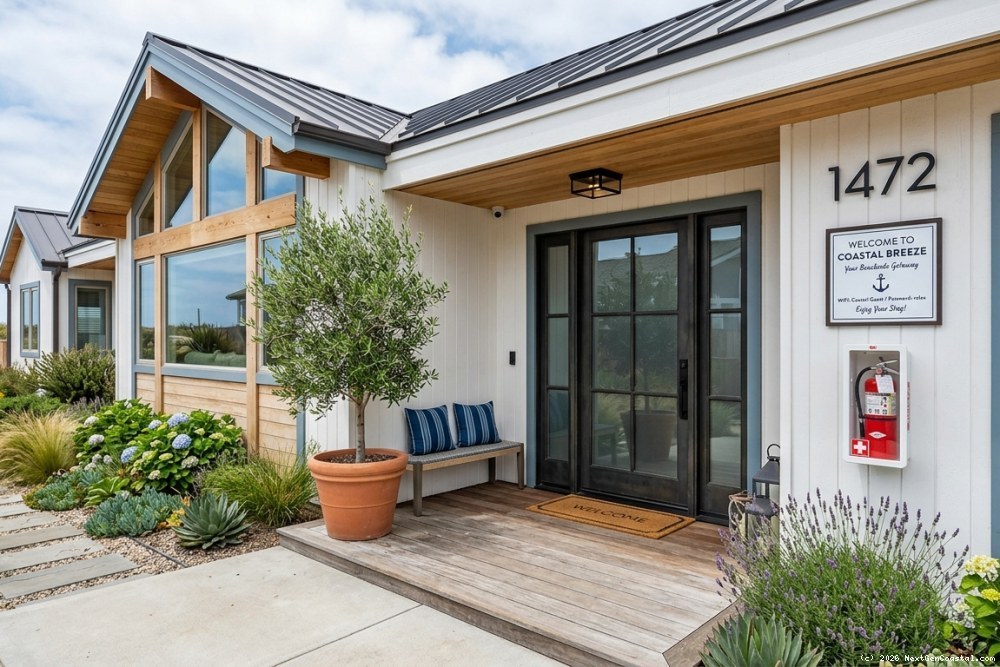
Applications route through the city's online portal, with processing times ranging from 45 to 60 days for complete submissions that include all required documentation. Incomplete packages trigger deficiency notices that restart the clock, so assemble the full set before filing.
Required Documentation Package
Every application must include the following:
- Grant deed or title report dated within 30 days, proving current ownership
- Primary residence verification: utility bills covering the preceding 12 months, California driver's license, vehicle registration, voter registration, all showing the property address
- Floor plan identifying every sleeping area, exit route, and fire-safety equipment location
- Parking plan demonstrating compliance with NBMC standards (two off-street spaces required for properties with three or more bedrooms)
- Signed good neighbor policy acknowledging noise, occupancy, and conduct standards
- Liability insurance certificate showing minimum $1 million coverage with the City of Newport Beach named as additional insured
- Transient Occupancy Tax registration certificate from the Finance Department
- Contact information for a local responsible party available 24/7 within 30 minutes of the property
Coastal Zone parcels require a coastal development permit application or exemption determination, typically extending approval timelines by 30 to 45 days due to Coastal Commission review protocols embedded in the Local Coastal Program.
Transient Occupancy Tax Registration
Before submitting the STR permit application, register with the Newport Beach Finance Department for TOT collection. The current rate is 13%, applied to all rental charges including cleaning fees and ancillary service charges, per NBMC Chapter 3.12. Remittance is due monthly by the 15th of the following month; failure to collect and remit TOT constitutes a violation and grounds for permit revocation.
The city cross-references STR permit holders with TOT filings regularly, flagging non-compliant operators for enforcement. Most operators use platforms like Airbnb and VRBO that collect and remit TOT automatically, but you remain legally responsible for accurate collection and timely remittance even when the platform handles the mechanics. Maintain independent transaction records and TOT documentation for audit purposes.
Operational Standards and Compliance Requirements
The ordinance imposes detailed operational standards designed to minimize neighborhood impact while maintaining public safety. These requirements apply throughout the permit term, with violations subject to escalating penalties under the schedule codified in NBMC 5.54.080.
Occupancy and Parking Limits
Two persons per bedroom plus two additional guests, hard-capped at 12 overnight occupants regardless of bedroom count.
View chart data
| Category | Max overnight guests |
|---|---|
| 1 BR | 4 |
| 2 BR | 6 |
| 3 BR | 8 |
| 4 BR | 10 |
| 5 BR | 12 |
| 6+ BR | 12 |
Day guests are capped at the overnight maximum plus four additional persons between 8:00 AM and 10:00 PM. Parking requirements mandate two off-street spaces for properties with three or more bedrooms, and NBMC 5.54.060(E) prohibits guest use of street parking, a provision added in response to neighborhood concerns about parking congestion in coastal areas during peak season.
"Parking restrictions appear among the most frequently cited provisions in STR ordinances, particularly during summer months when guests arrive with multiple vehicles. Include explicit language in rental agreements and pre-arrival communications stating that street parking is prohibited and may result in citations and permit violations."
Noise and Conduct Standards
Quiet hours run from 10:00 PM to 8:00 AM daily, during which noise audible beyond property boundaries constitutes a violation. The city applies a "plainly audible" standard rather than decibel measurements, if enforcement officers or neighbors can clearly hear the noise, you're in violation regardless of the technical sound level.
Outdoor amplified music is prohibited at all times. Events, parties, and gatherings exceeding the occupancy limit are forbidden, as are wedding receptions, corporate events, and similar commercial gatherings even if attendance remains within occupancy caps, STR permits authorize transient residential use, not event-venue operations.
Safety and Equipment Requirements
All properties must maintain the following:
- Working smoke detectors in every bedroom and on each floor, tested monthly with documentation retained
- Carbon monoxide detectors within 15 feet of all sleeping areas, per California Health and Safety Code § 13113.7
- Fire extinguisher (minimum 2A:10BC rating) on each floor, inspected annually
- Emergency exit diagrams posted in each bedroom showing primary and secondary egress routes
- Emergency contact information posted prominently: local responsible party, police non-emergency (949-644-3717), fire department
- First aid kit accessible to guests
Properties with pools or spas face additional requirements under California Health and Safety Code § 115920 et seq., including compliant barriers, self-closing gates, and anti-entrapment drain covers. Pool safety inspections are required every three years, with certificates provided to the city upon permit renewal.
Coastal Commission Requirements and Coastal Zone Considerations

If your parcel sits in Newport Beach's Coastal Zone, Balboa Peninsula, Balboa Island, Corona del Mar, West Newport, you operate under dual regulatory oversight from both the city and the California Coastal Commission. The Coastal Zone encompasses a significant portion of the city's STR inventory, and the added layer of review introduces both procedural complexity and substantive policy constraints.
Coastal Development Permit Requirements
Public Resources Code § 30600 requires a coastal development permit (CDP) for any development in the Coastal Zone unless a categorical exemption applies. The Coastal Commission has indicated that STR use may constitute a change in intensity of use requiring CDP review when the property has not been previously used for transient rental, the STR use increases density beyond previous residential intensity, or the property is located in an area where STR concentration may impact coastal access or housing availability.
Newport Beach's Local Coastal Program (LCP), certified by the Coastal Commission in 2017 and amended in 2024, provides streamlined CDP processing for STR permits meeting specific criteria. Properties qualifying for LCP streamlining may receive administrative CDP approval concurrent with the city STR permit, avoiding separate Coastal Commission hearings in many cases.
The Commission retains appellate jurisdiction over all Coastal Zone STR permits, however. Any interested party may appeal a city-approved permit to the Commission within 10 business days of city action, and the Commission may overturn city approvals if it finds the STR use inconsistent with Coastal Act policies, particularly regarding protection of lower-cost visitor accommodations and residential housing supply.
Coastal Act Policy Considerations
Coastal Commission review focuses on several key policy areas embedded in the Coastal Act:
Public Access
Under § 30210–30214, the Commission evaluates whether STR proliferation may reduce public coastal access by converting long-term housing to short-term use, potentially affecting the residential population that supports coastal access infrastructure and services.
Housing Supply
Under § 30213 and § 30604(f), STRs that remove housing from the long-term rental market face heightened scrutiny, particularly in areas with constrained housing supply. The Commission has expressed concern about STR programs' potential impacts on housing availability for lower-income households who support coastal communities.
Visitor-Serving Uses
Under § 30213 and § 30222, the Commission balances the benefit of STR visitor accommodations against the loss of long-term residential use. Properties previously used as long-term rentals may face more stringent review than owner-occupied homes occasionally rented short-term.
In practice, Coastal Zone properties may face longer approval timelines and more intensive scrutiny, particularly for non-hosted permits in areas with high STR concentration. Engage with the city's planning department early to assess Coastal Commission considerations before committing capital to property improvements or marketing expenditures.
Enforcement Mechanisms and Penalty Structure

The city employs a multi-tiered enforcement approach combining proactive monitoring, complaint response, and escalating penalties for violations. Monitoring methods include software that scans rental platform listings for unpermitted properties and cross-referencing permit holder compliance with operational standards.
Violation Categories and Penalties
Administrative fines escalate steeply within a 12-month window, a third violation triggers a $2,500 fine plus a 90-day permit suspension.
View chart data
| Category | Administrative fine |
|---|---|
| 1st Violation (warning) | Warning |
| 2nd Violation | Fine |
| 3rd Violation (+90-day suspension) | Fine + suspension |
| 4th Violation (revocation + 5-yr ban) | Revocation |
Two nuances worth flagging under NBMC 5.54.080: violations stay on the property record for 12 months, so a stale second offense still triggers third-tier penalties, and the five-year post-revocation reapplication ban runs with the property, not the owner, a sale does not reset it. Third-violation suspensions require canceling existing reservations and can expose operators to guest-compensation claims during the 90-day blackout.
Most Common Violations
Based on available city enforcement data, the most frequently cited violations include:
- Guest street parking in violation of the prohibition
- Occupancy limit exceedances detected through neighbor reports or inspections
- Noise complaints during quiet hours
- Operating without a valid permit or with an expired permit
- Failure to maintain local responsible party availability within the required 30-minute response window
- Inadequate safety equipment or expired inspection certificates
The city responds to neighbor complaints through its enforcement process, with code officers authorized to issue citations and require immediate compliance. After-hours enforcement for noise and occupancy violations routes through the Police Department.
Permit Renewal and Ongoing Compliance
STR permits are valid for one calendar year, expiring December 31st regardless of the initial issuance date. Renewal applications must be submitted between October 1st and November 30th, accompanied by the renewal fee.
Renewal Documentation
Renewal requires updated documentation demonstrating continued eligibility:
- Primary residence affidavit with supporting documentation covering the preceding 12 months
- Proof of current liability insurance meeting city requirements
- TOT compliance certification from the Finance Department
- Updated safety equipment inspection certificates
- Signed attestation of compliance with all permit conditions during the preceding permit term
Properties with substantiated violations during the permit term may face enhanced renewal scrutiny. Multiple violations may result in renewal denial even if fines were paid and correction periods satisfied, the city conducts discretionary review of renewal applications with violation histories, weighing factors like violation severity, correction timeliness, and demonstrated compliance improvements.
Transfer and Assignment Restrictions
STR permits are non-transferable. Property sale, ownership change, or transfer of management to a new operator requires a new permit application with full documentation and fee payment. The new owner receives no preferential processing and enters the standard application queue.
This creates significant due diligence requirements for buyers acquiring properties with existing STR permits, the permit expires upon title transfer, and the new owner receives no guarantee of permit approval. Purchase agreements should include contingencies for STR permit approval and address the risk of permit denial or waitlist placement for non-hosted permits if the citywide cap has been reached.
HOA Restrictions and CC&R Compliance
Many Newport Beach coastal properties operate under homeowners association governance, with CC&Rs (Covenants, Conditions & Restrictions) that may restrict or prohibit short-term rentals regardless of city permit approval. California Civil Code § 4740–4745 governs HOA rental restrictions, establishing the framework for enforceable limitations on transient use.
HOA Restriction Enforceability
HOAs may prohibit or restrict STRs through properly adopted CC&R amendments or operating rules. Under Civil Code § 4740, rental restrictions are enforceable if the restriction appears in recorded CC&Rs or properly adopted operating rules, the restriction is reasonable and applied uniformly, and the restriction does not violate public policy or fair housing laws.
Many Newport Beach HOAs have adopted STR restrictions in response to the city's permit program. Common HOA restrictions include:
- Outright STR bans, limiting rentals to 30-day minimum terms or longer
- Minimum rental periods such as seven-day minimums that effectively prohibit weekend rentals
- Caps on the number of units within the HOA that may operate as STRs at any given time
- Enhanced insurance or security deposit requirements for STR operators beyond city minimums
- Mandatory HOA approval before applying for city permits, creating a two-stage approval process
City STR permits do not override HOA restrictions, operators must comply with both city ordinances and HOA rules. Violating HOA rental restrictions can result in fines, injunctions, and enforcement actions by the HOA separate from city enforcement.
Due Diligence for HOA Properties
Before applying for a city STR permit, operators in HOA-governed properties should:
- Review recorded CC&Rs for rental restrictions, obtainable from the Orange County Recorder or the HOA management company
- Request current operating rules and regulations from the HOA board, as these may contain restrictions not present in the recorded CC&Rs
- Verify whether the HOA has adopted STR-specific policies since the city ordinance took effect in 2023
- Obtain written confirmation from the HOA that STR use is permitted, ideally reviewed by an attorney familiar with California HOA law
- Review recent HOA meeting minutes for discussions of STR restrictions or enforcement actions against other unit owners
- The restriction is contained in recorded CC&Rs or properly adopted operating rules
- The restriction is reasonable and applied uniformly
- The restriction does not violate public policy or fair housing laws
Some HOAs require pre-approval before owners may apply for city STR permits. Factor this additional approval layer into your timeline, HOA boards typically meet monthly and may require multiple meetings to review and approve STR applications, particularly if the HOA lacks established STR approval procedures.
Platform Listing and Compliance Tools
Major rental platforms including Airbnb, VRBO, and Booking.com have implemented compliance features to support Newport Beach ordinance requirements. Platform tools do not substitute for operator due diligence and direct compliance responsibility, however, you remain accountable for compliance regardless of platform features.
Permit Number Display Requirements
NBMC 5.54.070 requires all online listings to display the city-issued STR permit number prominently in the listing description, not buried in house rules or fine print. Platforms have implemented permit number fields in their listing interfaces, with some offering permit verification features that cross-reference city databases.
Listings without valid permit numbers are subject to takedown notices from the city, and operators who fail to display permit numbers face operating-without-a-permit violations. Compliance with permit display requirements is essential for maintaining active listings on all platforms.
Automated Compliance Features
Leverage platform features to automate compliance where possible:
- Occupancy limits: Set maximum guest counts in platform settings matching your permit limits, and disable instant booking for requests exceeding those limits
- Minimum stays: Configure minimum night requirements if your HOA or permit conditions require them
- House rules: Use platform house rules features to communicate parking, noise, and conduct requirements, and require guests to acknowledge rules before booking
- Automated messaging: Set up pre-arrival messages reiterating parking restrictions, quiet hours, and occupancy limits, and include local responsible party contact information
- TOT collection: Enable platform TOT collection features, but verify that rates match current city requirements rather than relying solely on platform defaults
Consider third-party property management software offering enhanced compliance features like automated messaging sequences, occupancy verification through smart lock access logs, and security monitoring. These tools provide documentation useful in demonstrating proactive compliance efforts if violations are alleged.
2026 Amendments and Recent Changes
The Newport Beach City Council adopted several STR ordinance amendments in late 2025, taking effect January 1, 2026. These changes reflect ongoing refinement of the regulatory framework based on implementation experience since the ordinance's 2023 adoption.
Key 2026 Changes
Non-Hosted Permit Cap Adjustment
The citywide cap on non-hosted permits was adjusted through the 2025 amendment process, with existing permit holders grandfathered under transition provisions. New applications now compete for the adjusted allocation.
Enhanced Primary Residence Verification
The city now requires more frequent primary residence attestations for non-hosted permit holders, submitted quarterly with supporting documentation rather than annually. This reflects heightened verification standards for demonstrating primary residence status in response to concerns about investment properties masquerading as primary residences.
Coastal Zone Density Considerations
New provisions address STR density in the Coastal Zone, reflecting Coastal Commission requirements incorporated into the LCP amendment. These provisions may affect new applications in areas with high STR concentration, though existing permits are grandfathered under transition provisions.
Good Neighbor Policy Requirements
The city now requires operators to provide guests with a good neighbor policy acknowledgment before check-in, not merely at booking. Operators must retain signed or electronically confirmed acknowledgments and produce them upon city request during inspections or violation investigations.
Increased Insurance Requirements
Minimum liability insurance increased to $1 million, with the City of Newport Beach named as additional insured. Policies must specifically cover short-term rental activity rather than general homeowner liability, as many standard homeowner policies exclude coverage for commercial rental use.
Best Practices for Compliant Operations
Successful Newport Beach STR operators implement systems and processes that exceed minimum compliance requirements, creating buffers against violations and building positive relationships with neighbors and city staff. In my experience advising operators in this market, compliance is not a one-time permit application hurdle but an ongoing operational discipline.
Proactive Compliance Strategies
Neighbor Relations
Introduce yourself to immediate neighbors before beginning STR operations. Provide your contact information and assure them you're committed to maintaining neighborhood quality. Consider hosting a brief neighborhood meeting to address concerns proactively and explain your operational standards, this investment in goodwill often prevents complaint-driven enforcement actions.
Guest Screening
Implement screening beyond platform identity verification. Require government ID upload, verify that the guest identity matches the booking name, and decline bookings that present elevated risk profiles. Consider minimum age requirements (typically 25 or older) and prohibit bookings where the guest is reserving for a third party rather than their own stay.
Pre-Arrival Communication
Send detailed pre-arrival messages 48 hours before check-in, reiterating parking restrictions, occupancy limits, quiet hours, and conduct expectations. Require guests to acknowledge receipt and understanding through platform messaging or a separate confirmation system. Follow up with additional communication for higher-risk bookings such as local guests or single-night stays.
Technology Integration
Consider technology solutions that support compliance monitoring and documentation. Smart locks can verify check-in and check-out times, creating a timestamped record of occupancy periods. Occupancy sensors can provide evidence of compliance with occupancy limits if violations are alleged. Security systems with cameras covering exterior areas (not interior spaces or areas where privacy is expected) can document compliance with parking and noise standards.
Local Responsible Party
Designate a reliable local responsible party who takes the role seriously, this person should live within 30 minutes of the property, be available 24/7 with authority to address compliance issues immediately, and be prepared to respond to neighbor concerns or city inquiries. Consider professional property management services if you cannot fulfill this requirement personally or through a trusted designee.
Documentation Systems
Maintain comprehensive records of all compliance activities: safety equipment inspections, guest acknowledgments of house rules, TOT remittances, primary residence documentation, and responses to any violations or complaints. Organize records digitally with cloud backup, making them readily accessible for city audits or renewal applications, in my observation, operators with organized documentation systems fare better in discretionary renewal reviews following violations.
Looking Ahead: Regulatory Trends and Future Considerations
Newport Beach's STR regulatory environment continues evolving as the city balances property rights, neighborhood preservation, and coastal access obligations. Operators should monitor several emerging trends that may shape future requirements over the next several years.
Potential Future Changes
The Coastal Commission has indicated ongoing interest in STR regulation within coastal jurisdictions statewide, with potential implications for local policies. The Commission's 2024 guidance documents on STR regulation in the coastal zone reflect evolving perspectives on balancing visitor accommodations with housing supply and coastal access considerations, Newport Beach's ordinance may face additional amendments to align with Commission expectations.
State legislation continues addressing STR regulation at the macro level. Recent legislation requires cities to report STR data to state agencies, creating statewide tracking of STR impacts on housing markets. Future legislation may establish additional standards or guidance for local STR regulation, potentially preempting certain local provisions or establishing statewide minimum standards.
Technology-driven enforcement is expanding in many jurisdictions as software platforms improve their ability to identify unpermitted listings and verify permit compliance. Newport Beach may implement enhanced monitoring capabilities that enable more efficient compliance verification and violation detection, reducing the city's reliance on complaint-driven enforcement.
Insurance requirements may continue evolving as carriers reassess STR risk profiles and adjust coverage offerings. Operators should review coverage annually and maintain relationships with multiple carriers to ensure continuous compliance with city insurance requirements if a carrier exits the STR market or substantially increases premiums.
Conclusion: Compliance as Competitive Advantage
Newport Beach's STR regulatory framework reflects the city's commitment to balancing property rights with neighborhood preservation and coastal resource protection. For operators willing to invest in compliance systems and proactive management, the ordinance creates a stable operating environment with clear expectations and predictable enforcement.
The permit requirement and operational standards create barriers to entry that reduce competition from operators unwilling to meet compliance obligations, in that sense, regulation functions as a competitive moat for professional operators. Those who exceed minimum requirements, maintain positive neighbor relations, and implement solid guest management systems can build sustainable STR businesses in one of California's most desirable coastal markets.
What the data suggests over the cycle: the operators who thrive in Newport Beach's regulated environment are those who view the ordinance not as a constraint but as a framework for professional, sustainable short-term rental operations that serve the interests of property owners, guests, and the community simultaneously. Treat compliance as an ongoing operational priority rather than a one-time permit application hurdle, and you position yourself to succeed in this market over the ten-year arc.
- The property has not been previously used for transient rental purposes
- The STR use increases density or intensity beyond previous residential use
- The property is located in an area where STR concentration may impact coastal access or housing availability
- Review recorded CC&Rs for rental restrictions, obtainable from the Orange County Recorder or the HOA management company
- Request current operating rules and regulations from the HOA board
- Verify whether the HOA has adopted STR-specific policies since the city ordinance took effect
- Obtain written confirmation from the HOA that STR use is permitted, ideally reviewed by an attorney familiar with HOA law
- Review recent HOA meeting minutes for discussions of STR restrictions or enforcement actions
Frequently Asked Questions
What's the difference between hosted and non-hosted STR permits in Newport Beach?
Do I need a coastal development permit for my Newport Beach STR?
What are the penalties for operating an STR without a permit in Newport Beach?
Can my HOA prohibit short-term rentals even if I have a city permit?
What's the current TOT rate for Newport Beach short-term rentals?
How many guests can stay at my Newport Beach STR property?