
Ordinance Overview: What Changed and Why It Matters
Manhattan Beach Municipal Code Chapter 10.48 took effect January 1, 2024, following amendments enacted in late 2023. The ordinance prohibits short-term rentals, defined as any residential occupancy under 30 consecutive days, across all R-1 (single-family residential) zoning districts. The city council framed the prohibition as necessary to preserve neighborhood character and address resident complaints regarding noise, parking, and the erosion of owner-occupied community fabric along historically stable beach blocks.
The immediate consequence for investors: a substantial portion of Manhattan Beach's residential inventory, including most oceanfront and ocean-view single-family homes, lost STR eligibility. Properties that previously generated STR revenue must convert to long-term leases or pursue the ordinance's narrow mixed-use exception. No grandfathering applied; all non-conforming STR operations were required to cease by March 31, 2024, with no amortization window.
Manhattan Beach now aligns with Hermosa Beach and Redondo Beach, both of which enacted R-1 STR prohibitions between 2022 and 2023. The difference: Manhattan Beach's mixed-use carve-out, though limited, provides a compliance pathway absent in neighboring cities. This creates a bifurcated investment thesis for coastal luxury buyers.
R-1 Prohibition Mechanics: Zoning, Enforcement, and Penalties
The R-1 prohibition functions as a use restriction, not a property-type ban. Any parcel zoned R-1 under the General Plan is ineligible for short-term rental licensing, without regard to architectural configuration, historical use, or proximity to commercial corridors. The city's zoning map designates R-1 districts across the Sand Section, Tree Section, Hill Section, and inland residential neighborhoods; the designation covers single-family detached homes, duplexes on R-1 lots, and accessory dwelling units (ADUs) on R-1 parcels.
Enforcement began as complaint-driven but has become increasingly proactive. The city contracts with Host Compliance (now Granicus STR) to monitor Airbnb, Vrbo, and Booking.com listings, cross-referencing active postings against the municipal TOT registry. Properties identified as operating without a valid STR permit in a prohibited zone receive a notice of violation with a 10-day cure period. Failure to delist the property triggers administrative citations with escalating penalties. Since the ordinance took effect, the city has issued citations, with some cases escalated to criminal misdemeanor prosecution for repeat violators.
The ordinance imposes joint and several liability on property owners and listing platforms. Airbnb and Vrbo must verify that each Manhattan Beach listing holds a valid city-issued STR permit and TOT certificate before accepting a booking. Platforms face penalties for facilitating unpermitted rentals, a provision that has driven near-total delisting compliance in R-1 zones.
The Mixed-Use Exception: Eligibility Criteria and Permit Process
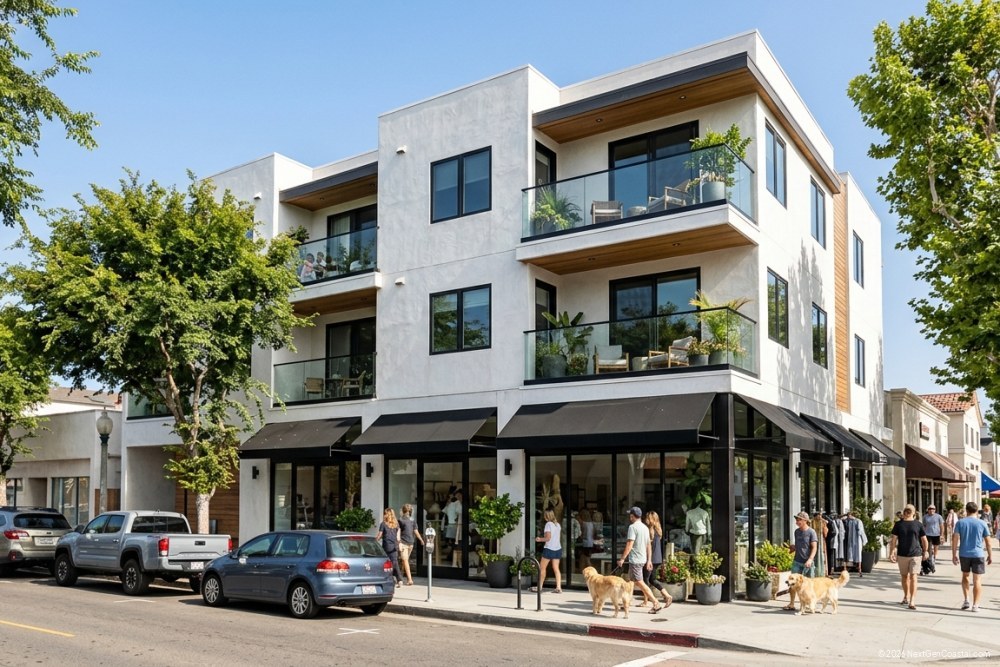
Properties located in C-1 (neighborhood commercial), C-2 (general commercial), and MU (mixed-use overlay) zoning districts retain STR eligibility under the ordinance, provided the property meets four cumulative criteria:
- Zoning compliance: The parcel must carry a legal C-1, C-2, or MU designation on the city's official zoning map. Properties in R-1 zones adjacent to commercial corridors do not qualify, even if they front a commercial street.
- Conditional-use permit (CUP): The owner must obtain a CUP from the Planning Commission. The application requires demonstration that the STR use will not adversely affect surrounding properties, parking availability, or neighborhood character. Submission requirements include a site plan, parking analysis, noise mitigation plan, and neighbor notification within 300 feet.
- TOT registration: The property must be registered with the city's Transient Occupancy Tax program. Registration requires proof of liability insurance, a local contact available 24/7, and annual renewal.
- Occupancy caps: STR occupancy is limited to two persons per bedroom plus two additional, with a hard cap of 10 occupants regardless of bedroom count. Parking must be provided at a ratio of one space per bedroom, either on-site or via a recorded off-site parking agreement.
The CUP process is discretionary. The Planning Commission evaluates each application on its merits, considering proximity to residential uses, historical complaints, parking adequacy, and cumulative STR density in the surrounding block. Approval is not guaranteed; according to city records, a portion of CUP applications have been denied since 2024, primarily for properties in MU zones abutting R-1 districts where commissioners found insufficient buffering from single-family neighbors.
Processing time averages 90 to 120 days from application to final decision, with an additional 21-day appeal period. For investors, the all-in cost to establish a compliant mixed-use STR operation is substantial in year one, with ongoing annual costs thereafter.
Mixed-Use Inventory Analysis: Where the Opportunities Remain
Manhattan Beach's mixed-use and commercial zoning districts concentrate in three corridors: downtown Manhattan Beach (Manhattan Beach Boulevard from Valley Drive to the Strand), the Rosecrans Avenue commercial strip (Rosecrans from Aviation Boulevard to Sepulveda Boulevard), and the Highland Avenue mixed-use node (Highland from 8th Street to 15th Street). These districts contain residential components (condos above retail, live-work lofts, townhomes in mixed-use projects), of which a portion currently hold active STR permits.
Inventory characteristics skew toward smaller, higher-density product. The majority are one- or two-bedroom units, with a smaller percentage of three-bedroom townhomes and detached single-family homes on commercially zoned lots. Median acquisition cost for STR-eligible mixed-use properties varies by unit type and location, sitting significantly below the median for R-1 beachfront single-family homes.
The most liquid STR-eligible inventory sits in the downtown core, where mixed-use projects built between 2008 and 2019 offer condo and townhome units with STR provisions. These properties reflect a premium over comparable non-STR-eligible condos in adjacent R-1 zones, a premium that reflects the value of the STR entitlement.
The mixed-use STR market in Manhattan Beach is not a substitute for the lost R-1 beachfront opportunity. It's a different asset class entirely, with lower absolute revenue but tighter operational efficiency and a more defensible regulatory position.
ROI Comparison: Mixed-Use STR vs. Long-Term Luxury Lease
Despite higher gross income, compliant STRs deliver only marginally better NOI than long-term leases due to elevated operating costs.
View chart data
| Category | Annual Net Operating Income |
|---|---|
| Mixed-Use STR (Low) | $40k |
| Mixed-Use STR (High) | $56k |
| Long-Term Lease (Low) | $48k |
| Long-Term Lease (High) | $55k |
For investors evaluating the mixed-use STR pathway, the ROI calculus turns on three variables: gross rental yield, operating expense ratio, and regulatory risk premium. Consider a representative two-bedroom, two-bath mixed-use condo in downtown Manhattan Beach, 0.4 miles from the beach.
Scenario A: Compliant Mixed-Use STR
Gross rental income runs approximately $110,000 to $135,000 annually at 65–75% occupancy and an average daily rate (ADR) in the range typical for this product type. Peak summer months (June through August) typically drive higher ADRs; shoulder and winter months (September through May) average lower rates.
Operating expenses include TOT remittance, platform fees, property management (full-service STR management typically takes a meaningful percentage of gross income), utilities, HOA dues, insurance for STR-specific coverage, maintenance and turnover, and permit/registration fees. Total operating expense ratio runs approximately 58 to 64% of gross income.
Net operating income (NOI) falls in the range of $40,000 to $56,000. Levered returns may improve: at 60% LTV, cash-on-cash return could rise after debt service.
Scenario B: Long-Term Luxury Lease
Market rent for the same two-bedroom unit runs approximately $5,800 to $6,400 per month, or $69,600 to $76,800 annually.
Operating expenses are lower: no TOT, no platform fees, no turnover costs. Property management and maintenance costs are typically lower for long-term occupancy. Total operating expense ratio runs approximately 28 to 32% of gross income.
Net operating income falls in the range of $48,000 to $55,000, yielding a cash-on-cash return all-cash, or improved returns levered at 60% LTV. Long-term leases carry zero regulatory risk, no CUP renewal uncertainty, and significantly lower operational complexity.
The comparison between STR and long-term lease NOI is narrower than many investors expect. The advantage can shift depending on occupancy rates and regulatory changes. For risk-adjusted returns, the long-term lease often performs competitively, particularly when factoring in the investor's time cost for STR oversight and the tail risk of future ordinance amendments.
The Beachfront Pivot: Long-Term Luxury Leasing in R-1 Zones
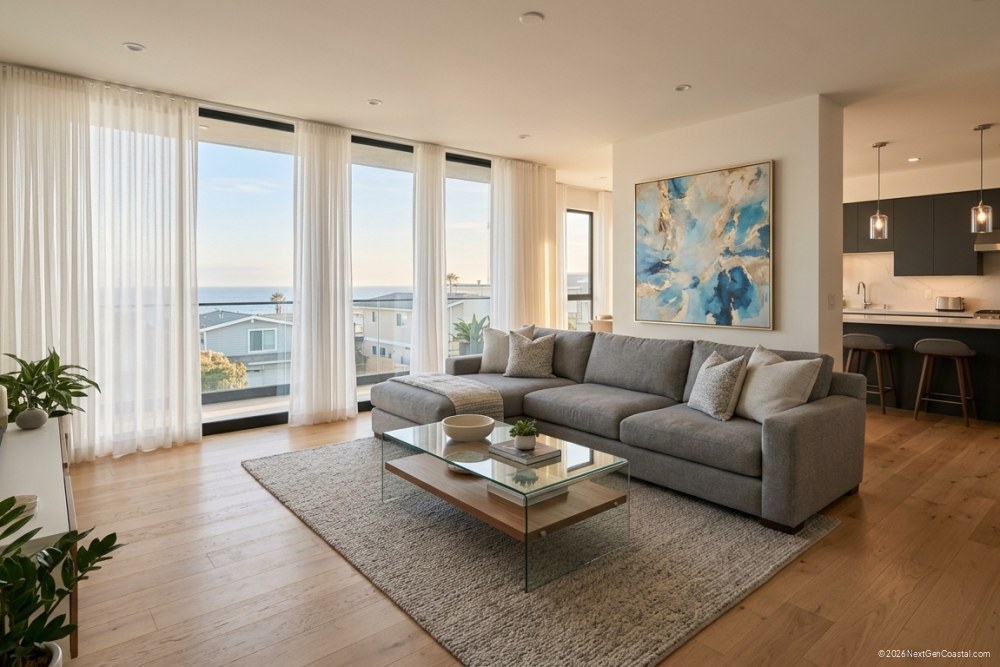
For investors holding R-1 beachfront assets (the high-value single-family homes that once anchored Manhattan Beach's STR market), the ordinance forces a wholesale strategy pivot. The long-term luxury lease market has absorbed much of this displaced inventory, with properties converting to annual leases since January 2024. Rental performance has been strong: beachfront homes in the Sand Section and ocean-view properties in the Hill Section command competitive monthly rates.
Tenant demand is bifurcated. A significant portion of luxury long-term tenants are corporate relocations (entertainment executives, tech professionals, finance managers) on 12- to 24-month assignments with employer-paid rent. The remaining portion are high-net-worth individuals seeking a trial period before purchasing, often families relocating from out of state who want to experience the Manhattan Beach school district and beach lifestyle before committing to a purchase.
Lease terms are typically investor-favorable: 12-month minimum, first and last month plus security deposit (typically one month's rent), annual escalations, and tenant responsibility for all utilities and routine maintenance. Vacancy risk is generally low for luxury beachfront properties, and tenant retention is typically strong. For investors, the trade-off is clear: lower gross income than STR operations, but dramatically lower operating expenses, zero regulatory risk, and stable, predictable cash flow.
The cap rate environment for R-1 luxury rentals has been affected by the STR prohibition. Properties that previously traded at higher cap rates (when STR income was capitalized into value) now transact at lower cap rates on long-term lease income, reflecting buyer confidence in the durability of luxury tenant demand and the relative safety of the regulatory environment post-ordinance.
Legal Workarounds and Gray-Area Strategies: What to Avoid
In the wake of the R-1 prohibition, a predictable set of quasi-compliant and non-compliant workarounds has emerged. Investors should understand these strategies and why they fail legal and practical scrutiny.
The 30-Day Minimum Workaround
Some owners attempt to circumvent the STR definition by imposing a 30-day minimum stay, arguing that rentals of 30 days or longer fall outside the ordinance's scope. This strategy is legally sound in theory (rentals of 30 days or longer are not classified as STRs under Chapter 10.48) but practically unworkable in Manhattan Beach's luxury market. Demand for 30-day-plus vacation rentals is limited; most visitors seek shorter stays. The few tenants willing to commit to 30-day terms typically expect discounts relative to nightly rates, eroding gross income to levels comparable to (or below) long-term annual leases. Additionally, 30-day rentals still trigger TOT obligations and require a business license, eliminating much of the administrative simplicity owners hope to achieve.
The ADU Conversion Play
Another strategy involves converting a detached garage or building a new ADU on an R-1 lot, then attempting to lease the ADU short-term while the primary residence remains owner-occupied or long-term leased. The theory: ADUs are a distinct property type and might qualify for different treatment under the ordinance. Chapter 10.48 applies to all residential uses on R-1 parcels, including ADUs. The city has confirmed that ADUs on R-1 lots are ineligible for STR permits, regardless of whether the primary dwelling is owner-occupied. Owners who pursued this strategy have received cease-and-desist orders.
The Multi-LLC Listing Strategy
A more aggressive (and clearly non-compliant) approach involves creating multiple LLCs, each listing the same property under a different entity name and rotating listings across platforms to evade monitoring. This strategy is both illegal and easily detected. The city's monitoring software flags properties by address, not entity name, and cross-references parcel numbers against the TOT registry. Owners caught using this tactic face serious legal consequences and risk having their properties placed on a permanent STR blacklist that prevents future permit eligibility even if the property is later rezoned or sold.
There are no viable gray-area workarounds. The ordinance is tightly drafted, enforcement is robust, and the penalties for non-compliance far exceed any incremental revenue an owner might capture through evasion.
Acquisition Strategy: Targeting Mixed-Use STR-Eligible Inventory
For investors committed to maintaining a Manhattan Beach STR position, the acquisition strategy must focus exclusively on CUP-eligible mixed-use inventory. The due diligence checklist is more complex than a standard residential purchase:
- Zoning verification: Obtain a zoning confirmation letter from the city planning department confirming the parcel's C-1, C-2, or MU designation. Do not rely on the seller's representation or the MLS listing; zoning errors are common, and a property marketed as "STR-eligible" may in fact sit in an R-1 zone with a commercial overlay that does not confer STR rights.
- HOA STR policy: If the property is part of a condominium or townhome project, review the CC&Rs and HOA bylaws to confirm that short-term rentals are permitted. Some mixed-use projects have enacted internal STR bans even though the underlying zoning allows it. Obtain written confirmation from the HOA board that STRs are allowed and that no pending rule changes are under consideration.
- Existing CUP status: If the property currently operates as an STR, verify that the CUP is active, in good standing, and transferable to a new owner. Some CUPs are issued to the individual operator, not the property, and do not automatically transfer upon sale. Budget for a new CUP application if transfer is not guaranteed.
- Parking compliance: Confirm that the property meets the one-space-per-bedroom parking requirement. Many older mixed-use buildings provide limited parking per unit, which may be insufficient for a three-bedroom STR. If on-site parking is deficient, investigate whether the seller has a recorded off-site parking agreement that can be assigned to the buyer.
- Neighbor relations: Interview adjacent property owners and review the property's complaint history with the city's code enforcement division. A property with a history of complaints or neighbor disputes will face heightened scrutiny during CUP renewal and may be denied even if it meets all technical criteria.
Acquisition pricing for STR-eligible mixed-use properties should reflect a reasonable premium over comparable non-STR-eligible units, but investors should be cautious of overvaluation. Sellers often overvalue the STR entitlement, pricing properties as if the CUP were a permanent, risk-free asset. In reality, CUPs are subject to annual review, can be revoked for cause, and carry ongoing compliance costs. A disciplined buyer underwrites the property on long-term lease fundamentals first, then layers in STR upside as a call option, not a base case.

Regulatory Outlook: What Comes Next for Manhattan Beach STRs
The January 2024 ordinance is unlikely to be the final word. City council discussions have indicated interest in monitoring STR activity in mixed-use zones and evaluating whether additional restrictions may be warranted. Specific concerns raised by council members include cumulative density (the risk of entire mixed-use buildings converting to de facto hotels), parking spillover into adjacent R-1 neighborhoods, and whether the CUP process is sufficiently rigorous to protect residential character.
Several potential amendments have been discussed informally:
- Density caps: Limiting the number of STR permits per block or per mixed-use project, similar to approaches taken by other California coastal cities. Such caps could affect existing operators when their CUPs come up for renewal.
- Owner-occupancy requirement: Requiring that STR operators maintain their primary residence in Manhattan Beach, a rule designed to exclude out-of-area investors. This would mirror amendments in other coastal communities and would effectively limit institutional and out-of-state capital from the market.
- Minimum stay requirement: Imposing a citywide minimum stay requirement, even in mixed-use zones, to reduce turnover frequency and transient impacts. This would compress gross income and potentially make some STR operations economically unviable.
None of these amendments has been formally proposed, and any change would require a public hearing process with appropriate notice. However, the political momentum appears to be toward further restriction rather than liberalization. Investors should assume that the mixed-use STR environment may become more restrictive over the cycle and underwrite accordingly.
The Investor Thesis: When Manhattan Beach STRs Still Make Sense
Given the regulatory headwinds, compressed ROI, and operational complexity, when does a Manhattan Beach STR investment still pencil? The thesis is narrow but defensible for three investor profiles.
Profile 1: The portfolio diversifier. An investor with a concentrated long-term rental portfolio in inland Southern California who wants coastal exposure and is willing to accept lower cash-on-cash returns in exchange for geographic and asset-class diversification. The mixed-use STR serves as a hedge against inland market softness and provides optionality to convert to long-term lease if STR economics deteriorate further.
Profile 2: The personal-use investor. A high-net-worth individual who wants a Manhattan Beach pied-à-terre for personal use 30 to 60 days per year and is willing to STR the property during non-use periods to offset carrying costs. The investment is lifestyle-driven, not return-driven, and the STR income is a bonus, not the primary rationale.
Profile 3: The regulatory arbitrage player. A sophisticated operator who believes the mixed-use CUP pathway may face further restrictions and is willing to acquire now, operate actively for a defined period, then exit to a long-term lease buyer or personal-use owner. This is a short-duration, high-touch strategy that requires active management and a clear exit plan.
For all other investors (those seeking stable, passive income; those with limited operational bandwidth; those underwriting 7-plus year hold periods), the long-term luxury lease is the superior strategy. The risk-adjusted returns are comparable, the regulatory risk is zero, and the operational simplicity is an order of magnitude better.
Implementation: Building a Compliant Manhattan Beach STR Operation
For investors who proceed with a mixed-use STR acquisition, operational excellence is non-negotiable. The margin for error is thin, and a single code violation can trigger CUP revocation. The compliance checklist:
- Engage a local STR management firm with Manhattan Beach-specific experience. Generic vacation rental managers lack the municipal knowledge required to handle CUP conditions, TOT reporting, and neighbor relations. Expect to pay a significant percentage of gross income for full-service property management, but the investment is essential.
- Install a noise monitoring system (Minut, NoiseAware) that alerts the manager in real time if decibel levels exceed thresholds. Noise complaints are the leading cause of CUP non-renewal; proactive monitoring prevents violations before they occur.
- Maintain a 24/7 local contact who can respond to neighbor concerns or city inquiries within 30 minutes. The ordinance requires a local contact within 10 miles of the property; many operators use a dedicated property manager or a local answering service.
- Over-communicate with neighbors. Provide adjacent property owners with the local contact number, explain the CUP conditions, and proactively address any concerns. A single vocal opponent can derail a CUP renewal; building goodwill is a strategic investment.
- Document everything. Maintain meticulous records of TOT remittances, guest registrations, parking compliance, noise monitoring logs, and neighbor communications. The city can request these records during annual CUP review, and incomplete documentation is grounds for non-renewal.
The operational intensity is real. Manhattan Beach STRs are not a passive investment; they require active, professional management and constant regulatory vigilance. Investors who underestimate this reality are the ones who end up with revoked CUPs and stranded capital.
Conclusion: The Ten-Year Arc for Manhattan Beach Coastal Rentals
Manhattan Beach's STR ordinance has fundamentally reordered the coastal luxury investment thesis. The R-1 prohibition eliminated the highest-revenue, highest-visibility segment of the market, while the mixed-use exception preserved a narrow, operationally complex pathway for investors willing to work through CUP requirements and accept compressed returns. For most investors, the long-term luxury lease is now the dominant strategy, delivering comparable NOI, zero regulatory risk, and dramatically lower operational overhead.
The investors who succeed in this environment are those who underwrite conservatively, operate meticulously, and maintain the flexibility to pivot as the regulatory environment continues to evolve. The Manhattan Beach STR opportunity is not dead, but it is no longer the straightforward, high-yield play it was in 2019 through 2022. It is a niche strategy for sophisticated operators with local expertise, strong neighbor relations, and a clear-eyed view of the risks. For everyone else, the message is simple: focus on long-term luxury leasing, capture the stable income, and let the regulatory risk sit with someone else.
Frequently Asked Questions
Can I still operate a short-term rental in Manhattan Beach if my property is in an R-1 zone?
What properties are still eligible for short-term rental permits in Manhattan Beach?
How does the ROI of a compliant mixed-use STR compare to a long-term luxury lease in Manhattan Beach?
What is the conditional-use permit (CUP) process for Manhattan Beach STRs, and how long does it take?
Are there any legal workarounds to operate an STR in an R-1 zone in Manhattan Beach?