
Why Coastal STR Rules Are Stricter Than Inland

When the legislature passed the California Coastal Act in 1976, it vested the Coastal Commission with land-use authority over a zone extending roughly one thousand yards inland from mean high tide, though the boundary varies by municipality. Cities within this zone adopted Local Coastal Programs that the Commission certifies, and any STR ordinance those cities enact must align with the certified LCP. If a city attempts to amend its STR rules in a way that conflicts with the LCP, the change can be appealed to the Commission, which has the power to overturn it.
What this means in practice:
- A city cannot impose an outright STR ban in the coastal zone unless the LCP supports it; the Commission has reversed several attempted prohibitions.
- Regulations such as permit caps, night limits, and owner-occupancy requirements generally survive Commission review.
- Cities that have not yet secured a certified LCP operate under direct Commission oversight for any ordinance change touching short-term rentals.
"The same Airbnb listing strategy that works in Newport Beach can be illegal in Santa Monica, capped at 90 nights in San Diego, and prohibited entirely in Carmel."
Orange County Coast

Newport Beach
The city issues a fixed number of permits and maintains an active waitlist; owner-occupancy is not required, but the scarcity of permits makes new entry difficult. Certain neighborhoods impose a thirty-day minimum stay, while others permit shorter rentals under the permit regime. Transient occupancy tax runs at the county base rate. The ordinance prohibits STR use of accessory dwelling units and junior accessory dwelling units outright. We cover the permit application sequence and neighborhood carve-outs in our detailed Newport Beach STR guide.
Laguna Beach
Permit supply is constrained, and the ordinance varies block by block. The Coastal Commission has pushed back on prior attempts to tighten restrictions, and the city enforces aggressively even though owner-occupancy is not formally required. Before you underwrite a property here, verify that the specific single-family zone allows short-term rentals; not all do.
Huntington Beach
Most coastal zones permit STRs with a city-issued license, and owner-occupancy is not mandatory. The regulatory environment is less restrictive than Newport or Laguna, though you still remit the standard transient tax and comply with the permit process.
Dana Point
The ordinance has been revised multiple times since 2020, and the Commission has shaped several of those amendments. Expect the rules to continue evolving. A permit is required, and the transient tax applies at the county base rate.
Los Angeles County Coast

Santa Monica
The city permits hosted STRs only, meaning you must remain on the property during the guest's stay; this effectively eliminates whole-house rentals within city limits. You need a Home-Sharing License to operate, and the transient occupancy tax reaches 14%, one of the highest rates on the coast. Our detailed Santa Monica licensing guide walks through the documentation the city requires to verify primary residence.
Malibu
Permits are available but supply is limited, and the city enforces the ordinance rigorously. Owner-occupancy is not a formal requirement, though the Coastal Commission's heavy jurisdiction over the Local Coastal Program governs most changes to the rules. The transient tax is 12%.
Manhattan Beach
Single-family residential zones (R-1) prohibit STRs entirely. The ordinance allows them in select multi-family and mixed-use zones with a permit, and in those areas owner-occupancy is not required.
Hermosa Beach / Redondo Beach
Both cities issue permits but impose restrictions. Hermosa requires either owner-occupancy or a principal-residence designation; Redondo is more permissive but caps the number of licenses it will issue.
Venice / City of LA
The City of Los Angeles Home-Sharing Ordinance imposes a primary-residence requirement and caps unhosted rentals at 120 nights per year; you can lift the cap by obtaining an extended-home-sharing permit. The transient tax is 14%.
San Diego County Coast
San Diego's 4-tier STR ordinance allocates whole-home permits at 1% of housing stock citywide (Tier 3) plus a Mission Beach-specific 30% cap (Tier 4). Tier 1 (part-time, <20 days) is unlimited.
View chart data
| Category | Approximate Distribution |
|---|---|
| Tier 1: Part-Time (<20d) | 40% |
| Tier 2: Primary Residence | 30% |
| Tier 3: Whole-Home (1% cap) | 20% |
| Tier 4: Mission Beach (30%) | 10% |
Ordinance 21156 established a four-tier licensing structure that varies by property type and use intensity:

San Diego
- Tier 1: Part-time STR, fewer than twenty days per year, permitted at any property you own.
- Tier 2: Whole-home STR at your primary residence; you must occupy the property the remainder of the year.
- Tier 3: Whole-home STR at a non-primary residence, subject to a cap of one percent of the city's housing units and allocated by lottery.
- Tier 4: Whole-home STR in Mission Beach, capped at thirty percent of neighborhood housing stock.
The citywide transient occupancy tax is 10.5%. If you are evaluating a junior accessory dwelling unit for STR use in the coastal zone, consult our San Diego JADU + CCC guide, which addresses the intersection of JADU permits and Coastal Commission review.
Oceanside
A permit is required. The ordinance explicitly prohibits STR use of ADUs and JADUs permitted on or after September 9, 2017. The transient tax matches the county base rate.
Carlsbad / Encinitas / Solana Beach / Del Mar
Each municipality maintains its own ordinance. Carlsbad issues permits under a relatively permissive framework; Del Mar is restrictive; Encinitas requires both a permit and transient-tax registration. Verify the rules property by property before you model cash flow.
Central Coast: Santa Barbara to Big Sur
Santa Barbara
STRs are severely limited in single-family residential zones and allowed only in select commercial and mixed-use districts. The city strongly favors owner-occupancy where rentals are permitted.
Carmel-by-the-Sea
Short-term rentals are prohibited. The minimum rental period is thirty days, and the city enforces the rule strictly.
Big Sur (Monterey County unincorporated)
The Local Coastal Program largely prohibits STRs, and the Coastal Commission has actively defended that prohibition on appeal. Consider the market effectively closed.
Pismo Beach / Morro Bay / Cayucos
These cities allow STRs with a permit, charge a transient tax in the ten-to-twelve-percent range, and do not require owner-occupancy. The regulatory environment is more permissive than the Carmel cluster.
San Francisco Bay Coast
San Francisco
The ordinance requires primary residence, caps unhosted rentals at ninety nights per year, and permits unlimited hosted rentals. You must register with the city. The transient tax is 14%.
Half Moon Bay / Pacifica
Both cities allow STRs with a permit, and both operate under Coastal Commission jurisdiction; the Local Coastal Program governs any ordinance amendments.
TOT Rates Summary
TOT, California's hotel tax, applies to rentals under 30 days. Rates set by city. Santa Monica, City of LA, and SF top the coast at 14%; Newport Beach and Huntington Beach are at 10%.
View chart data
| Category | TOT Rate (%) |
|---|---|
| Newport Beach | 10% |
| Huntington Bch | 10% |
| San Diego | 11% |
| Malibu | 12% |
| Santa Monica | 14% |
| Los Angeles | 14% |
| San Francisco | 14% |
| City | TOT Rate | Notes |
|---|---|---|
| Santa Monica | 14% | Hosted only |
| City of LA / SF | 14% | Primary-residence |
| Malibu | 12% | Constrained supply |
| Newport Beach | 10% | Permit required, neighborhood-restricted |
| San Diego | 10.5% | Tiered system |
| Oceanside / Carlsbad / Huntington Beach | 10% | Permit required |
Enforcement Realities
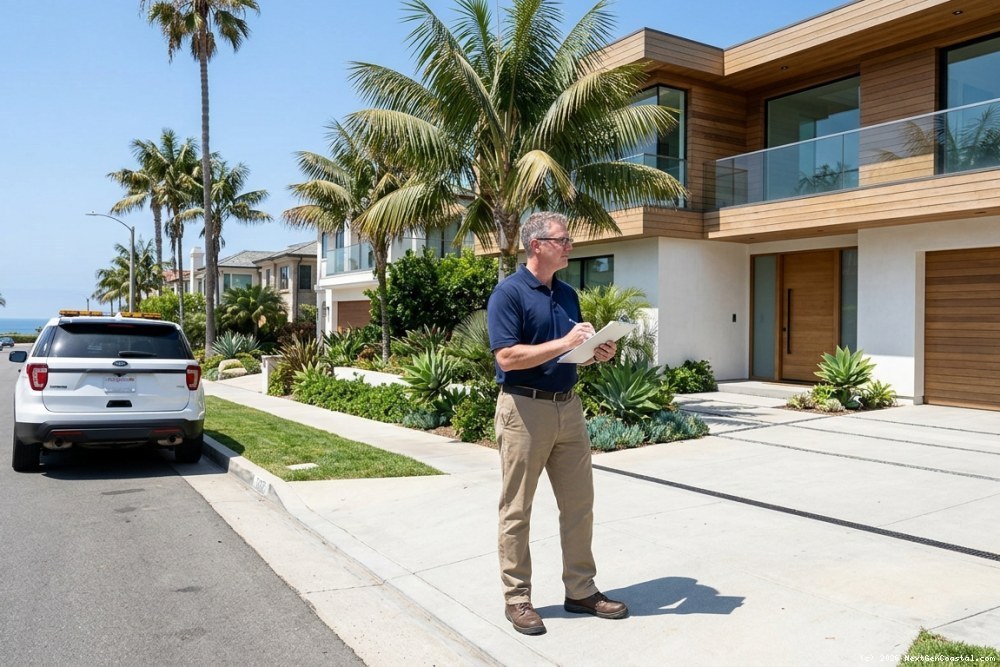
Coastal municipalities have contracted with third-party vendors such as Host Compliance and Granicus to scrape Airbnb and VRBO listings and cross-reference them against the city's permit database in near-real time. Penalties for operating without a permit start at $1,000 for a first violation and escalate to $10,000 or more per night for repeat offenders, according to the municipal codes we have reviewed in Newport Beach, Santa Monica, and San Diego. The business case for running an unpermitted STR has collapsed over the past three years; build compliance cost into your underwriting from the start, or accept that the city will eventually find you and the fine will exceed any revenue you captured in the interim.
Frequently Asked Questions
Can I run a short-term rental anywhere on the California coast?
Does the California Coastal Commission regulate STRs directly?
What is TOT and who collects it?
Can I run an STR in my ADU on the coast?
What’s the penalty for running an unpermitted coastal STR?