The Legal Framework: California Civil Code and CC&R Authority
Homeowners associations in California derive their regulatory power from covenants, conditions, and restrictions recorded against title. Two Civil Code provisions structure that authority. Section 4740 allows the board to adopt operating rules by resolution, applicable to all members without a membership vote. Section 4350 governs amendments to the CC&Rs themselves, which typically require a membership vote and supermajority approval. The line matters: the board can regulate nuisances or parking by rule, but a substantive use restriction (an outright rental ban, for example) almost always requires a formal amendment adopted by the owners.
Interactive Tool
HOA Rental Restriction Impact Calculator
Estimate the financial impact of a rental ban or restriction on your Orange County property

Gross monthly rent collected from tenant
How many more years do you plan to own the property?
Complete loss of rental income.
Typical range: $25,000–$75,000 for litigation through trial
 Built by NextGen Coastal
Between 2018 and 2023, a wave of rental-restriction amendments swept Orange County's coastal communities. Owner-occupants, reacting to the short-term rental boom and what they perceived as erosion of neighborhood character, pressed boards to tighten use rules. Newport Beach's Balboa Peninsula saw several associations adopt 30-day minimum lease terms to shut out vacation rentals. In Laguna Beach's hillside neighborhoods, some HOAs went further, recording outright rental bans or caps that limit rentals to a fixed percentage of units.
Three factors determine whether these restrictions hold up in court. First, did the association follow the correct adoption procedure (notice, quorum, vote threshold)? Second, is the restriction's language clear and unambiguous? Third, does the restriction violate public policy? Courts have upheld bans that meet procedural requirements, but landlords win when they can demonstrate defective notice, improper vote counts, or failure to achieve the required supermajority.
Grandfathering and Vested Rights
Renting your property before the HOA recorded a rental ban does not automatically grant you a perpetual right to continue, but it may give you a grandfathered window. Civil Code § 4740(b) prohibits enforcement of new operating rules against owners who complied with the prior regime at the time of adoption. That protection is narrow: it applies to rules, not CC&R amendments. When an association amends the CC&Rs to ban rentals, California courts conduct a fact-specific vested-rights analysis.
The central question is whether you had a tenant in occupancy, under a written lease, on the date the amendment was recorded. If the answer is yes, most associations will honor the existing lease term but prohibit renewal once it expires. A vacant unit at the effective date typically confers no vested right. Keep meticulous records: the lease itself, rent ledgers, correspondence with the tenant. If the HOA contests your claim, those documents are dispositive.
Common Rental Restrictions in Orange County HOAs
Minimum lease terms are the most prevalent restriction type, balancing owner-occupant concerns with rental flexibility.
View chart data
| Category | Estimated % of HOAs with restriction type |
|---|---|
| Minimum lease term (30-day or 6-month) | 45% |
| Rental caps (20-25% of units) | 30% |
| Approval process required | 20% |
| Outright rental ban | 5% |
Rental restrictions take several forms, each with its own compliance burden and vulnerability profile. Identifying which type your HOA has adopted is the first step in formulating a response.
Outright Rental Prohibitions
A minority of Orange County coastal HOAs prohibit all non-owner occupancy. Blanket bans cluster in smaller communities (under 50 units) where owner-occupants dominate and rental activity is viewed as incompatible with the association's character. Properly adopted bans are legally defensible, but they attract heightened scrutiny when challenged on reasonableness or selective-enforcement grounds.
A 2021 case out of Dana Point illustrates the vulnerability. A landlord attacked a rental ban that the association had adopted without conducting any economic-impact study or documenting specific harms attributable to rental occupancy. The court found the ban arbitrary and capricious, noting that the association failed to establish a rational nexus between the restriction and the problems (noise, parking, deferred maintenance) it purported to solve. The lesson: blanket prohibitions require evidentiary support, not assumptions about tenant behavior.
Minimum Lease Terms
Minimum lease-term requirements (30 days or 6 months) are more prevalent than outright bans. These restrictions target short-term vacation rentals while allowing traditional tenancies to continue. Newport Beach and Laguna Beach associations favor this structure because it aligns with municipal STR ordinances and survives judicial review more reliably. Courts treat lease-term minimums as reasonable time-place-manner regulations rather than outright use prohibitions.
Compliance is straightforward: draft leases that meet or exceed the minimum, and include a clause barring subleasing or assignment without HOA consent. Risk arises when landlords attempt evasion through successive short-term leases to the same occupant or by characterizing tenants as guests. Associations police these workarounds aggressively, and courts side with the HOA when the violation is documented.
Rental Caps and Waiting Lists
Some associations cap rental units at a fixed percentage of total homes, often in the range of one-fifth to one-quarter of the community. Once the cap is reached, owners who wish to rent must join a waiting list. Larger master-planned communities adopt this structure to satisfy Fannie Mae and Freddie Mac financing requirements, which mandate at least 50% owner-occupancy for conventional loan eligibility. Many HOAs set the cap well below that threshold to maintain a financing cushion.
Caps create a first-come, first-served queue that can lock out landlords for years. If you're subject to a cap, monitor the waiting list and challenge any queue-jumping or preferential approvals. Associations must administer caps uniformly; selective approval or undisclosed exceptions give you an equitable estoppel defense.
Approval Processes and Application Requirements
Where rentals are permitted, many HOAs require landlords to submit tenant applications for board review. Requirements vary but commonly include credit reports, background checks, income verification, and an interview. Approval processes are legally permissible if applied uniformly, but they become problematic when the HOA uses them as a de facto ban by denying applications on pretextual grounds or imposing requirements so onerous that compliance is impractical.
California fair housing law constrains HOA discretion. Government Code § 12955 prohibits discrimination based on source of income, familial status, and other protected classes. If your tenant application is denied, demand a written explanation with specific, non-discriminatory reasons. Vague denials ("not a good fit for the community") are legally insufficient and support a fair housing claim.

HOA Enforcement Tactics and Landlord Defenses
Once a rental restriction is in place, enforcement follows a predictable sequence: notice of violation, opportunity to cure, fines, and (if the landlord does not comply) litigation seeking an injunction and cost recovery. Understanding the enforcement timeline and your procedural rights is critical to mounting an effective defense.
Notice and Hearing Rights
Before imposing fines or other sanctions, the HOA must send written notice of the alleged violation and provide an opportunity for a hearing before the board or a designated committee. Civil Code § 5855 requires at least 10 days' advance notice and the right to attend the hearing, present evidence, and bring counsel. Associations that skip this procedural step or provide inadequate notice create grounds for overturning any subsequent fine.
At the hearing, concentrate on three defenses: the restriction was not properly adopted; the restriction is being selectively enforced; or you hold a grandfathered right to continue renting. Bring documentation: CC&R amendment records, meeting minutes, lease agreements, evidence of other owners renting without sanction. HOAs frequently struggle to produce clean records of the adoption process, and procedural defects are your strongest line of attack.
Fines and Special Assessments
If the HOA finds a violation, it will impose fines. California law caps each fine at $500 unless the governing documents specify a higher amount. Fines accrue daily for continuing violations. In our experience, a landlord who refuses to remove a tenant accumulates significant exposure within weeks.
You are not required to pay fines while pursuing internal dispute resolution or alternative dispute resolution. Civil Code § 5900 requires associations to offer ADR before filing suit, and participation in ADR tolls fine accrual. Use this window to negotiate: many HOAs will waive fines in exchange for a compliance timeline or a buyout of your grandfathered rights.
"The most successful landlord defenses in HOA rental disputes are procedural, challenging the amendment process, notice defects, or selective enforcement. Substantive challenges to the reasonableness of the restriction rarely succeed in California courts."
Selective Enforcement as an Equitable Defense
If the HOA enforces the rental restriction against you while ignoring violations by other owners, you have an equitable defense grounded in selective enforcement. Courts will not permit an association to single out one owner while turning a blind eye to others. To establish this defense, you must prove that other owners are violating the same restriction, the HOA is aware of those violations, and the HOA has chosen not to act.
Gather evidence systematically. Photograph rental listings for other units in the community; document short-term rental activity on Airbnb or VRBO; submit written complaints to the HOA about other violators. If the HOA fails to act, its inaction becomes proof of selective enforcement. In a 2020 Orange County Superior Court case, a landlord defeated an injunction request by presenting evidence that twelve other units were renting in violation of the same restriction and the HOA had taken no enforcement action against those owners.
Challenging CC&R Amendments: Procedural and Substantive Grounds
If your HOA recently adopted a rental restriction, you can challenge the amendment itself. California law imposes strict procedural requirements on CC&R amendments, and associations frequently stumble.
Procedural Defects in the Amendment Process
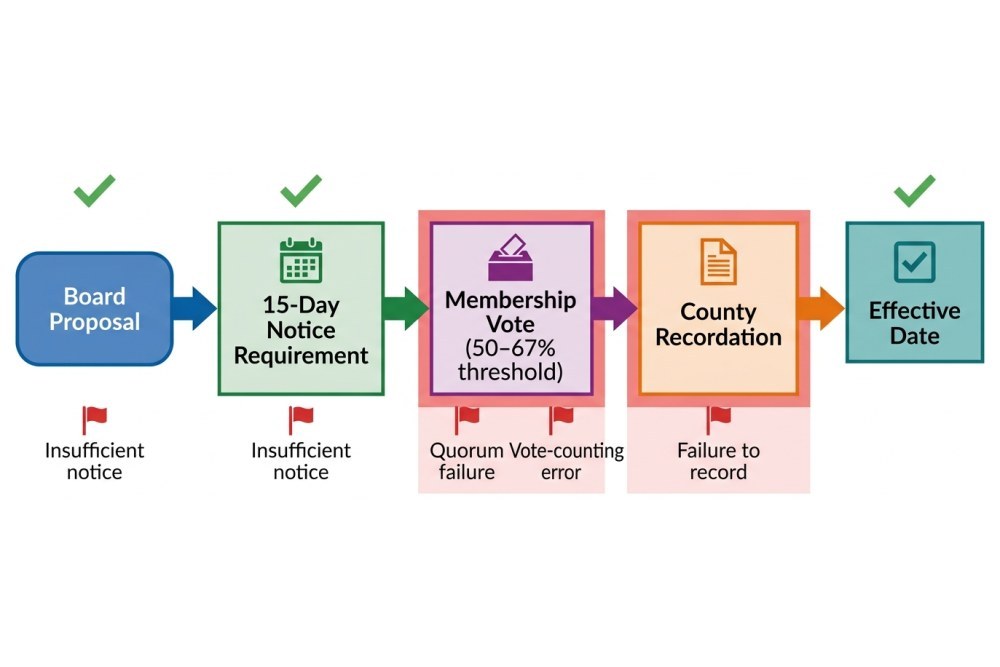
CC&R amendments require a membership vote, and the threshold varies by community (commonly 50% to 67% of total owners). The association must provide advance notice of the proposed amendment, hold a meeting, and record the amendment with the county recorder once approved. Common defects include:
- Insufficient notice: Civil Code § 4360 requires at least 15 days' advance notice of any membership meeting to consider a CC&R amendment. Notice must be delivered by first-class mail or email (if the owner has consented to electronic delivery). Associations that provide shorter notice or fail to mail to all owners create grounds for invalidation.
- Quorum failures: Many governing documents require a quorum (commonly 50% of owners) to be present (in person or by proxy) for a valid vote. If the association counted proxies improperly or failed to verify quorum, the amendment is void.
- Vote-counting errors: Associations must count votes accurately and provide owners with results. If the amendment passed by a narrow margin, demand a recount and inspect the ballots. Errors in vote tabulation are common, particularly in larger communities.
- Failure to record: A CC&R amendment is not effective until recorded with the county recorder. If the association adopted the amendment but never recorded it, the restriction is unenforceable.
To challenge an amendment on procedural grounds, act quickly. California's statute of limitations for challenging recorded CC&R amendments is one year from the date of recordation under Civil Code § 4235. Miss that deadline, and the amendment becomes conclusively valid, even if procedurally defective.
Substantive Challenges: Reasonableness and Public Policy
Even a properly adopted amendment can be challenged if it is unreasonable or violates public policy. California courts apply a deferential standard: restrictions are presumed valid unless arbitrary, capricious, or bearing no rational relationship to a legitimate association interest. This is a high bar, and substantive challenges rarely succeed.
The strongest substantive argument invokes California's statutory policy favoring housing availability. In Nahrstedt v. Lakeside Village Condominium Assn. (1994), the California Supreme Court held that use restrictions are enforceable unless they violate public policy or are unconscionable. Rental bans do not violate public policy per se, but a restriction that eliminates all rental housing in a community (combined with evidence of regional housing shortages) carries some vulnerability.
In practice, substantive challenges gain traction when paired with evidence of discriminatory intent or impact. If the rental ban disproportionately affects protected classes (for example, by excluding Section 8 voucher holders or families with children), you have a fair housing claim under state and federal law.
Negotiation and Settlement Strategies
Litigation is expensive and protracted, and even landlords with strong defenses often prefer to settle. HOAs, too, are motivated to settle: drawn-out legal battles drain reserve funds and create member dissatisfaction. The key is to approach negotiation strategically, with a clear understanding of your position and the association's constraints.
Buyout Agreements and Transition Plans
If you have a grandfathered right to rent but the HOA is making enforcement difficult, consider negotiating a buyout. The association pays you a lump sum in exchange for your agreement to cease renting and either sell the property or convert to owner-occupancy. Buyout amounts vary but in our experience fall in a range that reflects the present value of the foregone rental income, discounted by the litigation risk.
Alternatively, propose a transition plan: you agree to phase out rental activity over a defined period (12 to 24 months, for example) in exchange for the HOA waiving fines and legal fees. This gives you time to find a buyer or transition the property to personal use without the financial pressure of daily fines.
Variance Requests and Hardship Exceptions
Some governing documents permit the board to grant variances or hardship exceptions to use restrictions. If you can demonstrate that strict enforcement would cause undue hardship (for example, you rely on rental income to cover mortgage payments, or you're temporarily relocated for work), the board can grant a limited exception.
Hardship requests succeed more often when you propose conditions that address the HOA's concerns: agree to a minimum lease term, submit tenants for approval, or limit the number of occupants. Frame the request as mutual benefit: you get to continue renting, and the HOA avoids litigation and maintains community standards.
Litigation Considerations: When to Sue and What to Expect
Pre-trial costs consume the majority of litigation budgets, making early settlement negotiations financially prudent.
View chart data
| Category | Legal fees (USD) |
|---|---|
| Initial filing & pleadings | $5k |
| Discovery & depositions | $18k |
| Motion practice | $12k |
| Trial preparation | $15k |
| Trial (3-5 days) | $25k |
| Total | $75k |
If negotiation fails, litigation becomes the only option. HOA disputes are governed by California's Davis-Stirling Common Interest Development Act, which provides for cost-shifting: the prevailing party in an HOA lawsuit is entitled to recover attorney fees and costs. This cuts both ways. If you win, the HOA pays your legal bills; if you lose, you pay theirs.
Pre-Litigation Requirements: ADR and Meet-and-Confer
Before filing a lawsuit, you must participate in alternative dispute resolution. Civil Code § 5930 requires associations to offer ADR (mediation or arbitration) before pursuing legal action, and landlords must request ADR in writing before suing the HOA. ADR is non-binding unless both parties agree otherwise, but it provides a structured forum for settlement discussions.
In addition to ADR, Civil Code § 5965 requires a pre-litigation meet-and-confer process. You must send the HOA a written request to meet and confer, and the association has 30 days to respond. If the HOA refuses or the meet-and-confer fails to resolve the dispute, you can proceed to litigation.
Common Causes of Action
Landlord lawsuits against HOAs commonly assert one or more of the following claims:
- Declaratory relief: Ask the court to declare that the rental restriction is invalid, unenforceable, or inapplicable to your property. This is the most common claim and is often paired with a request for injunctive relief to stop the HOA from enforcing the restriction.
- Breach of CC&Rs: If the HOA is enforcing a restriction that does not appear in the recorded CC&Rs (for example, an operating rule that exceeds the board's authority), you can sue for breach.
- Violation of Civil Code: If the HOA failed to follow statutory procedures for adopting the restriction, imposing fines, or conducting hearings, you can seek damages and injunctive relief under the Davis-Stirling Act.
- Fair housing violations: If the restriction has a discriminatory impact or was adopted with discriminatory intent, you can bring claims under the Fair Employment and Housing Act (FEHA) and the federal Fair Housing Act.
Discovery in HOA cases focuses on the amendment process, enforcement patterns, and the association's decision-making. Demand production of meeting minutes, ballots, correspondence with other owners, and records of violations and fines. Depositions of board members often reveal inconsistencies in enforcement or procedural shortcuts that strengthen your case.
Cost-Benefit Analysis of Litigation
HOA litigation is expensive. In our experience, taking a case through trial costs between the lower and upper bounds of the typical range shown in the chart above, and more if the case is appealed. Even if you prevail, cost recovery is not guaranteed. Courts have discretion to apportion fees, and you recover only a portion of your costs in some cases.
Before filing, run the numbers. What is the present value of your rental income over the expected hold period? If you're generating net rent and plan to hold the property for several years, the rental income stream has substantial value. Spending a portion of that to protect the income stream is justified. But if you're nearing the end of your hold period or the rental income is marginal, litigation does not pencil.
Compliance Best Practices for Landlords in HOA Communities
Whether you're operating under a rental restriction or anticipating one, proactive compliance minimizes legal risk and preserves your ability to rent. The following practices are essential for landlords in Orange County HOA communities.
Document Everything
Maintain meticulous records of your tenancy: lease agreements, rent ledgers, tenant correspondence, HOA communications. If the HOA challenges your right to rent, these documents are your first line of defense. Store records electronically and keep backups. Lost paperwork can sink an otherwise strong legal position.
Monitor HOA Activity and Participate in Governance
Attend board meetings, read meeting minutes, stay informed about proposed rule changes. Rental restrictions are often telegraphed months in advance, and early intervention (lobbying board members, organizing other landlords, proposing alternative restrictions) can prevent a ban from taking effect.
If you own multiple units in the community, consider running for the board. Landlords on the board can shape policy, apply enforcement evenhandedly, and protect rental rights from within.
Draft Lease Clauses That Anticipate HOA Restrictions
Include a clause in your lease that permits early termination if the HOA adopts a rental restriction that prohibits continued occupancy. This protects you from liability if you're forced to remove a tenant mid-lease. Sample language:
"If the homeowners association adopts a restriction that prohibits rental occupancy of the Property, Landlord may terminate this Lease upon 60 days' written notice to Tenant. In the event of such termination, Landlord shall refund any prepaid rent on a pro-rata basis, and neither party shall have further obligations hereunder."
Engage Counsel Early
Do not wait until you receive a notice of violation to consult an attorney. If your HOA is considering a rental restriction, engage counsel during the amendment process to challenge procedural defects in real time. Once the restriction is recorded, your options narrow significantly.
Looking Ahead: The Future of HOA Rental Restrictions in California
The trend toward stricter rental restrictions shows no sign of abating. As California's housing crisis deepens and short-term rental platforms proliferate, HOAs face pressure from owner-occupants to limit rental activity. At the same time, state legislators are considering bills that would preempt local HOA rental bans in the interest of increasing housing supply.
AB 1033, signed into law in 2023, allows homeowners to separately sell accessory dwelling units (ADUs) in single-family zones, and some advocates are pushing for similar legislation to limit HOA authority over rental restrictions. If enacted, such laws could override existing CC&R bans and restore rental rights to landlords. Until the Legislature acts, landlords must work within the current framework, which heavily favors HOA authority.
For Orange County coastal landlords, the message is clear: know your CC&Rs, document your tenancy, and act quickly when restrictions are proposed. Landlords who preserve their rental rights are those who engage early, challenge procedural defects, and negotiate strategically. Those who wait until enforcement begins are fighting an uphill battle.
Frequently Asked Questions
Can my Orange County HOA ban rentals entirely?
What is the difference between a CC&R amendment and an HOA operating rule?
How do I prove selective enforcement by my HOA?
What are my options if the HOA imposes fines for renting my property?
Can I challenge a rental restriction after it has been recorded?
What is a rental cap, and how does it work?