Why Carlsbad HOAs Are Capping Rentals Now
Communities with >35% rentals incur 12–18% higher maintenance costs, driving board action.
| Category | Indexed maintenance cost per unit |
|---|---|
| Owner-Dominated HOAs | 100 |
| High-Rental HOAs (>35%) | 115 |
Rental penetration exceeded original design assumptions by nearly 2.5×, triggering cap amendments.
| Category | Rental occupancy rate (%) |
|---|---|
| Original Design Target | 15% |
| 2023 Actual Occupancy | 40% |
Carlsbad's master-planned communities—Aviara, Robertson Ranch, Bressi Ranch, Pacific Highlands Ranch (straddling the San Diego city line)—were designed as owner-occupied enclaves. Original CC&Rs from the 2000s and early 2010s imposed few rental restrictions, anticipating that homeownership rates would remain above 85%. By 2023, several associations reported rental penetration exceeding 40%, driven by investor acquisitions during the 2020–2022 buying surge and pandemic-era relocations that converted primary residences into long-term rentals.
Interactive Tool
Carlsbad HOA Rental Cap Compliance Calculator
Estimate waitlist position, registration timing, and potential fine exposure under your association's rental cap

Total number of homes or units in your association
Maximum rental occupancy allowed (e.g., 30% = 0.30)
Number of units currently rented in the community
HOA fine per month for operating without a registered slot
How many months you expect to operate without a slot (if waitlisted)
 Built by NextGen Coastal
Boards cite three operational pressures behind the cap amendments:
- Maintenance and common-area wear: Higher tenant turnover correlates with increased pool furniture damage, landscape irrigation issues, and gate-access abuse. Associations track these costs in reserve studies; communities with >35% rentals saw 12–18% higher annual maintenance spend per unit compared to owner-dominated HOAs.
- Architectural review volume: Tenant-occupied homes generate more exterior modification requests (satellite dishes, patio enclosures, unapproved paint) and compliance violations (trash-bin visibility, vehicle parking, holiday decoration duration). Boards report that rental properties account for 60% of architectural committee cases despite representing 40% of units.
- Resale value perception: Buyer agents in North County coastal markets routinely ask for rental-occupancy data during due diligence. Communities with published rental caps command a 2–4% premium on comparable sales, according to 2024 MLS analysis, because prospective owner-occupants perceive lower transience and stronger neighborhood cohesion.
The legal mechanism is a CC&R amendment approved by member vote—typically requiring 67% or 75% affirmative ballots under the association's governing documents. Carlsbad saw a wave of these votes in late 2024, with enforcement effective dates clustered around January 1, 2026, giving current landlords a 12–18 month transition window.
How the Caps Work: Mechanics and Thresholds
Rental caps are expressed as a percentage of total units or a fixed numerical limit. In a 200-home association, a 30% cap permits 60 rental properties at any given time. Once the threshold is reached, no additional homes may be leased until an existing rental converts back to owner-occupancy or sells to an owner-occupant, opening a slot.
Waitlist and Registration Systems
Most Carlsbad amendments include a rental registration requirement: owners must submit tenant information, lease term, and contact details to the HOA management company within 10–15 days of lease execution. Registration serves two functions—it populates the occupancy count and creates a communication channel for violation notices.
When the cap is reached, late-registering owners join a waitlist. Priority is typically first-come, first-served based on registration timestamp, though some associations grandfather existing rentals that were registered before the amendment's effective date. If you operate a rental that predates the cap and maintain continuous registration, you generally hold a non-conforming use right—you can continue leasing, but if you convert to owner-occupancy or sell, the slot returns to the pool and you lose priority.
Lease Term Restrictions
Amendments often impose minimum lease durations—commonly 12 months—to discourage short-term turnover. This aligns with California Civil Code § 4740–4745, which permits HOAs to regulate rental duration as long as restrictions don't conflict with local rent-control ordinances (Carlsbad has no citywide rent control, so HOA lease-term rules face no preemption issue). Operators accustomed to 6-month or 9-month leases must adjust lease templates and tenant-acquisition strategies to meet the 12-month floor.
Annual Recertification
Even grandfathered rentals face annual recertification deadlines—typically 30 days before lease renewal. Owners submit updated tenant information, proof of current lease, and sometimes a certificate of insurance naming the HOA as additional insured. Missing the recertification window can forfeit your rental slot, moving you to the back of the waitlist. Calendar these deadlines rigorously; HOA management companies send one reminder and then process the lapse.
"The recertification requirement is where we see the most unintentional non-compliance. Owners assume that once they're registered, they're set for the duration of tenancy—but the HOA treats each lease year as a new registration event. Miss the window by a week, and you're off the list."
Enforcement Timeline: What Happens January 2026
Associations that passed amendments in Q4 2024 are targeting January 1, 2026 as the compliance deadline. Here's the typical enforcement sequence:
- Q1 2025 (now through March): Boards mail formal notice of the amendment to all owners, including a summary of the cap percentage, registration process, and effective date. California Civil Code § 4360 requires individual delivery (mail or email) of governing-document changes; a newsletter mention is insufficient.
- Q2–Q3 2025: Early registration period opens. Owners with current tenants submit registration packets. Management companies process applications and assign slots on a first-come basis until the cap is reached. Late registrants are waitlisted.
- Q4 2025: Final compliance reminders. Boards may offer a 30-day cure window for owners who missed early registration but can demonstrate a lease executed before the amendment vote.
- January 1, 2026: Enforcement begins. Any rental operating without a registered slot is in violation. The HOA can issue a notice of violation, assess fines (typically $100–$500 per month), and ultimately record a lien against the property if fines remain unpaid for 90+ days.
Operators who ignore the timeline face compounding penalties. A $200 monthly fine accrues to $2,400 annually, plus collection costs and potential attorney fees if the HOA pursues lien foreclosure. More immediately, the violation creates a cloud on title that will surface in any refinance or sale transaction, forcing a payoff or settlement before escrow can close.

Owner Rights Under California Civil Code
While HOAs enjoy broad authority to amend CC&Rs, California law imposes procedural safeguards and substantive limits that protect rental-property owners.
Voting Thresholds and Notice
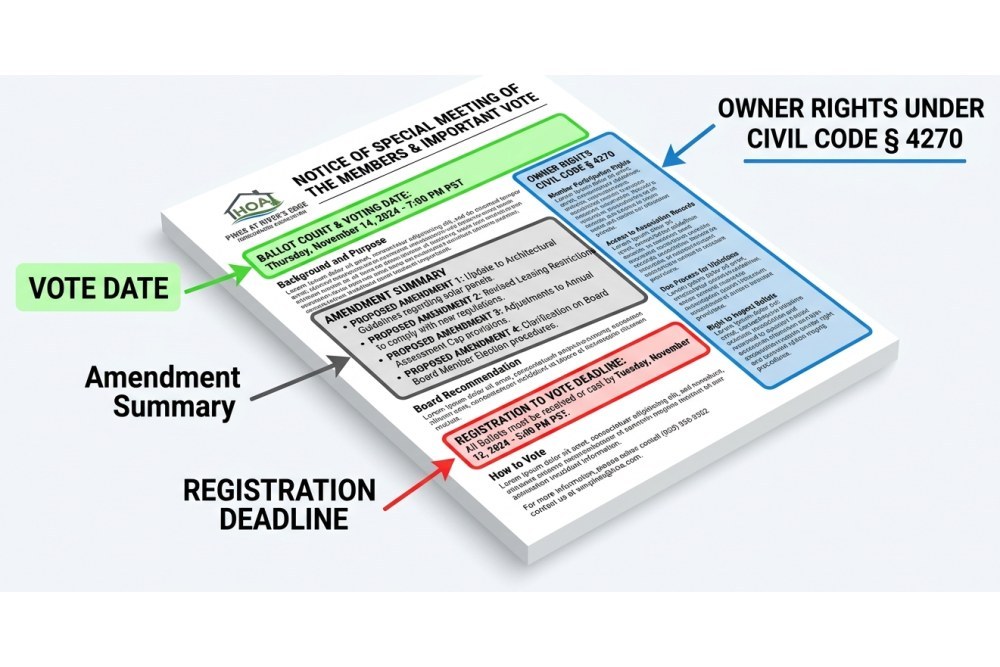
CC&R amendments require a supermajority vote—typically 67% or 75% of the membership, as specified in the association's declaration. Civil Code § 4270 mandates that the board provide at least 15 days' written notice of the vote, including the full text of the proposed amendment and a summary of its effect. If your association failed to meet these notice requirements, the amendment may be voidable. Owners who believe the vote was procedurally defective can petition the board for reconsideration or, in extreme cases, file a declaratory-relief action in superior court.
Grandfathering and Non-Conforming Use
Most Carlsbad amendments include a grandfathering clause for rentals in place at the time of the vote. Civil Code § 4740(b) does not mandate grandfathering, but associations adopt it to avoid claims of unconstitutional taking or breach of the implied covenant of good faith. If you had a tenant under lease on the amendment's vote date and you registered within the specified window, you typically retain the right to continue leasing—subject to annual recertification—even if the community is at or above the cap.
However, grandfathered status is non-transferable. If you sell the property, the new owner does not inherit your rental slot; the unit reverts to owner-occupancy unless the buyer secures a slot from the waitlist. This dynamic can depress resale values for investor-owned homes in capped communities, because the buyer pool shrinks to owner-occupants or investors willing to wait for a slot.
Reasonable Restriction Standard
California courts apply a "reasonableness" test to HOA rules under Civil Code § 4350. A rental cap is presumed reasonable if it's rationally related to a legitimate community interest—preserving owner-occupancy, controlling maintenance costs, protecting resale values. Challenges succeed only when the restriction is arbitrary, discriminatory, or so severe that it effectively prohibits all rentals. A 25–35% cap, applied uniformly and with a waitlist mechanism, will survive judicial scrutiny in nearly all cases. Owners hoping to overturn the cap face a high bar and significant legal expense.
Dispute Resolution and IDR
Before filing suit, California Civil Code § 5930 requires owners and HOAs to attempt internal dispute resolution (IDR)—a meet-and-confer process facilitated by the board or a neutral third party. If IDR fails, the next step is often binding arbitration or mediation, depending on the association's ADR policy. Litigation is the last resort and typically costs $15,000–$50,000 in attorney fees for a declaratory-relief case, with no guarantee of success. Operators should exhaust administrative remedies—requesting hardship exceptions, proposing phased compliance, negotiating waitlist priority—before escalating to legal action.
Compliance Strategies for Current Landlords
If you operate a rental in a Carlsbad HOA that has passed or is considering a cap amendment, these strategies minimize disruption and preserve income:
Register Immediately
As soon as the amendment is adopted, submit your rental registration packet—even if the effective date is 12–18 months out. Early registration secures your position in the queue and, in many cases, qualifies you for grandfathered status. Gather the required documents now: current lease, tenant contact information, proof of landlord insurance with $1–2 million liability coverage, and any HOA-specific forms. Management companies process registrations in the order received; a one-week delay can mean the difference between slot 58 and slot 62 in a 60-unit cap.
Align Lease Terms with Recertification
Structure lease renewals so that the annual recertification deadline falls mid-lease, not at lease expiration. If recertification is due March 31 and your lease renews April 1, you're submitting paperwork during tenant turnover—a high-risk window. Instead, renew leases in January or February, giving you a 60–90 day buffer to complete recertification while the tenant is in place and the lease is active. This also smooths the documentation process: you're submitting a current lease, not a renewal in negotiation.
Build HOA Compliance into Tenant Screening
Tenants in HOA communities must comply with CC&Rs—parking rules, noise ordinances, architectural guidelines, pet restrictions. A single violation can trigger a notice to the owner, and repeated violations can jeopardize your rental registration. During screening, provide applicants with a one-page HOA rules summary and require acknowledgment as part of the lease. Include a lease clause that makes tenant compliance with CC&Rs a material term, giving you grounds for eviction if the tenant generates chronic HOA violations. This shifts enforcement burden to the lease relationship and protects your registration status.
Monitor Waitlist Movement
If you're waitlisted, track slot availability monthly. Management companies often publish waitlist position on the owner portal or in quarterly reports. When a slot opens—because another owner sold to an occupant or converted to primary residence—waitlisted owners receive notice and a 10–15 day window to claim the slot by submitting a current lease. Miss that window, and the slot goes to the next owner in line. Set a calendar reminder to check waitlist status the first week of each month, and keep a lease draft ready so you can execute and submit within 48 hours of receiving slot-available notice.
Consider Sale Timing
If your investment thesis assumed indefinite rental income and the cap amendment materially impairs that assumption, evaluate a sale before the enforcement date. Properties sold in 2025—while the amendment is known but not yet enforced—can still market to both owner-occupants and investors, preserving some buyer competition. Once enforcement begins in January 2026, investor buyers will discount offers to reflect waitlist risk, and your pool shrinks. Running a comparative market analysis now, with a 2026 re-run, quantifies the timing value and informs the hold-versus-sell decision.
What If Your HOA Hasn't Passed a Cap Yet?
Not all Carlsbad associations have moved to cap rentals, but the trend is accelerating. If your HOA is discussing an amendment or has scheduled a vote, you have a narrow window to influence the outcome or prepare for the change.
Participate in the Vote
Rental-property owners are voting members. If you oppose the cap, organize other investor-owners, attend board meetings, and submit written comments during the notice period. Highlight the financial impact on property values, the administrative burden of waitlist management, and alternative solutions—such as stricter tenant-screening standards or higher registration fees—that address board concerns without capping occupancy. A well-reasoned opposition campaign can sway undecided owner-occupants, especially if you demonstrate that rentals are well-managed and contribute to community stability.
Propose a Higher Cap or Phase-In
If a cap is inevitable, negotiate the terms. A 40% cap with a 5-year phase-in is far less disruptive than a 25% cap effective in 12 months. Propose amendments that grandfather all current rentals indefinitely, rather than requiring annual recertification, or suggest a tiered system where long-term landlords (5+ years of continuous registration) receive priority over recent investor purchases. Boards are often willing to compromise on implementation details if it reduces legal risk and owner dissent.
Lock in a Long-Term Lease
If a cap vote is scheduled for Q2 2025 with a January 2026 effective date, execute a 24-month lease in Q1 2025—before the vote. Many grandfathering clauses key off "rentals in place at the time of the amendment," meaning a lease executed before the vote qualifies even if the tenant moves in after the vote. A 24-month term carries you through 2026 and into 2027, giving you two years of rental income and time to assess whether the cap stabilizes or tightens further. Confirm with HOA counsel that pre-vote leases will be grandfathered; if the amendment is silent, request clarification in writing before signing a long-term tenant.
Enforcement Mechanisms: Fines, Liens, and Foreclosure
HOA enforcement is more aggressive than municipal code enforcement because associations have financial tools that cities lack.
Monetary Penalties
Rental-cap violations typically incur $100–$500 per month in fines, assessed as a special assessment on your account. California Civil Code § 5850 requires the board to provide notice and an opportunity to cure before imposing fines, but the cure period is often just 15 days. If you don't cure—by either securing a rental slot or terminating the lease—the fine continues monthly. Fines are treated as assessments, meaning they carry the same collection priority as HOA dues and can trigger lien and foreclosure proceedings if unpaid for 12 months or if the total exceeds $1,800 (Civil Code § 5720).
Lien and Foreclosure Risk
Unpaid fines and assessments become a lien against the property, recorded in the county recorder's office. The lien clouds title, blocking refinances and sales until satisfied. If fines accumulate above the statutory threshold and remain unpaid for 12+ months, the HOA can initiate non-judicial foreclosure under Civil Code § 5700–5720. While rare, foreclosure is not theoretical—North County associations have foreclosed on properties with $10,000+ in unpaid assessments and fines. The foreclosure wipes out junior liens (including some second mortgages) but is subject to the first-position deed of trust, so the lender's interest survives. Operators who let fines accumulate risk losing the property or facing a lender-initiated sale to cure the default.
Estoppel and Resale Impact
When you sell, the buyer's lender orders an HOA estoppel certificate—a statement of assessments due, violations on record, and pending litigation. An active rental-cap violation appears on the estoppel, and most lenders will condition loan approval on the violation being cured before close of escrow. This gives the HOA leverage: you must either pay the fines, terminate the lease, or negotiate a settlement to clear the estoppel. Buyers can also walk if the estoppel reveals a violation, especially if curing requires waitlist time that delays occupancy.
Case Study: Aviara Amendment 2024
Aviara, one of Carlsbad's premier master-planned communities, passed a 30% rental cap in November 2024 with a January 1, 2026 effective date. The association has 420 single-family homes; the cap permits 126 rentals. At the time of the vote, 162 homes were tenant-occupied—38.6% of the community.
The amendment included a grandfathering provision: any rental registered by March 31, 2025 would retain its slot as long as the owner maintained continuous occupancy and annual recertification. Rentals not registered by that date would be waitlisted, and no new rentals could commence once the 126-unit threshold was reached.
By February 2025, 140 owners had registered, filling the 126 slots and creating a 14-owner waitlist. The remaining 22 rental-property owners—who missed the early registration window—faced a choice: convert to owner-occupancy, sell, or wait for a slot to open. As of March 2025, three waitlisted owners listed their properties for sale, and two negotiated lease buyouts with tenants to convert to primary residence and avoid the waitlist.
The Aviara case illustrates the first-mover advantage in rental-cap compliance. Owners who registered in December 2024—immediately after the vote—secured slots; those who delayed until February found themselves locked out despite having tenants in place for years. The lesson: treat the amendment vote as a starting gun, not a distant deadline.
Regional Context: How Carlsbad Fits the Coastal Trend
Carlsbad is not alone. HOA rental caps have appeared in Encinitas, Solana Beach, and Del Mar over the past 24 months, and Orange County communities—Irvine, San Clemente, Dana Point—are watching closely. The common thread is master-planned developments built in the 2000s–2010s that are now experiencing investor-driven rental conversion as coastal home prices push owner-occupancy out of reach for median-income buyers.
Statewide, California Civil Code § 4740 permits HOAs to "prohibit the rental or leasing of any of the separate interests" in the community, subject to the governing documents' amendment process. This grants associations near-plenary authority to regulate rentals, limited only by the reasonableness standard and procedural safeguards. The result is a patchwork: some coastal HOAs impose no restrictions, others cap at 50%, and a growing number are moving toward 25–30% thresholds to maintain owner-majority governance.
For operators with portfolios spanning multiple coastal communities, the compliance burden is rising. Each HOA has its own registration process, recertification schedule, and enforcement style. Centralized tracking—via property-management software that flags HOA deadlines alongside lease renewals and inspection dates—is no longer optional; it's a operational necessity to avoid violations that can cost thousands in fines and jeopardize rental income.
Looking Ahead: 2026 and Beyond
The January 2026 enforcement wave will test the rental-cap model. Associations will learn whether waitlist systems are administratively feasible, whether fines deter non-compliance, and whether owner-occupancy rates actually rise or simply stabilize. Early data from Aviara and other early adopters will inform the next round of amendments—expect some communities to tighten caps further if the initial threshold doesn't achieve the desired occupancy mix, and others to relax enforcement if waitlists grow unmanageable.
For landlords, the strategic question is whether to fight, comply, or exit. Fighting—through legal challenge or board opposition—is expensive and rarely successful unless the amendment is procedurally defective. Compliance is the default path for operators who value long-term cash flow and can absorb the administrative overhead of registration and recertification. Exit makes sense when the cap materially impairs returns, when waitlist uncertainty clouds future income, or when the property was a tactical hold that no longer fits the portfolio thesis.
The broader trend is clear: coastal HOAs are asserting control over rental occupancy, and the tools they're using—CC&R amendments, registration systems, waitlists, fines—are legally sound and difficult to overturn. Operators who adapt early, build compliance into their workflows, and maintain strong relationships with HOA boards will navigate the transition with minimal income disruption. Those who ignore the deadlines or assume the rules won't be enforced will face fines, liens, and forced sales that erase years of equity gains.
Action Checklist for Carlsbad Landlords
If you own a rental property in a Carlsbad HOA, complete these steps before the end of Q2 2025:
- Confirm amendment status: Contact your HOA management company or review board meeting minutes to determine whether a rental cap has been adopted, is under consideration, or is not currently planned.
- Review your CC&Rs: Obtain the current declaration and any recorded amendments. Identify the rental-regulation section, the amendment vote threshold, and any existing restrictions (minimum lease term, registration requirements).
- Register your rental: If an amendment has passed, submit your registration packet immediately—even if the effective date is months away. Gather lease, insurance certificate, tenant contact information, and any HOA-specific forms.
- Calendar recertification: If your HOA requires annual recertification, set a recurring calendar reminder 45 days before the deadline. Treat recertification as a lease-renewal task, not an afterthought.
- Update lease templates: Add a CC&R compliance clause, an HOA rules acknowledgment, and a provision that makes tenant-caused HOA violations grounds for lease termination.
- Assess waitlist risk: If you're waitlisted or the cap is near capacity, model the financial impact of 6–12 months without rental income. Decide whether to hold and wait, convert to owner-occupancy, or list for sale.
- Consult HOA counsel: If the amendment language is ambiguous—especially regarding grandfathering, waitlist priority, or hardship exceptions—request written clarification from the HOA's attorney. Do not rely on verbal assurances from board members or management staff.
Carlsbad's rental-cap enforcement in 2026 will reshape the North County coastal rental market for the next decade. Operators who treat compliance as a strategic priority—not a bureaucratic nuisance—will preserve income, avoid penalties, and maintain the flexibility to hold or sell on their own timeline. Those who wait will find their options narrowing and their costs rising.
Frequently Asked Questions
Can my Carlsbad HOA legally cap the number of rental properties?
What happens if I'm already renting my Carlsbad home when the cap takes effect?
How do HOA rental waitlists work in Carlsbad?
What are the penalties for violating a Carlsbad HOA rental cap?
Can I challenge my HOA's rental cap amendment in court?