The 12-month line, and why everybody asks about it
A few months ago an owner called me about a duplex she'd inherited in Tustin. The tenant in the back unit had moved in nine months earlier on a one-year lease the prior owner signed. She wanted to move her son in when the lease ended. Simple, right? It was, but only because she called at month nine and not month thirteen. Those four months are the difference between a 30-day letter and a legal process with relocation money attached.
Interactive Tool
12-Month Non-Renewal Timing Check
How much cushion do you have before AB 1482 just-cause protections attach?

Count from the actual move-in date, not the lease signing date.
Civil Code section 1946.1 for tenants under one year, served personally.
Process server lead time.
 Built by NextGen Coastal
 Here's the rule of thumb: in California, the statewide just-cause eviction law only kicks in once a tenant has lived in the unit for 12 continuous months. That law is AB 1482, the Tenant Protection Act of 2019, codified at Civil Code section 1946.2. Before the 12-month mark, the state doesn't require you to have a reason to end a tenancy. After it, you need one of the specific 'just causes' on the statute's list. If your reason is a no-fault one, like an owner move-in or taking the unit off the market, you also owe relocation assistance equal to one month's rent.
Most owners don't realize how much rides on that single date. Before 12 months, a non-renewal is a letter and a calendar. After 12 months, a lease expiring on its own is no longer a valid reason to end the tenancy. The statute is explicit that the landlord has to offer a renewal. So if you have a legitimate reason to part ways with a tenant and you're still inside the first year, the law gives you a clean window. The job is to use it correctly.
The 12-month mark under AB 1482 works like a door that only swings one way. Before it closes, a non-renewal takes a properly served 30-day notice. After it closes, you need a listed just cause, and 'the lease ended' is not on the list.
One caveat before we go further. This article covers the state rule. Several coastal cities have their own just-cause ordinances that start the clock earlier, sometimes at day one. I'll cover those below. If you own in Los Angeles, Santa Monica, or San Diego, please don't skip that section.
What state law actually requires before 12 months
Subsidized tenancies require triple the notice of a standard month-to-month tenant under one year.
View chart data
| Category | Written notice required (days) |
|---|---|
| Month-to-month, under 1 year | 30 |
| Month-to-month, 1 year or more | 60 |
| Section 8 / subsidized tenancy | 90 |
Strip away the commentary and the state rule for a tenant under 12 months is short. Two Civil Code sections do almost all the work.
Month-to-month tenants: 30 days' written notice
If your tenant is month-to-month and has occupied the unit for less than a year, Civil Code section 1946.1 requires at least 30 days' written notice to terminate. Once they've been there a year or more, that jumps to 60 days. The notice can be served any day of the month. The old idea that it has to line up with the first is a myth I still hear from owners who've been doing this for twenty years.
Fixed-term leases that end before 12 months
Say you signed a six-month or nine-month lease. Under state law, a fixed-term lease ends on its end date and no separate termination notice is technically required. In practice, I never rely on that. I send a written non-renewal notice at least 30 days before the end date anyway. It removes any argument that the tenant didn't know, and it's the same letter you'd need if the lease had quietly converted to month-to-month.
Which brings up the trap. Check your lease first. Most California leases say that if the tenant stays past the end date and you accept rent, the tenancy becomes month-to-month on the same terms. If you let a nine-month lease roll over and then accept three more rent payments, congratulations, you're at month 12 and just cause has attached. The lease didn't protect you. Your own inattention got you there.
The 24-month wrinkle when tenants are added
There's one more piece of the timing rule that surprises people. If an additional adult tenant is added to the lease before an existing tenant has hit 12 months, the just-cause protections attach once either of these is true:
- All of the tenants have continuously occupied the unit for 12 months or more, or
- One or more of the tenants has continuously occupied the unit for 24 months or more.
That matters if you added a roommate at month eight. Your original tenant hits 12 months, but the roommate is at month four, so protections don't attach yet. They will at the 24-month mark for the original tenant no matter what. Track both dates.
Exempt properties still follow the notice rules
Some units are exempt from AB 1482 altogether. The common ones are single-family homes and condos owned by an individual (not a corporation or REIT) where the lease includes the required exemption language, buildings with a certificate of occupancy issued within the last 15 years, and owner-occupied duplexes. If your property is exempt, the 12-month line doesn't apply at the state level. You still need the 30 or 60-day notice under section 1946.1, and your city's ordinance may cover you anyway. Exemption from the state law is not exemption from your city.

Counting the days so the termination lands on the right side
This is the part I want you to slow down on. The statute says just cause applies 'after a tenant has continuously and lawfully occupied' the unit for 12 months. It doesn't spell out whether that means the notice has to be served before the 12-month mark, or whether the tenancy has to actually end before it. Attorneys I work with read it conservatively, and so do I: get the termination date itself before the 12-month anniversary of move-in, not just the service date. A notice that terminates on day 372 invites a tenant's attorney to argue that protections attached on day 365 while the tenant was still lawfully in possession.
So the math works backward from the move-in date, not the lease signing date. Occupancy is what counts. If the lease was signed March 1 but keys were handed over March 10, your clock started March 10.
Here's how I lay it out for an owner:
- Find the actual move-in date. Check the move-in inspection form, the key receipt, or the first rent proration.
- Add 12 months. That's the line. Write it down.
- Subtract the notice period (30 days for a tenant under one year). That's the latest day the notice can be served and still terminate before the line.
- Subtract a few more days for the process server and any mailing extension. That's your real deadline.
One more thing about mailing. If you serve by posting and mailing rather than in person, many attorneys add five days to the notice period to account for the mail, based on the way courts have treated mailed notices. It's not universally agreed on, but I'd rather add the five days than litigate the question. A 30-day notice served by post-and-mail on day 320 might not be safe. Serve it on day 315 instead.
The timing calculator at the top of this article does this arithmetic for you. Plug in how many days the tenant has been in the unit and which notice period applies, and it tells you how much cushion you have. If the cushion is negative, stop and call a landlord-tenant attorney before sending anything.
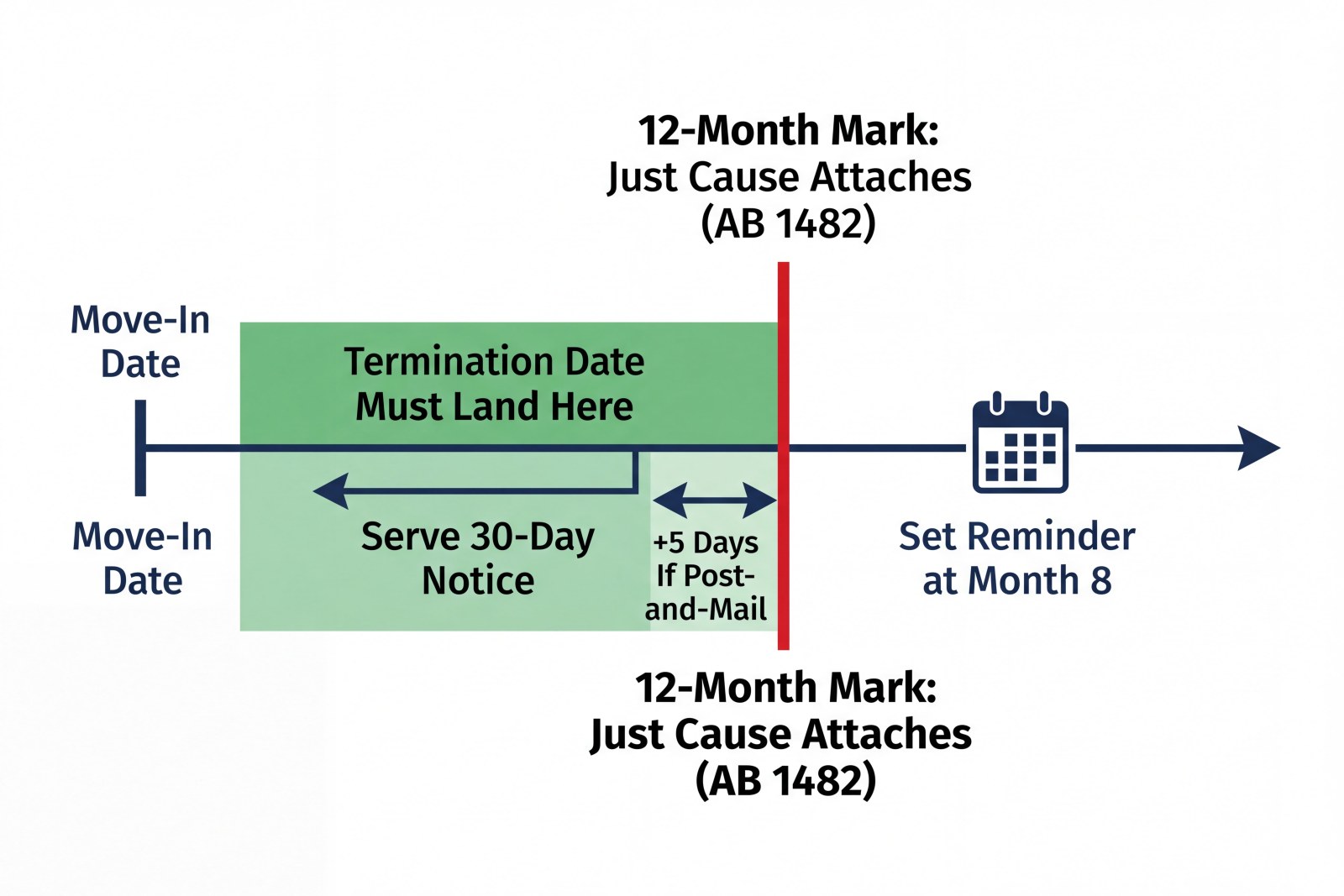
Last thing on timing: month 11 is not the time to discover a problem. I tell owners to set a calendar reminder at month eight for every new tenant. That gives you a full quarter to decide whether you want to renew, and enough runway to serve a clean 30-day notice if you don't.
The cities that move the line earlier
Santa Monica grants just-cause protection from day one, while Los Angeles cuts the state's 12-month window down to six months.
View chart data
| Category | Days until just-cause protections attach |
|---|---|
| Santa Monica | 0 |
| Los Angeles | 180 |
| California (state law) | 365 |
This is where coastal owners get burned. AB 1482 sets a floor, and it lets cities pass stronger protections. Several have. If your unit sits in one of these cities, the 12-month rule is not your rule.
City of Los Angeles
Los Angeles adopted its Just Cause Ordinance in 2023, and it covers rental units that the older Rent Stabilization Ordinance never reached, including newer buildings and many single-family homes. Under the LA Just Cause Ordinance, just-cause protections attach after six months of continuous occupancy or at the end of the first lease term, whichever comes first. So a six-month lease in Venice or Playa del Rey can't simply be non-renewed at its end date. You need a stated cause, and no-fault causes carry relocation payments that are considerably larger than the state's one month of rent.
Santa Monica
Santa Monica has had rent control and just-cause eviction under its City Charter (Article XVIII) since 1979. There's no waiting period. A tenant covered by the Santa Monica Rent Control Charter Amendment has just-cause protection from the day they move in, and the list of allowable reasons is short. Non-renewal at the end of a first lease is not one of them.
San Diego
San Diego's Residential Tenant Protections Ordinance took effect in 2023. It layers on top of AB 1482 and tightens the no-fault side: bigger relocation payments, more owner obligations on move-in evictions and substantial remodels, and protections that attach earlier than the state's 12-month mark. If you own in San Diego, treat the state timing rule as background and read the city ordinance with counsel before you serve anything.
Unincorporated areas and everyone else
Unincorporated Los Angeles County has its own Rent Stabilization and Tenant Protections Ordinance. As of this writing, most Orange County cities, including Costa Mesa, Huntington Beach, and Newport Beach, do not have adopted local just-cause ordinances beyond the state rule, though this may change. Check your city's municipal code once a year, or ask someone whose job it is to track it.

Section 8 and other subsidized tenancies
Housing Choice Voucher tenants are a separate case, and it's a big one. State law under section 1946.1 requires 90 days' written notice to terminate a tenancy where the tenant receives a government subsidy, regardless of how long they've lived there. On top of that, federal housing regulations governing the Housing Choice Voucher program set the initial lease term at one year and only allow the owner to terminate during that term for cause. Practically speaking, you cannot 'non-renew' a voucher tenant inside the first year just because you'd prefer a different tenant. The federal lease term won't let you.
Serving the notice so it actually holds up
I've said this before and I'll keep saying it. Tape on the door isn't service. A notice that isn't properly served is a notice that doesn't exist, and every day you spend arguing about it is a day the tenant gets closer to 12 months.
The notice itself should be simple. It's a letter that says the tenancy will terminate on a specific date, cites the lease and the applicable Civil Code section, and tells the tenant when and how to return keys. It does not need to state a reason if you're under 12 months in a city without a local ordinance. I generally recommend against stating one. A reason you write down is a reason the tenant can argue with.
Service methods for a termination notice follow Code of Civil Procedure section 1162, the same rules used for pay-or-quit notices. From best to worst:
- Personal delivery to the tenant. Best option. Done and dated.
- Substituted service: leave a copy with a person of suitable age at the unit and mail a second copy to the tenant.
- Post and mail: if nobody's home, post the notice conspicuously on the door and mail a copy the same day. Add five days to your timeline to be safe.
Whoever serves it should sign a proof of service that states the date, time, method, and address. Keep it with your copy of the notice. If the tenant holds over and you end up filing an unlawful detainer, that proof of service is the first thing the court looks at. A registered process server costs about the same as a nice dinner and gives you a declaration a judge will believe. Get it in writing, and get it from someone who serves notices for a living.
One more habit worth building: send a courtesy email or text the same day, with a PDF of the notice attached. That message is not legal service and won't replace it. But it starts the conversation, and most tenants would rather hear from a person than find a paper on their door.
The mistakes that turn a clean non-renewal into a lawsuit
Being under 12 months takes just cause off the table. It does not take fair housing, retaliation, or your own lease off the table. These are the four ways I've watched a simple non-renewal go sideways.
Retaliation
If the tenant complained about a habitability issue, called code enforcement, or asserted a legal right in the past six months, a termination notice looks like retaliation whether or not it is one. Civil Code section 1942.5 creates a presumption of retaliation for a notice served within 180 days of a protected act. You can rebut it, but now you're proving a negative. If there's a recent repair complaint in the file, talk to an attorney before you serve. Honestly, sometimes the right answer is to fix the issue, wait, and renew for a short term instead.
Discrimination
The Fair Employment and Housing Act and the federal Fair Housing Act apply on day one. A non-renewal that lands right after a tenant announced a pregnancy, requested a reasonable accommodation, or had a family member with a disability move in will be scrutinized. You don't have to state a reason, but you should have a legitimate one documented in your own file, and it can't be any of those things.
Accepting rent past the termination date
If your notice says the tenancy ends June 30 and you cash a check for July, you've likely reinstated the tenancy or created a new one. Now you're serving a new notice, and the tenant is 30 days closer to the line. Set up your rent collection so nothing is accepted after the termination date without you looking at it first. If you use auto-pay through a portal, turn it off for that unit the day you serve.
Using the 12-month window as a rent-increase strategy
Some owners have figured out that non-renewing at month 11 and re-leasing at market gets around the AB 1482 rent cap, since a new tenancy resets rent under Costa-Hawkins. Under current state law that's legal in most cities. It's also expensive, and not just in turnover cost. Doing it as a pattern across a building invites exactly the kind of local ordinance that Los Angeles and San Diego passed. Look, if you have a good tenant paying near-market rent, run the math on a vacancy before you chase the last few percent. A month of vacancy, paint, cleaning, and leasing time usually eats the increase.
The move-out and the deposit
Your notice held, the tenant is moving out, and the last thing between you and a clean file is the security deposit. Deposit disputes are where a tenant who felt pushed out goes looking for a win, so this is not the place to be casual.
The rules live in Civil Code section 1950.5. The ones that matter most on a non-renewal:
- Offer a pre-move-out inspection in writing. The tenant can decline, but the offer has to be made. If they accept, you give them an itemized list of proposed deductions with time to fix things.
- Return the deposit, or the balance with an itemized statement, within 21 days after the tenant vacates.
- Deduct only for unpaid rent, cleaning to the condition at move-in, and damage beyond normal wear. Not for repainting a unit that was last painted three years ago.
- Photograph the unit before the tenant moves in, right after they leave, and after any repairs you deduct for. Under state law, photographs should accompany the itemized deposit statement.
And a reminder on the amount. As of recent California law, the deposit you can hold is one month's rent for most owners. If a prior owner collected two months from this tenant under prior law, the excess isn't something you get to keep. Refund it.
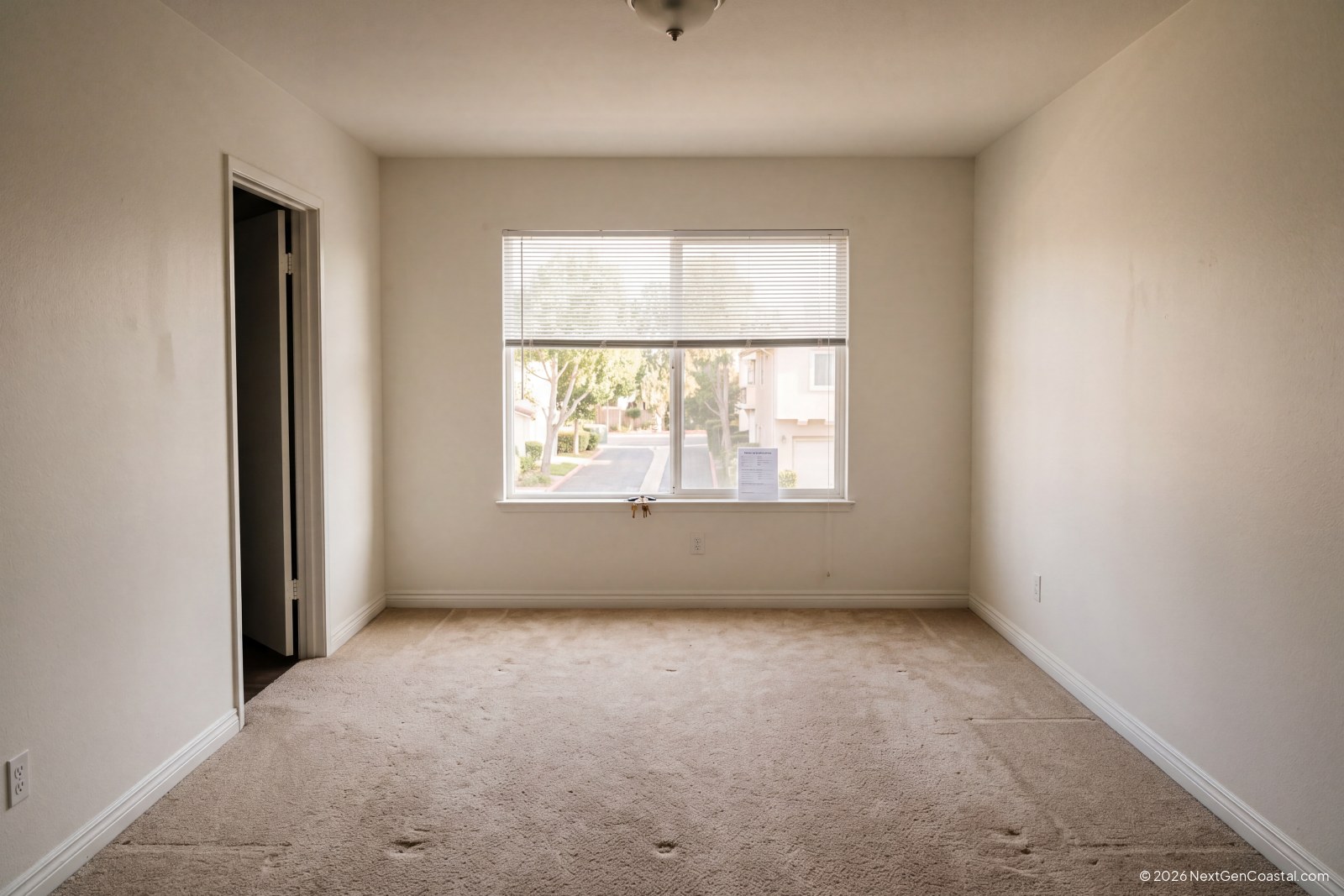
Handle the deposit cleanly and most tenants close the chapter. Handle it sloppily and you've handed a tenant who is already unhappy a small-claims case with statutory penalties attached. The deposit is the last impression. Make it a fair one.
Before you serve: should you actually do this?
I want to end on the question that comes before all the legal stuff. Every non-renewal I've handled started with an owner who was frustrated about something. Late rent, a noise complaint, an unauthorized pet, a plan to move a relative in. A few of those were good reasons to end the tenancy. More of them were fixable.
Back to the Tustin owner. We did serve the 30-day notice, at month nine, personally delivered, with a proof of service in the file. The tenant moved out on time and her son moved in. But before we served it, we spent twenty minutes on whether she'd rather keep a tenant who had paid on time for nine months and put her son in the front unit when it turned over instead. She chose the back unit for reasons that made sense to her. The point is she chose, with the numbers in front of her.
So here's the checklist I'd hand any owner considering a pre-12-month non-renewal:
- Confirm the actual move-in date and calculate the 12-month mark.
- Confirm whether a local just-cause ordinance applies to the address.
- Confirm the tenant isn't on a voucher and hasn't made a protected complaint in the last 180 days.
- Check your lease for the conversion clause and the notice terms.
- Run the math on vacancy and turnover against whatever the frustration is costing you.
- If you're still going ahead, serve at least 30 days before the mark, by process server, and shut off rent collection past the termination date.
The owners who get into trouble with this rule are almost never the ones who acted early. They're the ones who found out about the 12-month line at month 13. Set the reminder at month eight. Then decide.
Frequently Asked Questions
Can I non-renew a tenant in California who has lived in my unit less than 12 months?
Does the 12 months count from the lease signing date or the move-in date?
What happens if my fixed-term lease ends before 12 months and the tenant just stays?