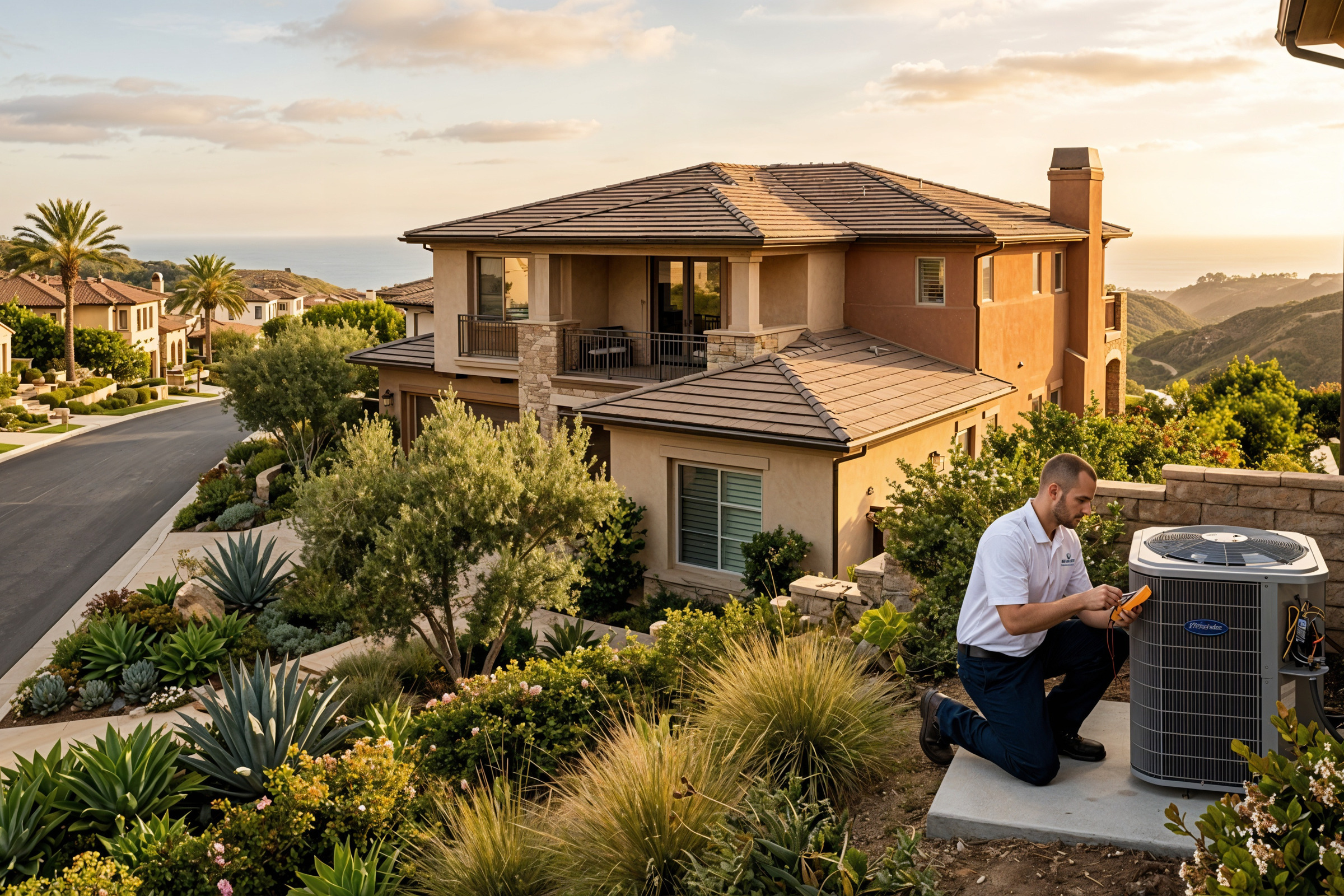
Why Maintenance Networks Matter in Luxury Single-Family Rentals
Tenant turnover in luxury single-family rentals costs $22,000–$38,000 when factoring in vacancy, marketing, screening, and lease-up expenses.
View chart data
| Category | Turnover cost per tenant |
|---|---|
| Minimum Cost | $22k |
| Maximum Cost | $38k |
Maintenance is a retention tool. I stopped treating it like a cost line to squeeze years ago. When someone is writing you a check for $14,000 every month to live in your Dana Point oceanfront property, they expect their irrigation controller fixed today, not Thursday. Our network delivers that speed without sacrificing quality, and I can show you the return in renewal rates.
Properties with sub-24-hour maintenance response achieve 18 percentage points higher renewal rates than the coastal California average.
View chart data
| Category | NextGen Portfolio (sub-24hr response) | Coastal CA Market Average |
|---|---|---|
| Lease Renewal Rate | 78% | 60% |
We track response time, vendor arrival, and tenant satisfaction for every work order across more than 200 managed units. Properties where we close tickets in under 24 hours renew at rates 18 percentage points above the coastal California average. That's three full years of dispatch data from our platform.
Tenants at this price point receive concierge treatment everywhere else in their lives. A faucet that drips for three days signals that you don't value their business. They'll find someone who does. A single turnover runs north of the low five figures once you add vacancy loss, marketing spend, screening costs, and lease-up labor. Keeping your existing tenant costs far less.
How We Screen Contractors for the NextGen Coastal Network
Fewer than one in four contractors who apply to our network make it through vetting. We start with licensing and insurance, then move to track record, and finish with a test job. Before anyone touches a property we manage, they clear these gates:
- Active California contractor license in the correct trade (C-10 electrical, C-20 HVAC, C-36 plumbing), with no disciplinary actions in the past five years
- General liability coverage of at least $2 million and active workers' comp for every employee on payroll
- Three verifiable references from property managers or commercial accounts in coastal markets
- Response-time guarantee: emergency calls answered in 60 minutes, on-site within four hours for urgent issues
- Transparent invoicing submitted within 24 hours of job completion, either flat-rate or itemized time-and-materials
- Labor warranty of 90 days minimum on all work, one year on major installs
- General liability insurance minimum $2M and workers' compensation coverage for all employees
Once they pass the paperwork review, we assign a test job. Usually it's something mid-complexity: water heater swap, electrical troubleshooting, pool system service. We watch their communication cadence, whether they show up on time, how they leave the site, and whether the repair holds. If they meet our bar, they go active. If not, we cut them loose before they ever talk to a tenant.
Service-Level Agreements and Performance Tracking
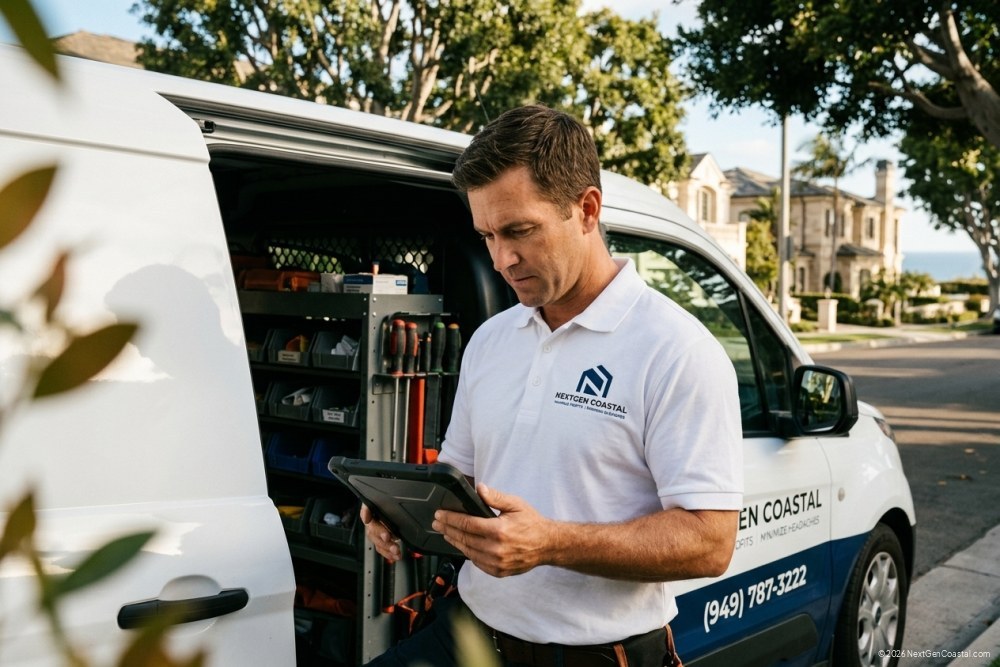
Every contractor signs a written SLA before they enter the rotation. The document spells out response windows, communication protocols, and quality thresholds. We customize terms by trade and by market, because a $16,000-per-month Laguna Beach lease commands different service than a $6,800-per-month Irvine townhome.
Response-Time Commitments
Emergency calls (no heat, no AC above 90 degrees, major leak, electrical hazard) require the vendor on-site within four hours. Urgent calls (appliance failure, minor plumbing issue, garage door malfunction) get a 24-hour window. Routine requests (landscaping tweak, cosmetic touch-up, preventive service) get scheduled inside 72 hours.
Communication Standards
Contractors confirm dispatch within 30 minutes via text or email to both tenant and our team. They document finished work with photos uploaded to the platform. Any repair projected to exceed $800 stops until we secure owner approval and a written scope.
Our platform grades every job. Tenants rate each completed ticket on a 1-to-5 scale. We monitor average response lag, first-time fix percentage, and invoice accuracy across the network. Contractors who fall below a 4.2 satisfaction average or miss response windows on more than 10 percent of dispatches get flagged for review. Repeat offenders exit the roster.
The best contractors in our network aren't just fast, they communicate proactively, they respect the tenant's time, and they leave the property cleaner than they found it. Those soft skills matter as much as technical competence in a luxury rental environment.
Trade Specialization Across Coastal Markets
You won't fix a Carrier Infinity system or a Navien tankless unit with a general handyman. Coastal luxury homes need trade specialists, and we maintain dedicated vendor relationships across eight core disciplines. We match the contractor to the equipment and the location.
HVAC
High-efficiency multi-zone systems, smart thermostats, and salt-air corrosion are standard in our portfolio. Our C-20 contractors specialize in Carrier Infinity, Lennox iComfort, and Daikin VRV platforms (the brands installed in most luxury new-construction and remodels along the coast).
Plumbing
Tankless water heaters, whole-house filtration, recirculation pumps, and smart irrigation controllers show up in nearly every property we manage. Our C-36 plumbers carry parts for Navien, Rinnai, and Rachio systems and can complete most repairs on the first trip.
Electrical
Smart-home integration, EV chargers, exterior lighting, and backup generators require C-10 expertise. We prioritize electricians certified in Lutron, Control4, and Tesla Wall Connector installation. Tenants paying $12,000-plus monthly expect those systems to function without troubleshooting.
Pool and Spa
Saltwater chemistry, variable-speed pumps, automated controls, and spa heaters are common in Orange County and San Diego coastal portfolios. Our pool techs hold CPO certification and stock inventory for Pentair, Hayward, and Jandy equipment.
Grounds & Yard Care
Drought-tolerant plantings, smart irrigation schedules, and HOA compliance requirements matter in every coastal market we serve. We work with C-27 licensed grounds contractors who understand coastal microclimates and adjust watering seasonally to avoid overwatering citations or dead turf complaints.
Appliance Repair
Sub-Zero, Wolf, Miele, Bosch. Factory-trained technicians protect warranty coverage and use OEM parts. We maintain direct relationships with authorized service providers for the major brands in our portfolio.
Locksmith and Security
Smart locks, keyless entry, and alarm systems appear in most of the homes we manage. Our locksmiths hold certification in August, Schlage Encode, and Yale platforms. They coordinate with our leasing team during turnover to rekey and reprogram access codes.
General Contracting
Larger between-tenant projects (kitchen updates, bathroom remodels, flooring replacement) go to licensed general contractors holding a B-license. They pull permits, manage subs, and deliver on schedule and on budget.

Coordination and Communication: The Operational Backbone
A vetted contractor roster is useless without a coordination layer connecting vendors, tenants, and owners. At NextGen Coastal, that layer is our proprietary work-order platform. It routes requests, tracks status in real time, and archives documentation for every maintenance event.
Here's the flow. A tenant logs a maintenance request through the portal. Say the dishwasher won't drain. The system tags the issue as urgent appliance, assigns it to our authorized Bosch technician, and auto-dispatches with property address, access notes, and tenant contact. The contractor confirms within 30 minutes and schedules directly with the tenant. After the repair, he uploads photos, submits an itemized invoice, and closes the ticket. The tenant receives a satisfaction survey. The owner sees the completed job in their monthly report.
This structure eliminates the phone-tag and email-chain mess that slows traditional property management. Average time from tenant request to contractor dispatch runs 47 minutes across our portfolio. Average on-site arrival for urgent issues is 3.2 hours. Those are trailing twelve-month figures.
We also calendar preventive maintenance through the platform. Every property gets seasonal HVAC tune-ups, annual water-heater flushes, semi-annual pool equipment inspections, and quarterly grounds reviews. These services auto-schedule, and contractors receive dispatch 72 hours ahead. Preventive work cuts emergency calls by roughly 30 to 40 percent and extends major system lifespan, which protects your capital investment.
Cost Control and Transparency for Owners
Maintenance is one of the largest variable line items in single-family rental operations. Owners deserve full visibility into every dollar going out the door. Our cost-control process starts with competitive bidding on any job above $1,200, continues with invoice auditing, and ends with monthly reporting that breaks spend down by category, property, and vendor.
We negotiate volume pricing with our highest-volume contractors. Because we dispatch more than 200 work orders monthly across the portfolio, we secure competitive rates on common services like HVAC tune-ups, plumbing diagnostics, and appliance service calls. Those savings flow straight to you.
We audit every invoice before cutting payment. Our team cross-checks line items against the original work order, verifies parts pricing against market rates, and confirms labor hours match scope. If something looks inflated, we push back. If a contractor consistently overbills, we drop them. Invoice accuracy across our network runs at roughly 97.4 percent (fewer than 3 percent require correction or dispute).
Owners receive a monthly maintenance report that includes:
- Summary of all work orders opened, completed, and pending
- Total maintenance spend by property and by trade
- Comparison to budget (if the owner has set a monthly or annual maintenance cap)
- Photos and documentation for every completed job
- Contractor performance scores and any vendor changes
This level of transparency matters when maintenance can swing from $400 per month in a quiet year to $2,800 per month when a major system fails. You need real-time data, not a December surprise.
Geographic Coverage Across Orange County, San Diego, and LA Coast
NextGen Coastal manages properties across three core coastal markets. Our maintenance network mirrors that footprint. We don't ask a single contractor to cover the entire region. We build market-specific vendor rosters that deliver fast response and local knowledge.
Orange County
This is our highest property density. We maintain vendor relationships in Newport Beach, Laguna Beach, Dana Point, San Clemente, Irvine, and the coastal-adjacent communities of Tustin, Orange, and Costa Mesa. Contractors here understand HOA rules, coastal building codes, and the service expectations of tenants paying $10,000 to $18,000 monthly.
San Diego
We manage luxury single-family rentals in La Jolla, Del Mar, Coronado, Point Loma, Carmel Valley, and Rancho Santa Fe. Our San Diego vendors handle coastal erosion, saltwater pool systems, and the permitting quirks of City of San Diego and County of San Diego jurisdictions.
LA Coast
Our LA portfolio concentrates in the South Bay (Manhattan Beach, Hermosa Beach, Redondo Beach) and Malibu. Contractors in this market deal with coastal commission requirements, seismic retrofit standards, and the logistical challenges of narrow canyon roads and gated beach colonies.
We also serve inland communities as far as the Inland Empire, Riverside County, and San Bernardino County. Our vendor network there includes contractors familiar with desert landscaping, evaporative cooling, and the temperature swings that stress HVAC equipment.
Emergency Response and After-Hours Coverage
Maintenance emergencies ignore the clock. A pipe bursts at 11 PM. Power fails during a heatwave. The garage door jams and traps a car inside. These situations demand immediate response, and our network is built to handle them.
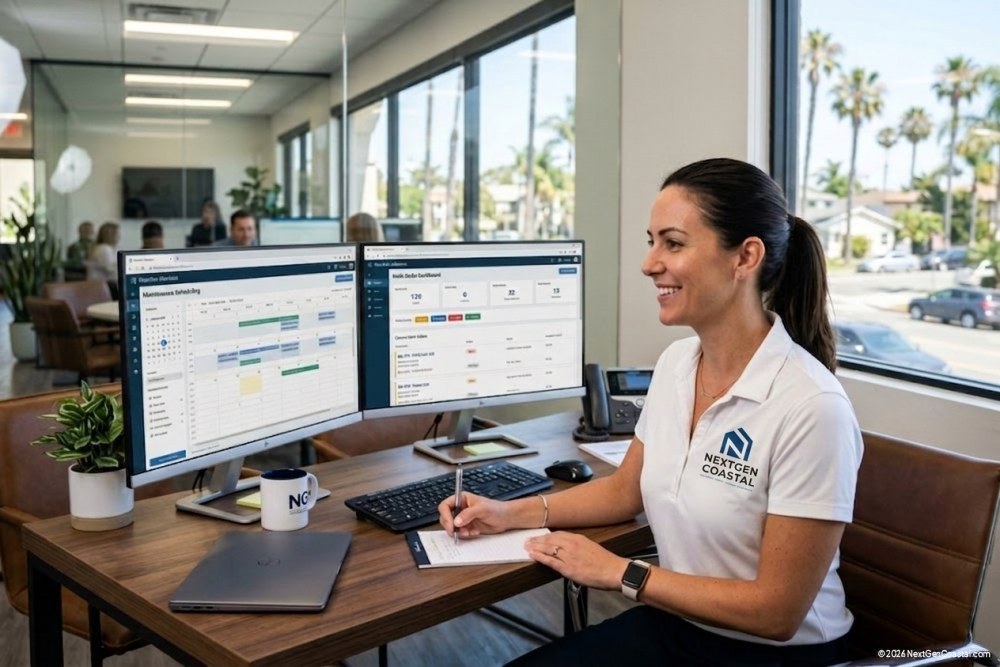
We run 24/7 emergency dispatch with live answer (no voicemail queue). Tenants call a dedicated emergency line, speak to a NextGen Coastal team member, and get contractor dispatch within 60 minutes. Our after-hours vendors carry the same licensing and insurance as daytime contractors.
We also define "emergency" explicitly in lease agreements and tenant handbooks so everyone understands what qualifies for after-hours dispatch versus what waits until morning. True emergencies (flooding, gas leak, electrical fire, no heat in winter, no AC when outdoor temps exceed 95 degrees, security breach) get immediate response. Non-emergencies (running toilet, tripped GFCI, stuck window) are logged and scheduled for next-business-day service.
After-hours dispatch costs more, typically 1.5 to 2 times standard rates. It's a necessary expense to protect the asset and keep tenants satisfied. Fast emergency response consistently ranks as one of the highest-rated service elements in our tenant surveys, and it contributes directly to our above-market renewal rates.
Vendor Retention and Long-Term Relationships
The best maintenance networks aren't transactional. We've worked with some core contractors for more than five years, and that continuity benefits everyone. Contractors who know our portfolio, understand our standards, and trust our payment cadence deliver faster, better work. They prioritize our tickets. They stock parts for the systems we manage most. They call when they spot a developing issue before it becomes a crisis.
We keep top vendors by paying promptly (invoices processed within five business days), providing consistent volume, and treating them as partners instead of interchangeable labor. We also refer our contractors to other managers and owners in our network when appropriate, which builds goodwill and strengthens the relationship.
Vendor turnover costs time and money. Every time we lose a contractor, we burn hours sourcing, vetting, and onboarding a replacement. Retention keeps our network stable and our service quality consistent.
What This Means for Owners
If you own a luxury single-family rental on the California coast, your maintenance network is either a competitive edge or a slow leak on rental income. Tenants paying $12,000 to $18,000 monthly have options. They'll move to a better-managed property if your response times lag or your contractors deliver mediocre work.
At NextGen Coastal, we've built a maintenance network that protects rental income, preserves property value, and delivers the service luxury tenants expect. Our 5.9 percent management fee includes full maintenance coordination with no hidden charges, no contractor invoice markup, and no surprise fees. You get transparency, speed, and expertise backed by a team managing more than 200 units across Orange County, San Diego, and LA coast markets.
The owners who work with us aren't shopping for the cheapest manager. They want the most competent one. If that describes you, let's talk about how our network can protect your investment and keep your tenants renewing year after year.
- Emergency response: on-site within four hours for issues that affect habitability, no heat, no AC in summer, major water leak, electrical hazard
- Urgent response: on-site within 24 hours for issues that impair functionality but not habitability, appliance failure, minor plumbing leak, garage door malfunction
- Routine response: scheduled within 72 hours for non-urgent maintenance, landscape adjustment, cosmetic repair, preventive service
- Communication standard: text or email confirmation to tenant and property manager within 30 minutes of dispatch; photo documentation of completed work
- Pricing cap: any job exceeding $800 requires owner approval before work begins, with written estimate and scope
Frequently Asked Questions
How does NextGen Coastal screen maintenance contractors?
What is the average response time for maintenance requests in NextGen Coastal's portfolio?
Do you mark up contractor invoices?
What trades are covered in your maintenance network?
How do you handle after-hours maintenance emergencies?