Dana Point's Market Position in 2026
Monthly rental rates span from ,500 for three-bedroom cottages to ,000+ for oceanfront estates, with a median of ,200.
View chart data
| Category | Monthly Rent |
|---|---|
| 3BR Cottage (Low) | $6,500 |
| Median Rental | $9,200 |
| 5BR Ocean Estate (High) | $18,000 |
Dana Point occupies a distinct middle ground in Orange County's coastal hierarchy. Newport Beach sits at the ultra-premium end, where price points can alienate even high-earning tenants; San Clemente anchors the lifestyle-focused lower tier, where surf culture sometimes dilutes investment-grade inventory. Dana Point offers accessible luxury, a genuine coastal setting, and a tenant pool that values finish quality without requiring concierge amenities in every property.
The portfolio we manage here reflects that positioning. Oceanview estates in Monarch Beach, hillside contemporaries in Niguel Summit, walkable single-family homes near the harbor and Lantern District. Rents vary widely by property type and location, but the median hovers near the mid-range for coastal Orange County. That price point attracts established professionals, relocating executives, and families seeking coastal living without the Newport premium.
Q1 2026 brought steady demand and disciplined pricing. The 2021–2022 frenzy is gone. Today's market rewards owners who understand their property's actual positioning. Overpriced listings languish; correctly priced homes lease within fourteen to twenty-one days. The difference often hinges on local expertise: knowing which streets command premiums, which upgrades matter to tenants, and how to present a home in a way that resonates with Dana Point's specific demographic.

Owner Returns: What the Numbers Show
Net yields after all costs range from 4.8% to 6.2%, with tenant retention at 64% and minimal vacancy periods.
View chart data
| Category | Performance Metrics (%) |
|---|---|
| Gross Yield (Low) | 5.2% |
| Gross Yield (High) | 6.8% |
| Net Yield (Low) | 4.8% |
| Net Yield (High) | 6.2% |
| Maintenance % of Rent | 6.1% |
Consider the twelve months ending March 2026. Across the Dana Point homes in our portfolio, owners experienced the following:
- Gross rental yields of 5.2% to 6.8% (annual rent divided by estimated property value)
- Net yields of 4.8% to 6.2% after management, maintenance, and reserves
- Eighteen-day average vacancy between tenants
- Tenant retention of 64% (renewals or extensions)
- Maintenance cost of 6.1% of annual rent
Those net yields require context. On a property valued at $2.1 million generating a 5.5% net return, annual net income totals approximately $115,500 after all costs. That is cash flow, not speculative appreciation. Because we operate at a 5.9% management fee rather than the industry-standard 10% to 12%, owners retain more of that income. On a $10,000-per-month rental, the difference is $410 to $610 monthly, or $4,920 to $7,320 annually, compared to traditional property management.
Maintenance costs in Dana Point run slightly higher than inland markets due to salt air, coastal weather, and the service expectations of luxury tenants. We budget 7% to 9% of annual rent for maintenance and reserves. Actual spend in 2025–2026 came in at 6.1%, a result of proactive upkeep, vetted contractor relationships, and systems that catch minor issues before they escalate into expensive failures.
"The difference between a 4.8% net yield and a 6.2% net yield on the same property often comes down to tenant quality, lease structure, and whether your manager is actually present on the coast, not routing work orders from an inland call center."
Tenant Quality and Our Screening Process
Yield figures tell half the story. The other half is tenant profile: who occupies your home and how they treat it.
In Dana Point we lease to a narrow demographic. Established professionals, often relocating from other coastal markets (San Diego, Bay Area, Seattle). Families prioritizing school districts and lifestyle. Occasionally, executives on corporate assignments. These tenants understand coastal living and the premium they are paying for it.
Interactive Tool
Coastal Rental Yield Calculator
Plug in a Dana Point (or any coastal SFR) acquisition to see cap rate, cash-on-cash, GRM, and monthly cash flow.

 Built by NextGen Coastal
Our screening process is rigorous and coastal-specific. Income verification at 3.5× monthly rent minimum, higher than the standard 3× threshold, because Dana Point rent levels require genuine financial stability. Credit pulled, employment verified directly with HR departments (not merely pay stubs), and landlord reference calls that probe beyond payment history. Did the tenant maintain the property? Communicate promptly? Would the landlord lease to them again?
We also screen for coastal lifestyle fit. A tenant relocating from Phoenix who has never lived near the ocean may not understand salt air maintenance expectations, may underestimate June gloom, or may discover that Dana Point's quieter charm does not match their expectation. Those mismatches produce early terminations and avoidable vacancy. Our leasing team, based in Costa Mesa and managing coastal properties daily, has the experience to identify red flags during showings and application conversations.
The result: tenant quality that protects your asset. In the past twenty-four months, zero evictions in our Dana Point portfolio, two early lease breaks (both corporate relocations with full notice and cooperation), and property condition at move-out that consistently meets or exceeds move-in standards.

Market Dynamics Shaping 2026 Performance
Several factors are influencing Dana Point luxury rental performance this year. Understanding them helps owners make informed decisions about pricing, timing, and property positioning.
First, inventory appears constrained. Dana Point lacks the new construction pipeline that Irvine or parts of San Diego enjoy. The luxury rental stock consists largely of existing single-family homes, and owners who might have sold in 2022–2023 are now holding and renting instead, waiting for more favorable rate environments and buyer sentiment. That supports rent levels.
Second, tenant preferences have shifted toward space and outdoor living. The work-from-home era did not end; it evolved. Tenants will pay premiums for home offices, outdoor spaces, and neighborhoods where they can walk to coffee, coastline, or parks. Dana Point delivers on all three, especially in pockets like Lantern District and the streets above Salt Creek. Homes with dedicated office space, usable yards, and walkability lease faster and command higher rents than comparable homes in car-dependent subdivisions.
Third, corporate relocation activity has stabilized. After the post-pandemic surge and subsequent pullback, steady corporate tenant demand has returned, particularly from tech, finance, and healthcare sectors. These tenants typically lease for twelve to twenty-four months, pay on time, and treat properties well. They are also less price-sensitive than individual renters, which supports the upper end of the Dana Point rental range.
Finally, interest rate volatility appears to be keeping some buyers on the sidelines, which may expand the luxury rental tenant pool. Families who would have purchased in Dana Point at 3.5% rates are renting at 7% rates, waiting for clarity. That is a potential tailwind for rental demand that may persist through at least mid-2026.
Why Boutique Coastal Management Matters
There is a reason we emphasize boutique coastal California specialization in everything we do. It is operational reality, not branding. Managing a luxury rental in Dana Point is fundamentally different from managing a condo in Riverside or a tract home in Temecula, and the management approach must reflect that.
Our headquarters sits in Costa Mesa, fifteen minutes from Dana Point. Our team lives and works on the coast. When a tenant reports a maintenance issue, we dispatch a contractor we have worked with for years who understands coastal properties, not a random Yelp vendor. When a showing needs to happen, our leasing agent drives from our office, not coordinating remotely from an inland hub. When an owner has a question about market positioning, they speak to someone who toured three Dana Point comps that week, not someone reading Zillow from out of state.
Our proprietary technology platform handles the operational heavy lifting: automated rent collection, digital maintenance requests, real-time financial reporting. But the judgment calls, the tenant interactions, the contractor relationships, and the market expertise are all human, local, and coastal-focused. That combination allows us to deliver boutique service at a 5.9% management fee instead of 10% to 12%. We are not a national franchise paying overhead for brand licensing and call centers; we are a focused coastal operation where every dollar of fee revenue goes toward better service, better technology, and better outcomes for owners.
We also do not manage everything. Our portfolio is 200+ coastal units, intentionally capped to maintain quality. Single-family luxury rentals in Newport Beach, Laguna Beach, Dana Point, La Jolla, Coronado, Santa Barbara, and Malibu. We do not chase volume; we pursue outcomes. That selectivity means we can be candid during onboarding. If a property is not positioned for strong rental performance, we will say so, even if it means walking away from a management contract.
What Sets Our Dana Point Management Apart
Owners in our Dana Point portfolio experience the following:
- Onboarding: Detailed property walkthrough, condition documentation with photos and video, and a custom maintenance plan based on the home's age, systems, and coastal exposure. We also provide a candid rental analysis: what the home will realistically lease for, what improvements (if any) would increase rent, and what tenant profile to expect.
- Marketing: Professional photography, drone footage for ocean-view properties, and listing copy that speaks to Dana Point's lifestyle, not generic "beautiful home" language. Syndication to all major platforms plus our network of corporate relocation contacts and local real estate agents.
- Tenant screening: Income verification at 3.5× rent, credit, employment, landlord references, and coastal lifestyle fit assessment.
- Lease execution: California-compliant lease agreements with coastal-specific addendums (salt air maintenance expectations, landscape care, HOA rules). Detailed move-in inspections conducted with the tenant present, establishing condition baseline and accountability from day one.
- Ongoing management: Monthly financial statements delivered by the tenth of the following month. Maintenance requests triaged within two hours. Quarterly property inspections (exterior and interior if tenant permits). Annual lease renewal conversations initiated ninety days before expiration, giving owners time to evaluate options.
- Financial transparency: Owners log into our platform and see every transaction: rent collected, expenses paid, reserves held. No surprises, no buried fees, no "miscellaneous charges." Our 5.9% management fee covers management; everything else is billed at cost.
This is not revolutionary. It is property management done correctly, with coastal expertise and priorities aligned with owner outcomes. But in a market where many managers juggle hundreds of units across multiple counties, that level of focus and transparency is increasingly rare.
How to Evaluate Your Dana Point Rental Strategy
If you own a luxury property in Dana Point and you are evaluating whether to hold and rent, sell, or switch management, consider the following framework:
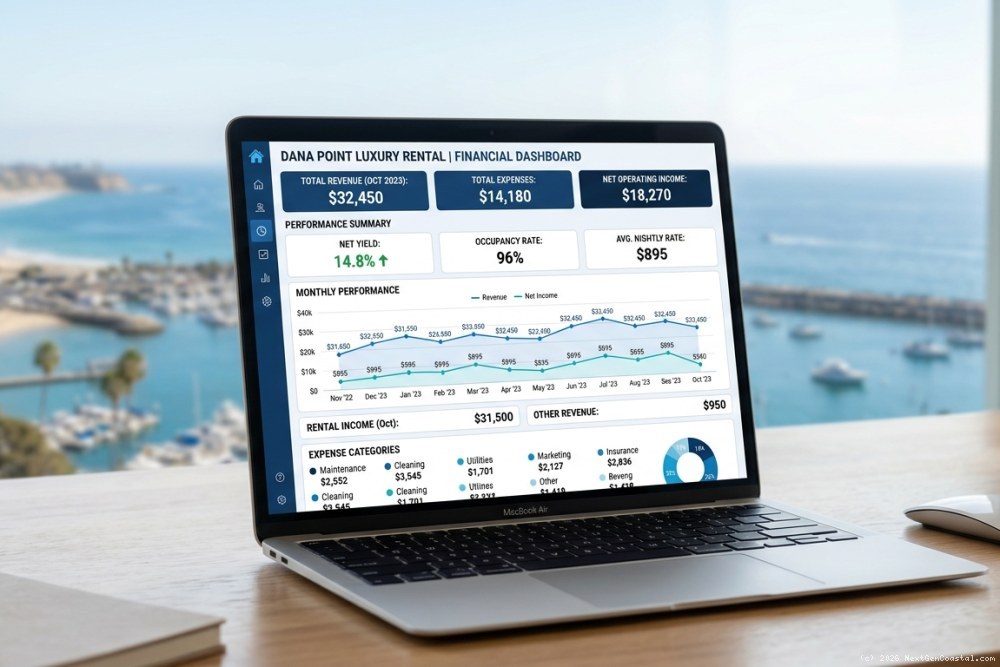
- Calculate your net yield after all costs. Annual rent, minus management fees (ours: 5.9%), maintenance and reserves (budget 7% to 9%), property taxes, insurance, and HOA dues. If you are netting below 4% and appreciation is not offsetting it, renting may not be the optimal strategy.
- Assess tenant quality and retention. If you cycle tenants every twelve months, incurring vacancy and turnover costs repeatedly, something in the screening or lease structure is not working. High-quality tenants in well-managed Dana Point homes typically stay eighteen to twenty-four months.
- Evaluate property positioning. Luxury tenants expect functional kitchens and baths, reliable HVAC, usable outdoor spaces, and interiors that feel current. If your home has not been updated since 2005, you are either leaving rent on the table or attracting tenants who do not match the neighborhood.
- Review reporting and communication. You should know your property's financial performance at any moment, and your manager should surface issues and opportunities before you have to ask. If you are chasing statements or discovering maintenance problems months after they occurred, you are with the wrong manager.
- Clarify your exit timeline. If you plan to sell in the next twelve to eighteen months, a long-term lease may not make sense. If you are holding for three to five-plus years, optimizing rental performance and tenant quality should be the priority.
We have these conversations with prospective clients regularly, and sometimes the answer is "renting does not make sense right now" or "you should sell." Honesty builds trust; signing a management agreement that leads to disappointment six months later does not.
Looking Ahead: Dana Point Rental Outlook
The outlook for Dana Point luxury rental performance through the remainder of 2026 and into 2027 appears favorable. Demand fundamentals appear strong: constrained inventory, steady corporate relocation activity, and a tenant pool that values coastal lifestyle and will pay for it. Rent growth will likely be modest (2% to 4% annually), but stability and consistent occupancy matter more than aggressive appreciation in a rental context.
The properties that will outperform are those with owners who understand positioning, invest in proactive maintenance, and work with managers who are present, transparent, and focused on outcomes. Dana Point is not a market where you can be hands-off and expect strong results. With the right approach, it is a market that delivers consistent, reliable returns and tenant quality that protects your asset over time.
For owners in our portfolio, that is exactly what the data suggests: net yields in the 4.8% to 6.2% range, tenant retention above 60%, and properties that are appreciating while generating income. It is not flashy, but it is sustainable, and in 2026, sustainability separates strong investments from mediocre ones.
Frequently Asked Questions
What rental yields are Dana Point luxury properties generating in 2026?
How does NextGen Coastal's 5.9% management fee compare to other property managers?
What tenant profile do Dana Point luxury rentals attract?
How long does it take to lease a luxury home in Dana Point?
What makes coastal property management different from inland management?