
The Frame: Representation Asymmetry and Its Consequences
For most of the modern history of California eviction practice, the defining feature of the unlawful detainer courtroom was not the law but the empty chair. Research cited in right-to-counsel advocacy has found that in Los Angeles, tenants appeared with an attorney in only a small minority of cases, while landlords were represented in the vast majority; similar patterns of representation asymmetry, though with varying proportions, have been documented in other major jurisdictions.
Interactive Tool
Contested Eviction Reserve Planner
Expected legal cost and carry for an unlawful detainer, weighted by the probability the tenant answers with counsel.

Right-to-counsel notice must accompany the termination notice.
Set near 100% for San Francisco; adjust for local program status and the tenant's likely eligibility.
Enter the quote from eviction counsel.
Motion practice, discovery, trial prep.
Cash-for-keys or rent waiver value.
 Built by NextGen Coastal
 The right-to-counsel movement exists to change that, and its results where implemented are well documented. New York City, which enacted a Universal Access law in 2017, reports through its Office of Civil Justice that approximately 84 percent of tenants represented under the program remained in their homes, and that residential eviction filings fell substantially in the covered ZIP codes relative to the rest of the city. Whether one reads that figure as tenants vindicated or as valid claims delayed depends on one's priors; the operative fact for a landlord is that a represented case ends differently, and later, than an unrepresented one.
California is now the largest laboratory for the model. Statewide unlawful detainer filings, which collapsed during the 2020 to 2022 moratoria, rebounded above 100,000 per fiscal year according to the Judicial Council of California's Court Statistics Report; Los Angeles County alone accounts for a disproportionate share of that total. The programs described below did not exist, or existed only as pilots, when most current leases were signed.
The Statutory Layer: AB 1487, AB 1577 and the Procedural Rewrites
Three distinct legislative threads converge on the 2026 eviction courtroom, and it helps to separate them because they operate on different mechanisms.
Funding: AB 1487 and AB 1577
The first thread is money. AB 1487 (2021) established the Homelessness Prevention Fund within the State Treasury and directed the Department of Housing and Community Development to distribute grants to qualified legal services organizations for eviction defense, pre-eviction counseling and related education; it did not create an individual entitlement, but it built the pipeline through which state dollars reach the legal aid providers who staff local programs. The framework associated with AB 1577 extends that approach, orienting state funding toward jurisdictions that commit to structured counsel programs and toward the data reporting that allows the Legislature to measure outcomes. The operator should read AB 1577 for what it is: not a statewide guarantee of counsel, which California has not enacted, but a financing and standardization layer that makes local guarantees cheaper for cities to adopt and therefore more likely to spread. The practical question for any given property is whether the local jurisdiction has taken the money and adopted the program, and that question is answered below.
Procedure: AB 2347 and the Ten-Court-Day Answer
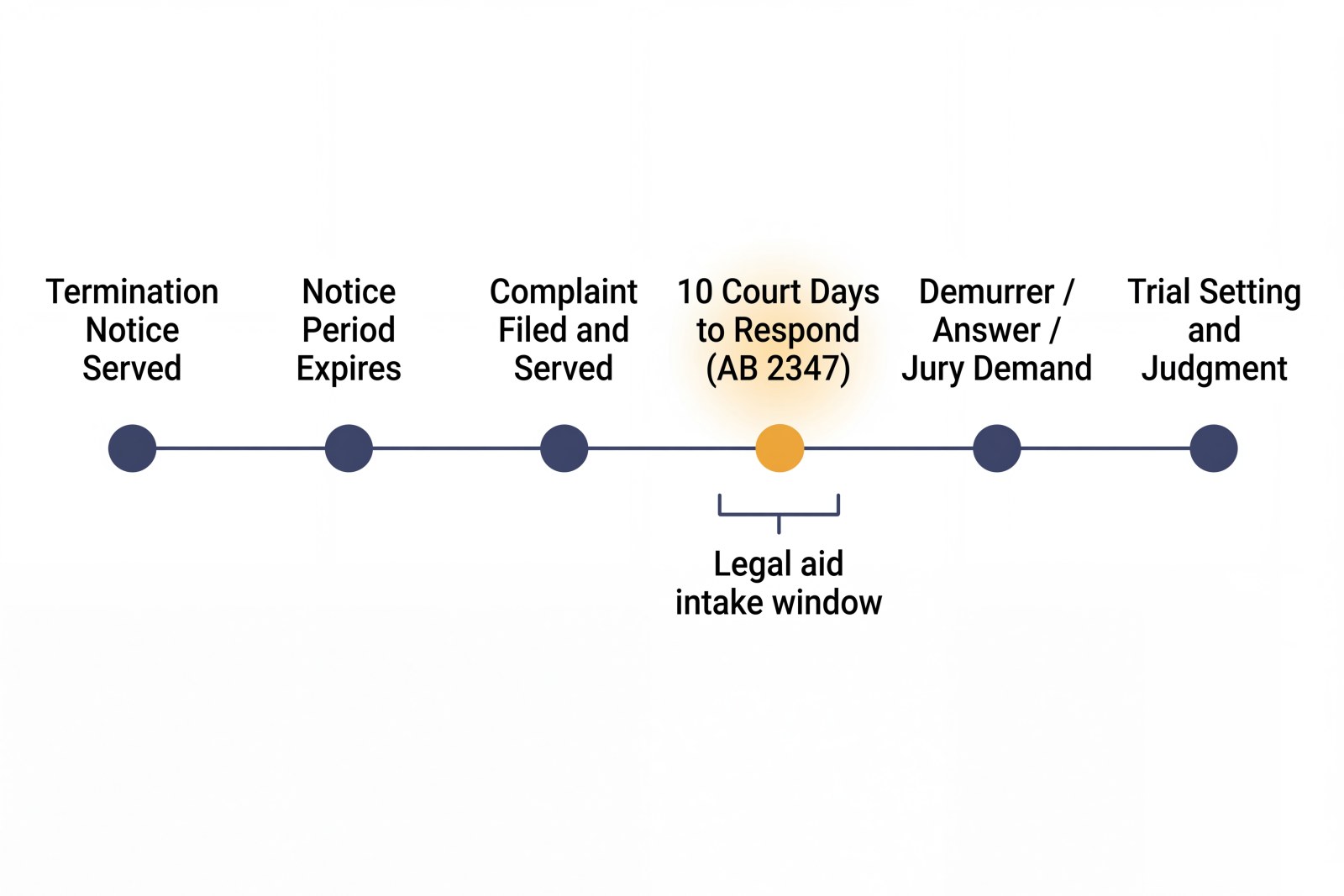
The second thread is procedural, and it applies everywhere in the state regardless of local ordinance. AB 2347 (2024) amended Code of Civil Procedure § 1167 to extend the defendant's time to respond to an unlawful detainer summons from five court days to ten, effective January 1, 2025. Five additional court days sounds trivial; in practice it is the difference between a tenant who cannot reach a legal aid intake line before default and one who can. The bill was drafted with the right-to-counsel programs explicitly in view, and legal aid organizations have reported that the longer window materially increased the share of defendants who file an answer or demurrer rather than defaulting. The same bill also clarified that a defendant may bring a motion to quash or a demurrer within that window, which, as discussed below, is where represented defendants do most of their early work.
Substance: SB 567 and the Enforcement of Just Cause
The third thread is substantive. SB 567 (Durazo, 2023), effective April 1, 2024, tightened the just-cause provisions of Civil Code § 1946.2 that AB 1482 created in 2019: an owner or relative move-in now requires that the owner occupy within 90 days and remain for at least twelve consecutive months; a substantial remodel must be described in the notice with permits attached; and the Attorney General, city attorneys and county counsel may sue for enforcement, with treble damages available for willful violations. Every one of those requirements is a defense a tenant's attorney can raise, and the represented defendant who can show a defective owner move-in notice does not merely defeat the eviction but may convert it into an affirmative claim.
Jurisdiction by Jurisdiction: Where Counsel Is Guaranteed
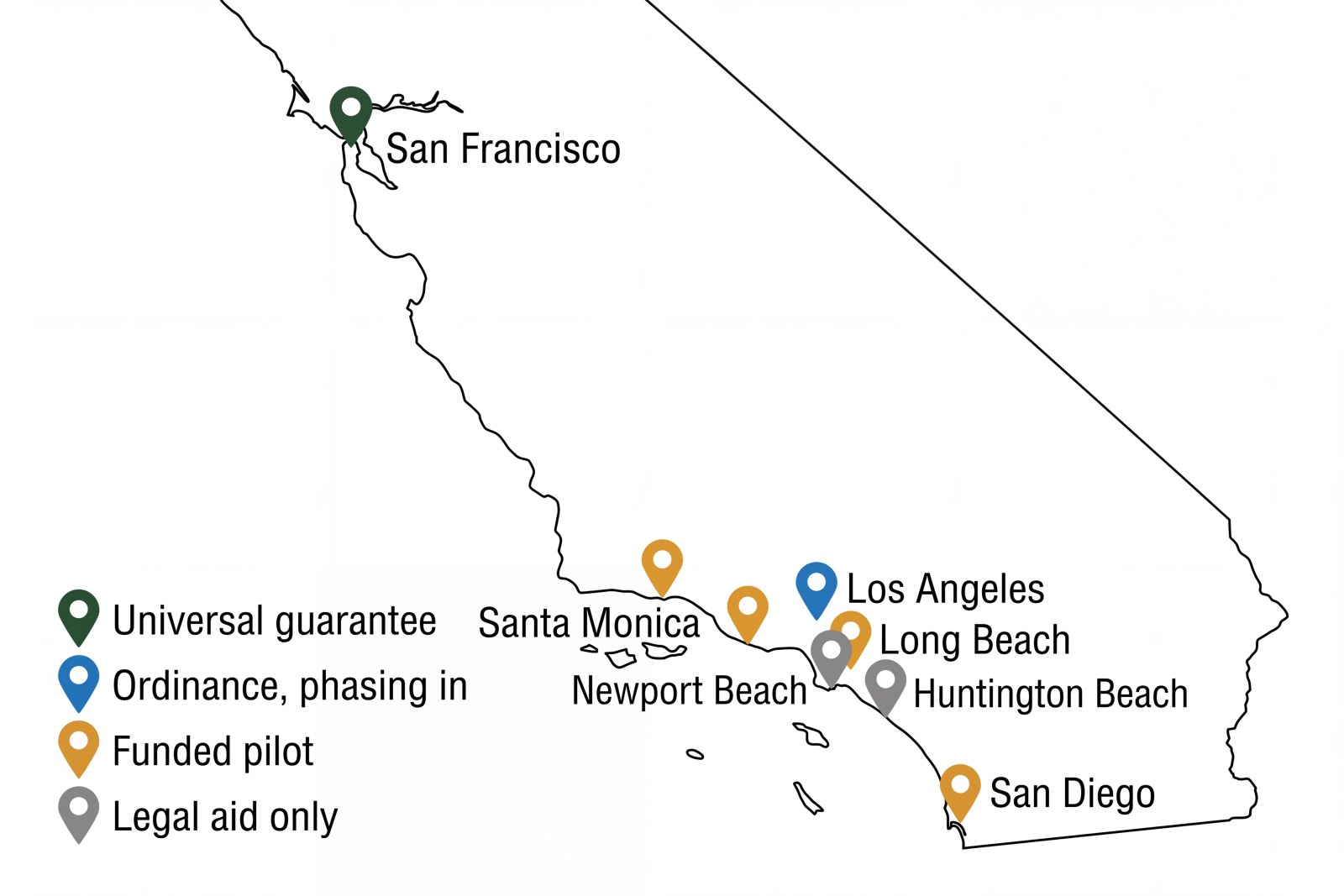
San Francisco's universal guarantee sits far above the ordinance-based, funded-pilot and legal-aid-only tiers that define representation odds elsewhere in coastal California.
View chart data
| Category | Program coverage level |
|---|---|
| Orange County Coastal / Ventura | 0 |
| Santa Monica / Long Beach / San Diego | 1 |
| City of Los Angeles | 1 |
| San Francisco | 2 |
California's right-to-counsel map is a patchwork of ordinances, funded pilots and general legal aid capacity, and the distinctions matter because they determine whether a tenant merely might find an attorney or is entitled to one.
San Francisco
San Francisco was the first California jurisdiction to adopt a universal guarantee. Proposition F, approved by voters in 2018 and codified at San Francisco Administrative Code Chapter 58, entitles every residential tenant facing an unlawful detainer to full-scope legal representation regardless of income. The program is administered through the Mayor's Office of Housing and Community Development and staffed by a consortium of legal aid organizations. Because eligibility is universal, the San Francisco landlord should assume from the outset that every filed case will be answered by counsel; the default judgment is functionally extinct there.
City and County of Los Angeles
Los Angeles arrived at the same destination by a longer route. The county launched Stay Housed L.A. in 2020 as a pandemic-era partnership between the Department of Consumer and Business Affairs and legal aid providers, offering representation to income-qualified tenants on a capacity-limited basis. The City of Los Angeles then adopted a Right to Counsel ordinance in late 2024, funded principally through revenues from Measure ULA, a documentary transfer tax that applies differential rates to high-value property sales, with thresholds indexed annually. The city program is being phased in geographically and by income tier, with households at or below 80 percent of area median income prioritized in the initial phases and a stated trajectory toward broader coverage as funding and provider capacity allow. The Board of Supervisors has moved on a parallel ordinance for unincorporated county territory. For the operator, the important compliance detail is the notice requirement: the city ordinance obligates the landlord to provide tenants with a written notice of the right to counsel, in a form prescribed by the Los Angeles Housing Department, alongside any termination notice, and the failure to do so is itself a defense.
Santa Monica and Long Beach
Santa Monica, which has operated one of the most litigated rent control regimes in the state since 1979, established a right-to-counsel program funded in part through a transfer tax measure approved in 2022 that dedicates proceeds to housing and homelessness prevention. The Santa Monica program is administered through the city's housing division in coordination with legal aid providers and the Rent Control Board; in a city where nearly every multifamily unit built before April 1979 is under the Charter's rent control article, the program layers a represented defense on top of an already demanding substantive regime. Long Beach funded a right-to-counsel pilot in the same period, initially through federal recovery dollars, and has continued it on a capacity-limited basis; the operator there should verify current funding status before assuming either universal or no coverage.
San Diego
The City of San Diego operates an Eviction Prevention Program through the Legal Aid Society of San Diego, launched in 2022 with an initial allocation from the city's American Rescue Plan funds and subsequently continued in the general fund budget. It is an income-qualified program rather than a universal guarantee, but it sits alongside the city's Tenant Protection Ordinance, effective June 2023, which extends just-cause protections beyond AB 1482 to tenancies from the first day of occupancy and imposes relocation assistance of two to three months' rent for no-fault terminations. Across San Diego County's Local Coastal Programs, from Oceanside to Imperial Beach, the incorporated cities outside San Diego proper generally rely on county legal aid capacity rather than dedicated programs.
Orange County and the Coastal Cities Without Programs
Within OC's coastal zone, no city has adopted a right-to-counsel ordinance as of this writing. Newport Beach, Huntington Beach, Laguna Beach, Dana Point and Costa Mesa tenants rely on the Legal Aid Society of Orange County and the Public Law Center, both of which receive AB 1487 funding and both of which have expanded eviction defense intake since 2022. The absence of a guarantee does not mean the absence of counsel; it means counsel is a function of provider capacity on the day the tenant calls. The operator in these cities should treat representation as probable in rent-controlled or subsidized units and possible elsewhere, and should not build a plan that depends on default.
- Universal guarantee, no income test: San Francisco (Admin. Code ch. 58).
- Ordinance-based guarantee, income-tiered and phasing in: City of Los Angeles; unincorporated Los Angeles County.
- Funded program, income-qualified, capacity-limited: Santa Monica, Long Beach, City of San Diego, Los Angeles County (Stay Housed L.A.).
- General legal aid only, AB 1487-funded: Orange County coastal cities, Ventura County, most of San Diego County outside the city.

How a Represented Defense Changes the Case
The question landlords most often ask about right to counsel is whether it makes eviction impossible. It does not. A tenant who has not paid rent for four months and has no habitability claim will, in the end, be evicted whether or not an attorney sits beside him. What changes is the path from filing to lockout, and the path is where the money goes.
The Pre-Answer Motion Practice
An unrepresented tenant who responds at all files a form answer. A represented tenant files a demurrer or a motion to quash service, and the distinction is consequential. A demurrer tests the complaint on its face: whether the notice attached to it complied with Code of Civil Procedure § 1161, whether the notice period was correctly computed, whether the just-cause ground pleaded is one Civil Code § 1946.2 recognizes, whether the amount demanded in a three-day pay-or-quit notice was precisely the rent due and nothing more. A motion to quash tests whether the summons was properly served under § 415.10 et seq. Either motion, once filed, takes the case off the summary track: it must be noticed, opposed and heard, and in the busier Los Angeles courthouses a hearing date may sit several weeks out. If the demurrer is sustained, the landlord starts over with a new notice, and the tenant's counsel has learned the landlord's theory of the case at no cost.
Discovery and the Jury Demand
Unlawful detainer discovery is expedited under Code of Civil Procedure § 1170.8, but it exists, and a represented defendant will use it. Requests for the rent ledger, all prior notices, maintenance records and code enforcement correspondence are routine; a deposition of the property manager is not unusual in a contested case. The jury demand is the more powerful tool. Either party may demand a jury in an unlawful detainer, and represented tenants do so as a matter of course because a jury trial cannot be set as quickly as a bench trial, requires the landlord's counsel to prepare instructions and voir dire, and introduces genuine uncertainty into a habitability defense that a judge might view skeptically. The § 1170.5 requirement that trial be set within 20 days of the request applies in theory; in practice, courtroom availability governs.
The Affirmative Defenses That Actually Work
Represented defendants win, when they win, on a short list of theories, and the operator who understands the list can audit for it before filing.
- Notice defects: an overstated rent demand, a miscounted notice period, a missing statutory statement, or, in Los Angeles, a missing right-to-counsel notice or a notice not filed with LAHD as the Rent Stabilization Ordinance requires.
- Breach of the warranty of habitability under Civil Code § 1941.1 and Green v. Superior Court (1974), which permits the tenant to argue that the rent demanded was not owed in full because the unit was substandard.
- Retaliation under Civil Code § 1942.5 where the termination followed a complaint to code enforcement or an exercise of a legal right within the prior 180 days.
- Just-cause noncompliance under § 1946.2 as amended by SB 567, particularly for owner move-in and substantial remodel terminations.
- Security deposit irregularities, which do not defeat an eviction directly but which counsel will raise as a cross-claim or a bargaining point, especially under applicable statutory documentation requirements.
A tenant's attorney does not need to win the case. The attorney needs to make the landlord's cost of proceeding exceed the landlord's cost of settling, and in a jurisdiction with a represented defense that threshold is reached earlier than most owners expect.
That dynamic explains why represented cases settle at high rates and why the settlement terms, typically a move-out date some weeks or months out, a waiver of the rent arrears, a neutral reference and a sealed record under Code of Civil Procedure § 1161.2, look the way they do. The landlord is buying certainty and time; the tenant is selling the litigation option.
Budgeting for Litigation Through 2026
At the calculator's illustrative defaults, a negotiated move-out costs roughly a third of the worst-case contested litigation outcome.
View chart data
| Category | Total cost, illustrative example |
|---|---|
| Negotiated Move-Out + 1 Month Carry | $10,800 |
| Expected Cost (50% Contest Probability) | $18,850 |
| Worst Case if Contested | $29,700 |
The traditional eviction budget in Southern California consisted of a flat attorney fee for an uncontested unlawful detainer, a filing fee, a process server and the sheriff's lockout fee, plus the rent lost between the notice date and repossession. That model assumed a default. The 2026 model must price the probability of a contested case and the cost conditional on contest, and it must do so per jurisdiction, because the probability varies enormously between a San Francisco building where representation is universal and a Dana Point duplex where it depends on a legal aid intake queue.
The Cost Components
A contested unlawful detainer with a represented defendant carries five cost categories, and the operator's counsel should be asked to quote each separately rather than as a blended flat fee.
- Pre-answer motion practice: opposing a demurrer or motion to quash, and if the demurrer is sustained, re-noticing and re-filing.
- Discovery: responding to document requests, preparing the property manager for deposition, and where the tenant asserts habitability, retaining an inspector.
- Trial preparation: exhibit binders, witness preparation and, if a jury is demanded, instructions and voir dire.
- Carry: rent forgone from the notice date to repossession, which in a contested Los Angeles case may run four to eight months longer than in a default, plus the utilities and insurance that continue regardless.
- Settlement consideration: the cash-for-keys payment or rent waiver that resolves the case short of trial, and in rent-stabilized jurisdictions the statutory relocation assistance, which for Los Angeles RSO units is set annually by LAHD and for San Diego no-fault terminations runs two to three months' rent under the Tenant Protection Ordinance.
The calculator above is built for this structure. It asks the operator to state the monthly rent, the flat fee for an uncontested case, the hourly rate and expected hours if the case is contested, the expected months to repossession under each scenario and the probability that the tenant will answer with counsel. The probability input is the one that requires judgment: in San Francisco it approaches certainty; in the City of Los Angeles it is high and rising as the phase-in proceeds; in the Orange County coastal cities it depends on the unit's rent level and the tenant's likely eligibility for legal aid, which generally tracks 200 percent of the federal poverty line or a local AMI threshold. The output is an expected cost, which is the number that belongs in the operating reserve, and a break-even against a negotiated move-out, which is the number that should inform the first settlement offer.
The operator who budgets for a contested case and receives a default has a windfall; the operator who budgets for a default and receives a jury demand has a crisis. The asymmetry argues for reserving at the contested figure in any jurisdiction with a funded program.
Pre-Filing Discipline: What Survives Scrutiny
The most reliable way to reduce the cost of a represented defense is to give the defense nothing to work with, and that is a matter of documentation practice established long before the notice is served. The following are the items a tenant's attorney will request in the first discovery set and the items that most frequently decide a demurrer.
- A rent ledger that reconciles to the penny with the amount demanded in any pay-or-quit notice; an overstated demand is fatal under California precedent and its progeny.
- Proof of service for every notice, executed by a person other than the owner where possible, with the method of service matching one of those authorized by Code of Civil Procedure § 1162.
- For Los Angeles units, the LAHD filing confirmation for the termination notice and the right-to-counsel notice in the prescribed form.
- Move-in and periodic inspection photographs with dates embedded, and a maintenance log showing response times to every tenant request.
- For owner move-in or substantial remodel terminations, the SB 567 disclosures: the identity of the person moving in, the permits pulled, and the relocation assistance tendered under Civil Code § 1946.2(d).
- Any code enforcement correspondence within the prior 180 days, reviewed for retaliation exposure under § 1942.5 before the notice is served.
None of these items is novel. What has changed is that in a right-to-counsel jurisdiction the probability that each will be examined by a trained adversary has moved from remote to near-certain, and the standard of care in property management has moved with it.
The Coastal Overlay: Ellis, Mello and Short-Term Rental Conversions
Two categories of eviction peculiar to the coastal zone deserve separate mention because they draw counsel from both the tenant bar and the land-use bar. The first is the Ellis Act withdrawal under Government Code § 7060 et seq., which remains available in every jurisdiction but which, within the coastal zone, triggers the Mello Act's replacement and feasibility requirements under Government Code § 65590 and, in Santa Monica, Los Angeles and San Diego, local implementing ordinances that impose additional noticing, relocation and re-rental restrictions. A represented tenant in an Ellis case will scrutinize the withdrawal notice, the recorded memorandum and the relocation payment, and will often coordinate with tenant organizations that track Ellis filings for later re-rental violations.
The second is the termination of a long-term tenancy to convert a unit to short-term rental use. Santa Monica prohibits the practice outright under Municipal Code Chapter 6.20, which permits only hosted home-sharing; Newport Beach caps short-term lodging permits and requires that no permit issue for a unit subject to the city's affordable housing covenants; and the California Coastal Commission has, in a series of appeals and Local Coastal Program certifications since 2016, treated the loss of long-term coastal housing to visitor serving use as a matter within its jurisdiction under Public Resources Code § 30213. A no-fault termination whose actual purpose is short-term rental conversion is not a just cause under § 1946.2, and a tenant's attorney who can demonstrate that purpose through listing history or permit applications has both a defense and a claim.
What the 2026 Plan Looks Like
The programs described here are not static. Los Angeles's phase-in is scheduled to broaden through 2026 as funding accumulates; Santa Monica and Long Beach are evaluating whether to convert pilots into ordinances; and the state funding stream that runs from AB 1487 through AB 1577 is designed to reward cities that do. The direction is unambiguous even where the pace is not.
The operator's response is correspondingly concrete. First, classify each unit in the portfolio by right-to-counsel status using the four tiers above, and record the classification in the property file alongside the AB 1482 exemption analysis. Second, obtain from eviction counsel a component-based fee schedule rather than a flat quote, and re-run the reserve calculation for each tier. Third, audit notice templates and documentation practices against the pre-filing list, with particular attention to the Los Angeles right-to-counsel notice and applicable statutory documentation requirements, both of which are new enough that many otherwise careful operators have not yet incorporated them. Fourth, adopt a settlement protocol that authorizes the property manager to make a negotiated move-out offer at the point the tenant's answer is filed by counsel, because the cost of that offer will rarely be lower than it is on that day.
The empty chair is being filled. The landlord who plans for the person sitting in it will spend less, and wait less, than the one who is surprised to find it occupied.
Frequently Asked Questions
Does California have a statewide right to counsel for tenants facing eviction?
How much longer does a contested unlawful detainer take when the tenant has an attorney?
What notice must a Los Angeles landlord give about right to counsel?