Why Energy Management Matters More in Coastal Vacation Rentals
Coastal vacation rentals carry structurally higher energy costs than long-term residential inventory for three reasons. First, guest behavior: transient occupants run HVAC at temperature extremes, leave windows open with AC running, and operate appliances without cost sensitivity. Second, building envelope: many coastal properties are older construction with single-pane windows, minimal insulation, and HVAC systems sized for occasional use rather than continuous occupancy. Third, utility rate structures: Southern California Edison and San Diego Gas & Electric offer time-of-use rate schedules that penalize peak consumption during summer afternoons — exactly when vacation guests are most likely to be in the unit running AC at 68°F.
Interactive Tool
Vacation Rental IoT Energy ROI Calculator
Model payback period and annual savings for your coastal STR portfolio

Enter as decimal: 0.6 = 60% of nights booked per year
June–September average without IoT
October–May average without IoT
Hardware + installation + integration
Optional; $0 if using DIY Home Assistant
 Built by NextGen Coastal
The result: a 1,800-square-foot coastal SFR in Newport Beach or Carlsbad with 60% annual occupancy may consume $340–$480/month in electricity during summer months, compared to $180–$240 for the same property under long-term residential occupancy. That $160–$240 monthly delta represents a potential opportunity. An IoT energy platform that cuts consumption 22% could recover $35–$53/month, or $420–$636 annually. At a typical all-in deployment cost of $1,200–$1,800 for a three-bedroom property, payback may occur in 19–34 months, and the savings compound over the asset hold period.
The Product Stack: What to Deploy and What to Skip
A functional IoT energy platform for a coastal vacation rental has four layers: HVAC control, outlet-level monitoring, water heating automation, and centralized analytics. Each layer addresses a distinct failure mode in guest energy behavior. The mistake most operators make is deploying only layer one — a smart thermostat — and assuming the job is done. That captures roughly 40% of the available savings. The remaining 60% lives in the other three layers.
HVAC Control: Ecobee vs Nest vs Sensi
The HVAC layer is non-negotiable. Guest-controlled thermostats in vacation rentals default to temperature extremes because the guest has no cost exposure. A smart thermostat with occupancy sensing and remote override capability is the single highest-ROI component in the stack. Three products are widely used in the STR market: Ecobee Smart Thermostat Premium, Google Nest Learning Thermostat (4th gen), and Emerson Sensi Touch 2.
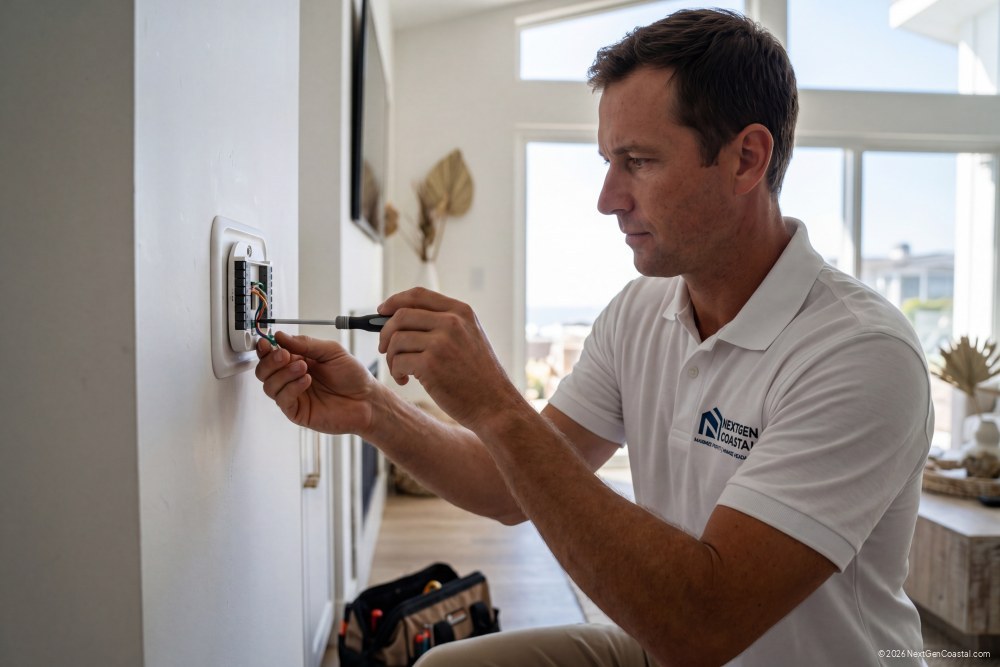
Ecobee is a strong choice for most operators. It has native occupancy sensing via built-in radar (no separate room sensors required for basic occupancy detection), API access for PMS integration, and geofencing capability that works with guest smartphone presence. The Premium model supports dual-fuel systems common in coastal properties and integrates with Alexa/Google Assistant for voice control — a guest-facing feature that reduces thermostat-override friction. All-in cost installed: $280–$320 per unit.
Nest is visually cleaner and has strong machine-learning algorithms for occupancy prediction, but the API is more restrictive. Google deprecated the Works with Nest program in 2023, which means third-party PMS integrations may be fragile. Use Nest if you're running a Google Workspace environment and can tolerate potential API changes. Cost: $260–$290 installed.
Sensi is the budget option at $180–$210 installed, but it lacks occupancy sensing entirely and requires manual scheduling. That makes it less suitable for vacation rentals where occupancy patterns are unpredictable. Consider it only if you're running a master-lease arbitrage model with predictable block bookings.
Outlet-Level Monitoring: Sense vs Emporia vs Shelly
The second layer is outlet-level monitoring. This is where you catch the phantom loads: window AC units left running in unoccupied bedrooms, space heaters in bathrooms, pool pumps running 24/7 because the guest doesn't understand the timer, electric water heaters cycling unnecessarily. A whole-home energy monitor with circuit-level granularity identifies these loads in real time and allows remote shutoff via smart plugs or breaker-level control.
Sense Energy Monitor is a leading option in this category. It installs at the main panel, uses machine learning to disaggregate individual appliance loads without requiring per-circuit CTs, and has a functional API for integration into home automation platforms. The solar-compatible version (required if the property has rooftop PV) costs $380; the standard version is $300. Installation by a licensed electrician adds $200–$350 depending on panel accessibility.
Emporia Vue 2 is a value alternative at $180 for the 16-circuit model, but it requires individual CT clamps on every circuit you want to monitor, which increases installation labor to $400–$600. The data granularity is strong for properties with complex electrical layouts (e.g., detached ADUs, pool equipment on separate panels), but the API is less mature and the mobile app is less polished. Use Emporia when you need per-circuit precision and have a cooperative electrician who won't charge hourly for CT placement.
Shelly EM is the DIY option at $90 for a two-channel monitor, but it's less suitable for vacation rentals because it requires per-device installation and has no centralized dashboard. Consider alternatives for this use case.
Water Heating Automation: Rheem EcoNet vs AO Smith iCOMM
Water heating is the third-largest energy consumer in a coastal vacation rental after HVAC and pool equipment. Electric resistance water heaters in vacation properties cycle continuously because guests use hot water unpredictably and the tank maintains temperature 24/7 even during vacancy periods. A smart water heater controller with vacation mode and occupancy-based scheduling can reduce water heating energy 30–40%.
Rheem EcoNet is a widely used option. It's a retrofit module that bolts onto most Rheem electric water heaters manufactured after 2015 and provides remote temperature control, leak detection, and vacation mode via a mobile app. The module costs $180; installation is $120–$180 if you're not already replacing the water heater. The API is functional but not extensively documented — expect to spend time with a developer if you want PMS integration.
AO Smith iCOMM is an alternative for properties with AO Smith water heaters. It has strong leak detection (it monitors both temperature and flow rate) and a cleaner API, but it's only compatible with AO Smith's Signature Premier series, which limits retrofit applicability. Cost: $200 for the module, $150–$220 installation.
If you're replacing a water heater in a vacation rental, consider specifying a heat-pump model (Rheem ProTerra or AO Smith Voltex) with native smart controls. The incremental cost over a standard resistance heater is $800–$1,100, but the energy savings can be 60–70% and the smart controls are integrated at the factory. Payback in a high-occupancy coastal STR may be 4–6 years.
Centralized Analytics: Enertiv vs Panoramic Power vs DIY
The fourth layer is centralized analytics. This is where you aggregate data from the HVAC controller, the energy monitor, and the water heater into a single dashboard that shows cost per booking, anomaly alerts, and trend analysis across your portfolio. Most operators skip this layer and try to manage energy manually by checking individual device apps. That works for a single property; it doesn't scale past three units.
Enertiv is an enterprise solution. It's a cloud platform that ingests data from any IoT device with an API, normalizes it into a common schema, and provides portfolio-level reporting with cost allocation by booking. The platform is overkill for operators with fewer than 10 units, but if you're managing 15+ vacation rentals it can deliver actionable intelligence without requiring a full-time analyst. Pricing is $40/unit/month with a 12-month minimum. The ROI threshold is roughly 8–10 units — below that, the subscription cost may exceed the incremental savings from better analytics.
Panoramic Power is a mid-market option at $25/unit/month, but it requires proprietary sensors (cost: $150/unit) and the API is read-only, which means you can't trigger automation rules from within the platform. Use it if you're already committed to Panoramic's sensor ecosystem for other reasons.
The DIY alternative is Home Assistant running on a local server with MQTT integration for all your IoT devices. This is a strong choice for operators with 3–8 units who have in-house technical capability or a developer on retainer. The software is free, the hardware (a Raspberry Pi 4 or Intel NUC) costs $150–$300, and the integration work is 8–12 hours for someone fluent in YAML and Python. The result is a fully customizable analytics dashboard with no recurring fees and complete data ownership. The downside: you own the maintenance burden, and if the server goes down you lose visibility until you fix it.

Integration Architecture: PMS Sync and Occupancy Detection
The product stack is necessary but not sufficient. The value in IoT energy management comes from automation rules that adjust device behavior based on occupancy state, and occupancy state must be derived from your property management system, not from motion sensors or geofencing alone. A guest who books a three-night stay but arrives six hours late shouldn't trigger HVAC pre-cooling at 2 PM if check-in is at 4 PM and they texted to say they're delayed. The thermostat needs to know the actual arrival time, and that data lives in your PMS.
The integration architecture has three components: a webhook listener that receives booking events from your PMS, a state machine that translates booking status into occupancy mode (pre-arrival, occupied, checkout, vacant), and automation rules that adjust device settings based on mode transitions. Most PMS platforms (Guesty, Hostfully, Lodgify, OwnerRez) support outbound webhooks for booking creation, modification, and cancellation. The webhook payload includes check-in/check-out timestamps, guest count, and booking ID. Your automation platform (Home Assistant, Hubitat, or a custom Node-RED flow) listens for these webhooks, updates the occupancy state, and triggers the appropriate device commands.
Occupancy Modes and Device Behavior
A functional IoT energy system for vacation rentals has four occupancy modes, each with distinct device behavior:
- Vacant mode (no booking, property empty): HVAC off or setback to 82°F cooling / 58°F heating. Water heater in vacation mode (120°F maintenance temperature). All smart plugs off except refrigerator and network equipment. Pool pump on timer (4 hours/day). This is the baseline low-power state.
- Pre-arrival mode (booking confirmed, guest arriving within 4 hours): HVAC pre-cool to 74°F starting 90 minutes before check-in (longer in summer, shorter in winter based on outdoor temperature delta). Water heater exit vacation mode and heat to 130°F. Pool pump run full cycle. Smart plugs for lamps and entertainment system turn on 30 minutes before check-in. This mode ensures the property is comfortable when the guest walks in without wasting energy on early pre-conditioning.
- Occupied mode (guest checked in, occupancy detected): HVAC in guest-control mode with temperature bounds (68–78°F cooling, 65–72°F heating) and occupancy-based setback (if no motion detected for 3 hours during daytime, setback to 76°F cooling / 66°F heating). Water heater at full temperature. Pool pump on guest-accessible schedule. Outlet monitoring active with anomaly alerts for loads >2 kW sustained for >4 hours.
- Checkout mode (guest departed, cleaning crew arriving within 2 hours): HVAC setback to 78°F cooling / 62°F heating. Water heater remains at full temperature for cleaning crew use. All guest-facing smart plugs off. This mode reduces energy use during the turnover window without making the property uncomfortable for the cleaning crew.
The mode transitions are triggered by PMS webhooks (vacant → pre-arrival, occupied → checkout) and by occupancy sensors (pre-arrival → occupied when the smart lock registers first entry). The occupancy sensors provide a fallback: if the PMS webhook fails or the guest arrives early, the system still transitions to occupied mode when the door unlocks.
Anomaly Detection and Remote Override
The second integration requirement is anomaly detection. Guests may do unexpected things with energy: they open windows and run AC, they turn on space heaters in July, they leave the oven on overnight. A functional IoT platform detects these anomalies in real time and either auto-corrects (e.g., shut off AC if a window sensor shows open for >10 minutes) or alerts the operator for manual intervention.
The detection logic is straightforward. For HVAC: if cooling demand exceeds 3 kWh/hour for >2 hours and outdoor temperature is below 75°F, flag it. For outlets: if any monitored circuit exceeds 1.5 kW sustained for >6 hours, flag it. For water heating: if the heater cycles more than 8 times in a 24-hour period, flag it (indicates a potential leak or a guest filling a bathtub repeatedly). The flags generate push notifications to the operator's phone and, optionally, trigger automatic shutoff for high-risk loads (space heaters, window AC units on smart plugs).
Remote override capability is important. If a guest calls to complain the AC isn't working and you can see from the dashboard that they've set the thermostat to 62°F and opened the sliding door, you need to be able to override the thermostat remotely, set it to 72°F, and lock the controls for 30 minutes while you call the guest to explain the issue. That requires API-level write access to the thermostat, which Ecobee and Nest both provide but many cheaper models do not.

ROI Modeling: Cost, Savings, and Payback
HVAC and energy monitoring represent 65% of total deployment cost, while capturing 70% of energy savings.
View chart data
| Category | Cost ($) |
|---|---|
| Smart Thermostat | $300 |
| Energy Monitor + Install | $615 |
| Water Heater Controller | $350 |
| Smart Plugs (4-6 units) | $150 |
| Integration Labor | $600 |
The all-in cost for a complete IoT energy stack in a three-bedroom coastal vacation rental is $1,800–$2,600 depending on product selection and installation complexity. That breaks down as follows: smart thermostat $280–$320, energy monitor $500–$730 (device + installation), smart water heater controller $300–$400 (device + installation), smart plugs for high-load outlets $120–$180 (4–6 plugs at $30 each), integration labor $400–$800 (webhook setup, automation rules, testing), and optional analytics platform subscription $300–$480/year.
The savings depend on baseline consumption, occupancy rate, and guest behavior, but a reasonable model for a 1,800-square-foot coastal SFR with 60% annual occupancy is as follows. Baseline summer electricity cost: $420/month. An IoT platform that reduces consumption 22% could save $92/month during June–September (4 months) and $58/month during October–May (8 months), for potential total annual savings of $832. At $2,200 all-in deployment cost, payback could be approximately 2.6 years. If you include the analytics platform subscription, payback may extend to 3.1 years.
The ROI may improve significantly in properties with higher occupancy or higher baseline consumption. A property with 75% occupancy and $520/month summer electricity cost could save $1,144/year, bringing payback down to approximately 1.9 years. Conversely, a property with 40% occupancy and $310/month summer cost might save only $614/year, pushing payback out to approximately 3.6 years. The breakeven occupancy for a 2.5-year payback is roughly 52% at typical coastal utility rates.
The mistake isn't in the decision to deploy IoT energy management — it's in the product selection and integration architecture. A smart thermostat alone captures 40% of the available savings. The remaining 60% requires outlet monitoring, water heating automation, and PMS-integrated occupancy detection.
Common Deployment Mistakes and How to Avoid Them
Most operators who deploy IoT energy management make one of three mistakes. First, they buy consumer-grade products without API access and discover six months later that they can't integrate with their PMS or automate occupancy-based rules. The fix: verify API availability and documentation quality before purchasing any device. If the manufacturer's developer portal is a dead link or the API docs are significantly outdated, skip the product.
Second, they deploy the hardware but never configure the automation rules, so the system operates in manual mode and delivers minimal savings. A smart thermostat that requires the operator to log in and adjust the schedule before every check-in is not meaningfully better than a programmable thermostat. The fix: budget 8–12 hours for integration work and treat it as a capital expense, not an operational task. If you don't have in-house technical capability, hire a home automation consultant or a developer with IoT experience. The going rate in Southern California is typically $100–$150/hour; expect to spend $800–$1,800 for a complete integration.
Third, they install energy monitoring but never look at the data, so anomalies go undetected and the system becomes unused. The fix: set up push notifications for high-priority alerts (HVAC runtime >12 hours/day, outlet load >1.5 kW sustained, water heater cycling >8x/day) and commit to reviewing the dashboard weekly during high season. If you're not willing to do that, consider deploying just the HVAC and water heater controllers with basic occupancy automation. You'll capture 70% of the savings at 60% of the full-stack cost.
The 2026 Product Landscape: What's Changed
The IoT energy management market for vacation rentals has matured significantly since 2023. Three trends are worth noting. First, PMS platforms are building native energy integrations. According to industry reports, Guesty added Ecobee integration in late 2025; Hostfully and Lodgify are expected to follow in 2026. This eliminates the need for custom webhook listeners and reduces integration labor from 8–12 hours to 1–2 hours. If you're on one of these platforms, waiting for the native integration before deploying could save you $600–$1,200 in developer fees.
Second, utility companies in California are piloting demand-response programs for vacation rentals. According to available information, SCE's Summer Saver STR program offers incentives for allowing the utility to remotely cycle your AC compressor during peak demand events (2–6 PM on hot weekdays). Participation requires a smart thermostat with OpenADR 2.0 support, which currently means Ecobee or Honeywell. The program signals that utilities are starting to recognize vacation rentals as a distinct load category, which may lead to more favorable rate structures in 2027–2028.
Third, the cost of whole-home battery storage has dropped significantly, making it potentially economical for high-occupancy coastal vacation rentals with rooftop solar. A Tesla Powerwall 3 costs approximately $11,500 installed (after federal tax credit) and stores 13.5 kWh. In a property with 5 kW of solar and 75% occupancy, the battery could enable time-of-use arbitrage (charge from solar during midday, discharge during evening peak) worth approximately $80–$110/month in avoided demand charges. Payback could be 8–10 years, which is marginal, but if you're already replacing an aging solar inverter the incremental cost drops to approximately $8,000 and payback could improve to 6–7 years. This is a 2026–2027 decision, not a 2026 deployment, but it's worth modeling if you're planning a solar retrofit.

What to Do in 2026
If you're operating coastal vacation rentals in Southern California and you haven't deployed IoT energy management, a reasonable approach in 2026 is to start with HVAC and water heating automation on your highest-occupancy properties and expand from there. Deploy Ecobee thermostats with PMS integration, add Rheem EcoNet or AO Smith iCOMM controllers to your water heaters, and configure basic occupancy-based automation rules (vacant mode, pre-arrival mode, occupied mode, checkout mode). That captures 70% of the available savings at 60% of the full-stack cost and could pay for itself in 18–26 months.
Once the HVAC and water heating layers are stable, consider adding outlet-level monitoring (Sense or Emporia) and anomaly detection. This is where you catch the high-cost edge cases — space heaters left on, window AC units running 24/7, pool pumps stuck in manual mode. The incremental cost is $500–$730 per property and the incremental savings could be $180–$280/year, so payback could be 2.0–3.2 years.
The analytics layer (Enertiv or Home Assistant) is optional until you cross 8–10 units. Below that threshold, you can manage energy manually by checking device apps weekly and responding to anomaly alerts. Above 10 units, the operational burden of manual monitoring may exceed the cost of a centralized platform, and the portfolio-level insights (which properties are over-consuming, which automation rules are underperforming, which guest behaviors are driving cost) become valuable enough to justify the subscription or the DIY integration effort.
The operators who deploy IoT energy management in 2026 could capture $800–$1,400/year/property in savings that their competitors are leaving on the table. That's a meaningful amount — it's 1.2–1.8% of gross revenue on a $65,000/year vacation rental, and it compounds over the hold period. The capital requirement is modest, the payback is predictable, and the operational complexity is manageable. There's no reason to defer this past Q2 2026.
Frequently Asked Questions
What is the minimum property count where IoT energy management makes economic sense for vacation rentals?
Can I use consumer-grade smart home products like Amazon Smart Thermostat or Google Nest Mini for vacation rental energy management?
How do I integrate IoT energy devices with my property management system if the PMS doesn't have a native integration?
What is the typical energy savings percentage from IoT management in a coastal California vacation rental?
Should I deploy battery storage alongside IoT energy management for my vacation rental?