Angle Stops: The $8 Part That Causes $18K Floods
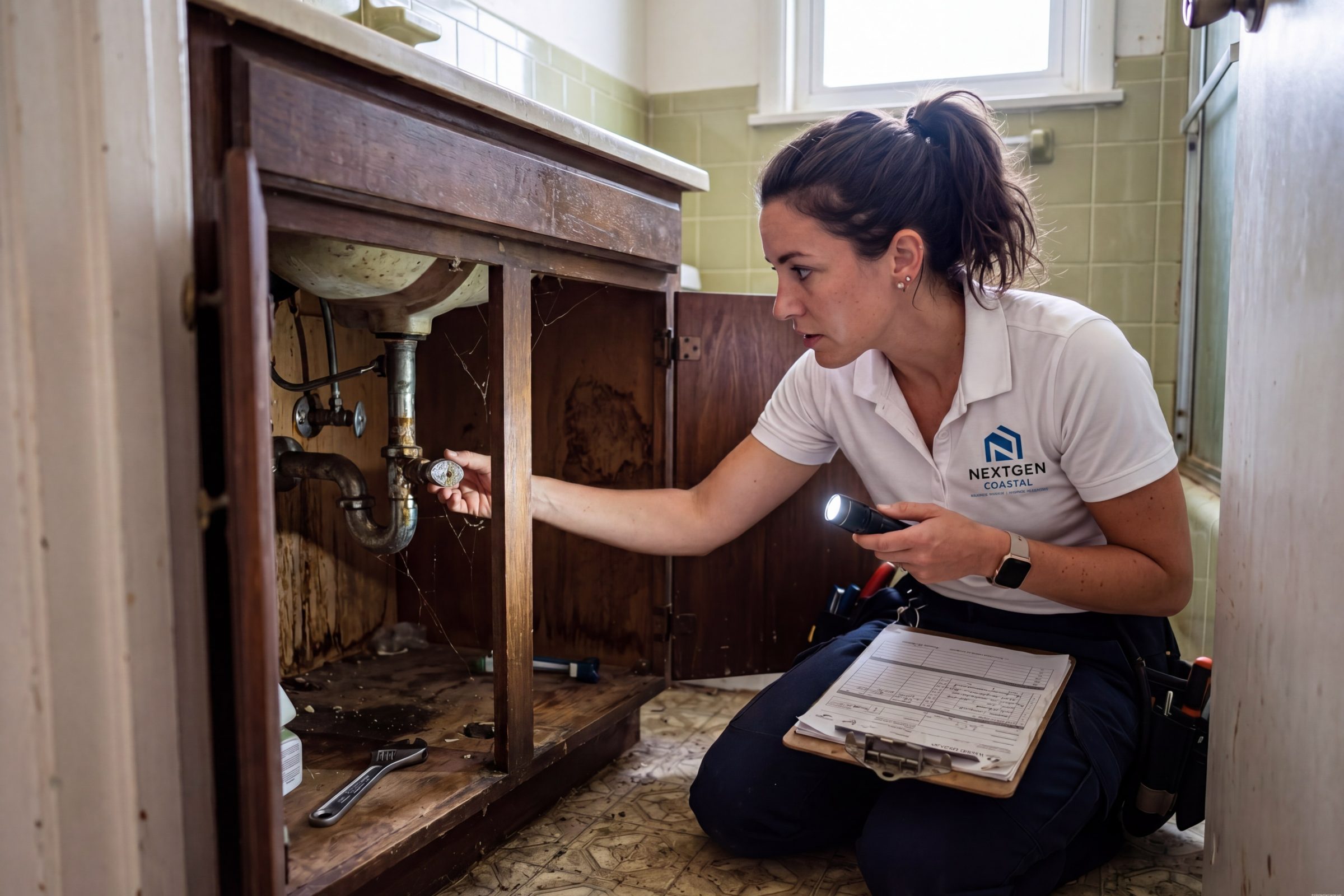
Every sink and toilet in your building has an angle stop. That's the small chrome valve under the fixture that lets you shut off water to that one appliance without killing the whole building. On coastal properties built in the 1970s and 1980s, those angle stops are original. The valve stem corrodes from the inside. The packing nut loosens. Water starts weeping around the stem at a rate so slow tenants don't notice it.
Interactive Tool
Coastal Building Maintenance Cost Calculator
Compare annual preventive maintenance cost vs. deferred-maintenance consequences

Total residential units in the building
Professional inspection fee, or $0 if you do it yourself
Angle stops, GFCI outlets, flashing reseal, filters, caulk
 Built by NextGen Coastal
I check every angle stop in every unit during the annual walk-through. Turn the valve off, then back on. If it's stiff or if you see any moisture on the stem or packing nut, it gets replaced. An angle stop costs $8. Installation takes twenty minutes if you're working alone. A failed angle stop that floods a unit costs $4,000 to $18,000 depending on how long the water ran and how many floors it hit.

The Oceanside eight-plex had three units with active leaks and two more with valves so corroded they wouldn't turn. I replaced all five for $180 in parts and four hours of labor. If the owner had waited another year, at least two of those would have failed completely. One was directly above the laundry room. A flood there would have taken out the washers, the electrical panel, and the drywall in the unit next door.
Water Heaters: Three Failure Modes, One $25K Consequence
Coastal water heaters can fail in multiple ways. The anode rod may corrode within several years if not replaced. The T&P valve may stick open or closed around year 8 or later. The tank wall can develop pinholes at year 10 to 12 or beyond because salt air can accelerate internal rust through small failures in the glass lining.
I open the access panel on every water heater during the walk-through. Check the manufacture date on the label. If the unit is older than 8 years and there's no maintenance log showing anode-rod replacement, I assume the rod is gone. Pull the T&P valve lever. If water doesn't flow or if it flows and won't stop, the valve is failed. Look at the floor under the tank. Any rust staining or moisture means the tank is leaking and you're on borrowed time.
Replacing a water heater costs $1,800 to $2,400 depending on capacity and whether you need a permit. A water heater failure that floods three floors below it can cost $25,000 to $40,000 in drywall, flooring, lost rent, and emergency mitigation. I have observed this scenario twice in the last three years. Both times the owner knew the unit was old and kept saying they'd replace it next quarter.
If you own a building older than 30 years on the coast and you've never proactively flushed your water heaters, you're carrying a ticking time bomb in every unit.
The annual check takes ten minutes per unit. Test the T&P valve. Check the manufacture date. Look for rust or moisture. If the unit is over 10 years old, budget for replacement in the next 12 months. If it's over 12 years old, replace it now. The $1,800 you spend today is cheaper than the $25,000 you'll spend when it fails at 2 a.m. on a holiday weekend.
Electrical Panels and GFCI Outlets: The Invisible Failures
I open the main electrical panel in every building I inspect. Look for discoloration on the bus bars. That's the copper or aluminum strips that distribute power to the individual breakers. Any black or green discoloration means corrosion. Corrosion means resistance. Resistance means heat. Heat means fire risk.
Coastal air is hard on electrical systems. Salt accelerates oxidation on every connection. Breakers that were rated for 20 amps in 1975 are now carrying 18 amps but generating twice the heat because the contact surfaces have corroded. I've pulled panels in buildings where the bus bars were so corroded the breakers weren't making full contact. The building was running on half its designed capacity and nobody knew until an AC unit wouldn't start.

GFCI outlets are the other invisible failure. Every bathroom, kitchen, and exterior outlet in a modern building has ground-fault protection. The test button on the outlet is supposed to trip the circuit when you press it. On buildings older than 25 years, a significant portion of GFCI outlets I test are non-functional. The outlet still provides power but it won't trip on a ground fault. That means no protection if a tenant drops a hair dryer in the sink.
I test every GFCI outlet during the walk-through. Press the test button. The outlet should click and the reset button should pop out. If it doesn't, the outlet is failed and needs replacement. A GFCI outlet costs $18. Installation takes fifteen minutes. The liability exposure from a non-functional GFCI is significant.
Roof Flashing: The $340 Fix That Prevents $12K Water Damage
I walk every roof during the annual inspection. Not looking for missing shingles. Looking at the flashing around every penetration. Chimney flashing. Vent stack flashing. Skylight flashing. Any place where metal meets roofing material is a potential leak point.
Flashing fails in two ways. The sealant dries out and cracks. The metal itself corrodes through. Both failures let water into the building. Water follows the path of least resistance. It runs down the inside of the wall cavity until it hits a horizontal surface. By the time you see a ceiling stain, the water has been running for months.
I check flashing by looking for gaps. If I can see daylight between the flashing and the roofing material, water is getting in. If the sealant is cracked or missing, water is getting in. If the metal is rusted through, water is getting in. Resealing flashing costs $120 to $340 depending on how many penetrations you have. Repairing water damage from a failed flashing costs $8,000 to $12,000 if it's been running for a year.
Last year I walked a 1981 sixplex in Carlsbad. The owner had a persistent leak in one unit. Three roofers had been out. All three said the roof was fine. I went up and found a vent stack with flashing so corroded there was a half-inch gap on the downhill side. Water was running straight into the wall every time it rained. We resealed the flashing for $180. The leak stopped. The owner had already spent $2,400 on interior repairs trying to chase the problem from below.
Crawlspace and Foundation: What You Can't See From Inside
If the building has a crawlspace, I go under it. Looking for three things. Standing water. Damaged vapor barrier. Subfloor rot.
Standing water means a drainage problem or a plumbing leak. Either way it needs to be fixed before it rots the floor joists. I have been under buildings where the crawlspace had six inches of water and the owner had no idea. The tenants never reported anything because the water never came up through the floor. But the joists were rotting and the subfloor was starting to sag.
Vapor barrier is the plastic sheeting on the crawlspace floor that keeps ground moisture from rising into the building. On older buildings the vapor barrier is torn or missing. Ground moisture rises. Subfloor gets damp. Mold grows. Joists rot. Replacing vapor barrier costs $800 to $1,800 depending on square footage. Replacing rotted joists and subfloor costs $12,000 to $30,000.
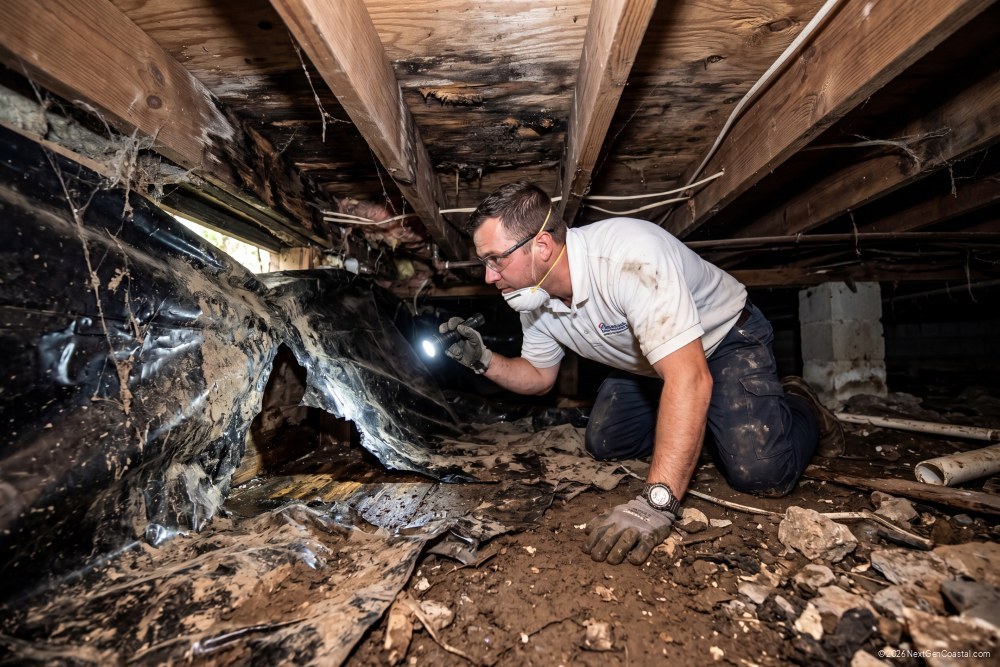
Subfloor rot shows up as soft spots when you walk the units. But by the time you can feel it from above, the damage is already severe. I check from below by pressing on the subfloor with a screwdriver. If the wood is soft or if the screwdriver sinks in, the subfloor is compromised. Catching it early means a $400 patch. Catching it late means a $8,000 floor replacement.
HVAC Systems: The Maintenance Nobody Does
I pull the filter on every HVAC unit during the walk-through. Many times the filter hasn't been changed in a year. A clogged filter makes the system work harder. The blower motor runs hotter. The evaporator coil ices up. The compressor cycles more frequently. All of that shortens the system's life.
A filter costs $6. Changing it takes two minutes. An HVAC system that fails early because of poor maintenance costs $4,500 to $7,200 to replace. I have observed systems fail at year 8 that should have lasted to year 15. The only difference was whether the filter got changed every 90 days.
I also check the condensate drain line. That's the small PVC pipe that carries water away from the evaporator coil. On coastal buildings the drain line clogs with algae. Water backs up. The overflow pan fills. If the pan doesn't have a working float switch, water spills onto the ceiling below. I have seen $6,000 in ceiling and drywall damage from a clogged condensate line that cost $40 to clear.
Exterior Siding and Paint: The Slow Failures
I walk the exterior of every building looking for paint failure and siding damage. Not cosmetic issues. Structural issues. Any place where water can get behind the siding is a problem.
Paint fails on coastal buildings faster than inland. Salt air breaks down the binder. The paint chalks and cracks. Water gets behind it. The wood swells. The paint peels further. The cycle accelerates. Repainting a building costs $8,000 to $18,000 depending on size. Replacing siding that rotted because the paint failed costs $25,000 to $60,000.
I look for three things. Peeling paint at the bottom of walls where water splashes up from the ground. Cracked caulk around windows and doors. Loose or damaged siding boards. All three let water in. All three are cheap to fix if you catch them early. A tube of caulk costs $4. Replacing a rotted wall section costs $2,400.
Cost Breakdown: Prevention vs. Consequence
Here's what the annual walk-through costs versus what you pay when you skip it.
- Angle stops: $8 per valve, 20 minutes labor. Failure cost: $4,000 to $18,000 per flood event.
- Water heater proactive replacement: $1,800 to $2,400. Failure cost: $25,000 to $40,000 including flood damage to lower units.
- GFCI outlet replacement: $18 per outlet, 15 minutes labor. Failure cost: significant liability exposure, potential injury claim.
- Roof flashing reseal: $120 to $340. Failure cost: $8,000 to $12,000 in water damage and mold remediation.
- Crawlspace vapor barrier replacement: $800 to $1,800. Failure cost: $12,000 to $30,000 in joist and subfloor replacement.
- HVAC filter replacement: $6 per filter, 2 minutes labor. Failure cost: $4,500 to $7,200 premature system replacement.
- Exterior caulk and paint touch-up: $200 to $600 annually. Failure cost: $25,000 to $60,000 siding replacement.
Total annual cost for a 90-minute inspection plus minor repairs on an eight-unit building: $1,200 to $2,400. Total cost of one major failure you didn't catch: $8,000 to $40,000. The math is clear.
The 90-Minute Protocol
Here's the checklist I run on every building. Ninety minutes for an eight-unit property. Longer if I find problems.
- Test every angle stop under every sink and toilet. Replace any that are stiff or weeping.
- Check manufacture date on every water heater. Test T&P valve. Look for rust or moisture. Budget replacement for any unit over 10 years old.
- Open main electrical panel. Inspect bus bars for discoloration. Test every GFCI outlet in the building.
- Walk the roof. Inspect flashing around every penetration. Look for gaps, cracks, or rust-through.
- Enter crawlspace if accessible. Check for standing water, damaged vapor barrier, subfloor rot.
- Pull filter on every HVAC unit. Check condensate drain line for clogs.
- Walk building exterior. Look for paint failure, cracked caulk, loose siding.
The inspection itself is free if you do it yourself. Hiring it out costs $300 to $600 depending on building size. The repairs you catch early cost $1,200 to $2,400 annually. The repairs you catch late cost $8,000 to $40,000 per incident. Run the inspection every year. Budget for the small fixes. Avoid the large disasters.
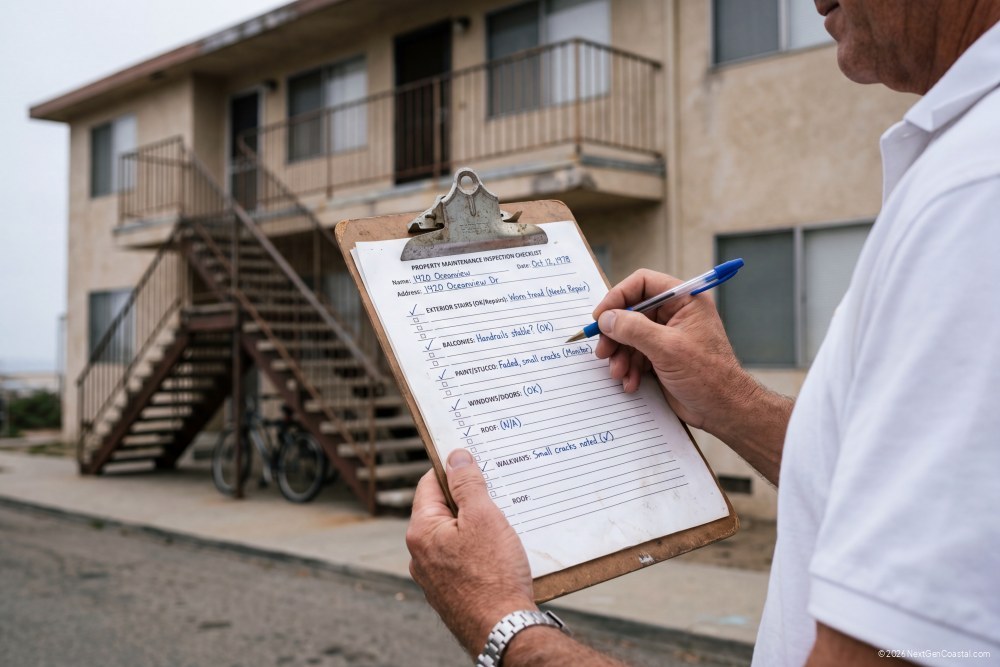
Documentation: The Part Nobody Does
I photograph every problem I find during the inspection. Not for the tenant. For the owner. When you're budgeting capital expenditures two years out, you need to know what's coming. A photo of a corroded angle stop today becomes the justification for a $4,000 plumbing line item next year.
I also log every repair in a maintenance database. Date, unit number, problem, fix, cost. When the building sells, that log is worth money. It shows the buyer that the property has been maintained. It reduces their risk. It justifies a higher price. According to industry experience, buyers may pay a premium for a building with a complete maintenance log versus one with no records.
The documentation takes an extra thirty minutes after the inspection. It's worth it. The log protects you in a habitability dispute. It protects you in a sale. It protects you when you're trying to remember whether you replaced the water heater in unit 3 or unit 4.
Frequently Asked Questions
How often should I inspect a 30+ year old coastal multifamily building?
What's the most common failure on aging coastal apartment buildings?
When should I replace a water heater proactively?
How do I know if my building's electrical panel is corroded?
What's the biggest maintenance mistake owners make on older coastal buildings?