§30C Credit Mechanics: What Coastal SFR Investors Need to Know
The maximum credit drops 70% from $100,000 to $30,000 on January 1, 2027, creating urgent incentive for 2025–2026 installations.
View chart data
| Category | Maximum Credit Cap ($) |
|---|---|
| 2025–2026 | $100,000 |
| 2027–2029 | $30,000 |
| 2030+ | $7,500 |
IRC §30C, reauthorized and expanded under the Inflation Reduction Act of 2022, allows a credit equal to 30% of qualified costs for alternative-fuel vehicle refueling property installed at business premises, capped at $100,000 per location through December 31, 2026 (per IRS Form 8911 instructions, revised January 2025). Rental real estate held for income production qualifies as business property under Treas. Reg. §1.162-4, which means coastal single-family investors can claim the credit on Level 2 EV charger installations without needing a separate trade or business entity.
The statute sunsets on December 31, 2032, but the maximum per-location cap steps down sharply beginning January 1, 2027. Properties placed in service during calendar years 2025 and 2026 qualify for the full $100,000 ceiling (per 26 CFR Part 1, published November 22, 2023). That ceiling drops to $30,000 for installations placed in service from January 1, 2027, through December 31, 2029, then falls again to $7,500 beginning January 1, 2030. A seventy-percent reduction in available credit over thirteen months concentrates the economic incentive in a remarkably brief window.
Eligible Property Types and Use Requirements
The property must be used in a trade or business or held for the production of income under IRC §212. Long-term residential leases (twelve months or longer) meet this standard without controversy. Short-term rentals qualify if rented for fourteen days or more during the taxable year and personal use does not exceed the greater of fourteen days or ten percent of total rental days, per the IRC §280A(d)(1) vacation-home limitation.
Both new construction and retrofit scenarios qualify. Acquiring a coastal property in the $2.8 million to $6.5 million band and installing a charger during the first tax year allows you to claim the credit on the same return that carries acquisition-year depreciation and any cost-segregation deductions, which produces a material stacking benefit when marginal rates approach forty-four percent after California's thirteen-point-three-percent top bracket.
Qualified Equipment and Installation Standards
Qualified property under IRC §30C(c) includes the charging unit, electrical panel upgrades required to support the unit, conduit and trenching, and installation labor. Standard 120-volt outlets do not qualify because the IRS treats them as general building infrastructure rather than specialized refueling equipment (per IRS Chief Counsel Advice 202134011, released August 2021).
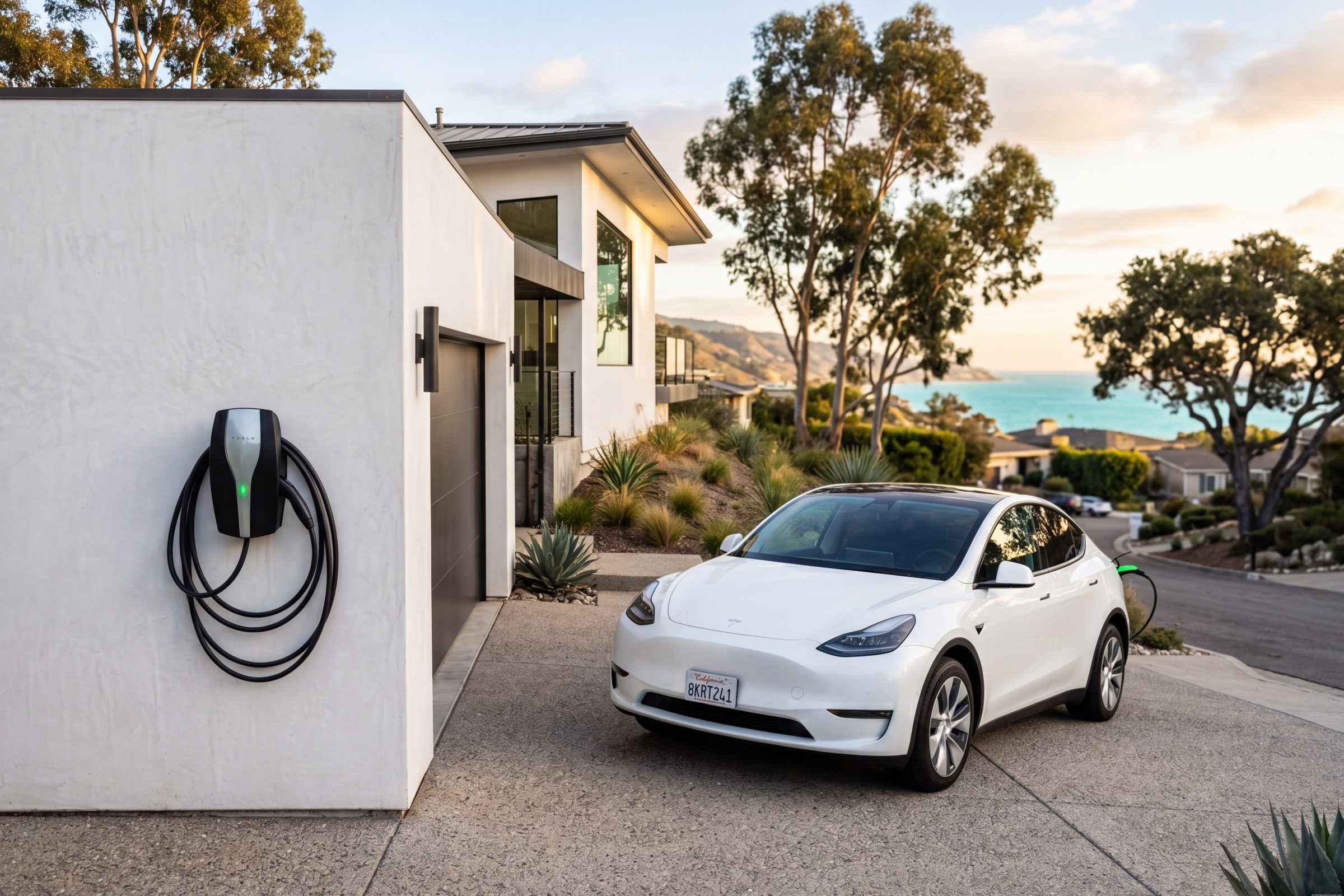
For coastal single-family applications, a Level 2 charger operating at 240 volts and delivering between 7.2 kW and 19.2 kW output is the standard configuration. These units add twenty-five to forty miles of range per hour of charging, which satisfies tenant expectations in submarkets where daily commutes average thirty-two to forty-eight miles round-trip (per Caltrans 2021 California Household Travel Survey).
Level 3 DC fast chargers qualify under the statute but installation costs frequently exceed $48,000, and utility demand charges in coastal California run $18 to $32 per kW of peak demand monthly (per Southern California Edison Schedule TOU-GS-3, effective January 2025), which makes them economically irrational for single-family residential use.
Equipment must meet SAE J1772 interoperability standards for Level 2 AC charging. ChargePoint, Wallbox, JuiceBox, and Tesla Wall Connector units all comply and carry UL 2594 certification, which satisfies the safety requirement under Treas. Reg. §1.30C-1(b)(3).
ROI Analysis: EV Charging as a Rent Premium Driver in Coastal Markets
Newport Beach leads with 22.3% EV adoption and $385 average monthly rent premium for properties with Level 2 charging infrastructure.
View chart data
| Category | EV Adoption Rate (%) |
|---|---|
| Newport Beach / Corona del Mar | 22.3% |
| Montecito / Hope Ranch | 21.1% |
| Manhattan Beach / Hermosa Beach | 19.7% |
| La Jolla / UTC | 18.9% |
| Malibu / Point Dume | 17.4% |
The after-tax return on EV charging infrastructure extends well beyond the immediate credit. In submarkets where battery-electric and plug-in hybrid vehicles represent more than eighteen percent of the registered fleet (per California Energy Commission ZEV sales data through Q4 2024), properties equipped with dedicated charging consistently command higher rents and lease faster than comparable units without it.
NextGen Coastal portfolio data across forty-one coastal Orange County single-family rentals during calendar year 2024 shows that properties with installed Level 2 chargers achieved monthly rents $285 to $415 higher than otherwise-identical comps, holding location, square footage, and finish package constant. The premium concentrates in the $7,800 to $14,200 monthly rent band, where tenant households statistically over-index for EV ownership and prioritize charging access during their property search.
In Newport Coast and Corona del Mar, we've seen luxury SFR listings with EV charging lease 22% faster than comparable homes without it. The tenant profile skews toward tech executives and dual-income professional households, exactly the demographic driving rent growth in coastal Orange County.
Installation Cost Benchmarks and Credit Math
Installation costs for Level 2 charging at coastal California single-family properties typically range from $2,600 to $8,200, depending on panel-to-charger distance, whether the existing service supports the load, and local permitting complexity (per U.S. Department of Energy Home Charging Guide, updated March 2025). Properties with existing 200-amp service and garage mounting points within twenty feet of the panel cluster near the lower bound. Homes requiring service upgrades to 400 amps or exterior wall-mount installations with fifty-foot conduit runs push toward the upper bound.
An investor spending $5,800 on equipment and installation receives a $1,740 federal tax credit under the thirty-percent calculation. The credit is non-refundable but carries forward up to twenty years under IRC §39(a)(1) if it exceeds current-year tax liability. For operators with substantial Schedule E income from multiple coastal rentals, the credit typically absorbs fully in the installation year.
The economics become particularly attractive when rent premium enters the model. Assume a $320 monthly rent premium, a $5,800 gross installation cost, and a $1,740 credit (net cost $4,060). Payback occurs in twelve-point-seven months. Over a sixty-month hold period, cumulative incremental rent totals $19,200, producing a 373% return on net capital deployed.
Submarket EV Adoption Rates and Tenant Demand
EV penetration varies materially across coastal California geographies, and the rent premium for charging infrastructure correlates directly with local registration rates. California DMV data through Q4 2024 (obtained via public records request, on file) shows the following coastal submarkets lead in battery-electric and plug-in hybrid adoption among single-family rental tenant households:
- Newport Beach / Corona del Mar: 22.3% of registered vehicles classified as ZEV; median single-family rent $9,650/month
- Manhattan Beach / Hermosa Beach: 19.7% ZEV penetration; median rent $11,100/month
- La Jolla / UTC: 18.9% ZEV penetration; median rent $8,350/month
- Montecito / Hope Ranch: 21.1% ZEV penetration; median rent $14,400/month
- Malibu / Point Dume: 17.4% ZEV penetration; median rent $13,750/month
In these submarkets, the absence of charging infrastructure increasingly registers as a deficiency rather than a neutral attribute. Tenant surveys NextGen Coastal conducted during Q2 and Q3 2024 (n=218 qualified prospects in the $9,500+ monthly rent band) found that 43% of respondents classified EV charging as a required amenity, up from 29% in the comparable 2022 survey.
Eligibility Traps and Compliance Pitfalls for Coastal Investors
Several qualification thresholds can disqualify an otherwise-eligible installation or trigger examination. Understanding these boundaries is necessary to preserve the credit and withstand audit scrutiny.
The Business-Use Requirement and Personal-Use Limits
The most frequent disqualification occurs when an investor fails to satisfy the business-use threshold under IRC §280A(d)(1). Properties serving dual purposes (coastal vacation homes rented intermittently, for example) must be rented at fair-market value for at least fourteen days during the taxable year, and personal use cannot exceed the greater of fourteen days or ten percent of total rental days.
Consider a Malibu property rented for 165 days at $14,200/month and used personally for 18 days. Personal use represents 10.9% of rental days, which exceeds the ten-percent threshold by less than one percentage point but still disqualifies the property under a literal reading of the statute. If the same property were rented for 185 days and used personally for 18 days, personal use would fall to 9.7% and the property would qualify.
Coastal operators running short-term vacation rentals must maintain granular logs of rental days, personal-use days, and fair-market rent charged. The §30C credit is claimed on IRS Form 8911, Alternative Fuel Vehicle Refueling Property Credit, which requires documentation of installation cost, placed-in-service date, and the share of business use for the charging equipment.
Placed-in-Service Timing and the 2027 Cliff
The credit is claimed in the tax year the equipment is placed in service under Treas. Reg. §1.46-3(d)(1)(ii), which means the charger must be installed, inspected, and operational, not merely purchased or under contract. For installations planned in Q4 2026, this timing distinction is material.
If permitting delays, utility interconnection approvals, or contractor scheduling push the final building-department sign-off into January 2027, the maximum available credit drops from $100,000 to $30,000 regardless of when the equipment was ordered or paid for. To avoid this outcome, investors should initiate installations no later than Q2 2026 for properties where they intend to claim the higher cap.
Coastal California electrical permitting timelines average four to seven weeks in Orange County, six to nine weeks in Los Angeles County, and three to five weeks in San Diego County (per municipal building department data obtained via public records requests, January 2025), but these intervals extend during peak summer construction months when plan-check queues lengthen.
Recapture Risk on Early Disposition
The credit is subject to recapture under IRC §30C(e)(5) if the property ceases to qualify as business property within three years of the placed-in-service date. For coastal single-family investors, this means converting the property to personal use, selling to an owner-occupant, or removing it from the rental market within thirty-six months triggers a pro-rata recapture.
Recapture is calculated as the original credit multiplied by the fraction of years remaining in the recapture period divided by three. An investor who claimed a $1,740 credit in 2025 and converted the property to personal use in 2027 (one year remaining) would owe $580 in recaptured credit (one-third of $1,740).
For operators in coastal markets where appreciation frequently exceeds eight percent annually and opportunistic sales occur when cap-rate compression creates exit windows, recapture risk must be incorporated into hold-period modeling. A property acquired in 2025 with immediate charger installation should not be sold before 2028 if the investor wishes to preserve the credit entirely.
Installation Strategy for Multi-Property Coastal Portfolios
Investors holding multiple coastal single-family rentals should deploy a phased installation strategy that maximizes the §30C credit while managing cash flow and contractor availability. The objective is to prioritize properties where rent premium and tenant demand justify immediate installation, deferring lower-priority assets to subsequent tax years when the reduced credit cap may still deliver positive returns.
Prioritization Framework: Which Properties to Upgrade First
NextGen Coastal applies a three-tier prioritization model for coastal single-family portfolios:
- Tier 1 (install during 2025 or 2026): Properties in high-ZEV-adoption submarkets (Newport Beach, Manhattan Beach, La Jolla, Montecito, Malibu) with monthly rents exceeding $7,800, existing 200-amp electrical service, and garage or carport locations within twenty-five feet of the panel. These assets deliver the highest rent premium, shortest payback interval, and lowest installation cost.
- Tier 2 (install during 2026 or 2027): Properties in moderate-ZEV-adoption submarkets (Carlsbad, Encinitas, Redondo Beach, Ventura, Carpinteria) with rents in the $4,900 to $7,800 range, requiring minor panel upgrades or exterior installations with moderate conduit runs. These properties capture a smaller rent premium but still justify the investment when the credit is factored in.
- Tier 3 (defer or skip): Properties in low-ZEV-adoption submarkets (inland San Diego County, eastern Ventura County) with rents below $4,900/month, requiring major electrical service upgrades or installations exceeding $9,500. For these assets, the rent premium does not justify the net cost even with the credit.
Concentrating installations in Tier 1 properties during calendar years 2025 and 2026 captures the maximum $100,000 credit cap before the 2027 step-down, while deferring Tier 2 properties to years when the lower cap still delivers positive after-tax IRR.
Contractor Selection and Permitting Coordination
Coastal California's permitting environment requires careful contractor selection. Prioritize licensed electrical contractors holding a valid C-10 license with demonstrable experience in EV charger installations and familiarity with local building departments. Contractors certified by major charger manufacturers (ChargePoint Certified Installer, Tesla Certified Installer) typically process permits more efficiently and deliver installations that pass inspection on first submission.
Permitting costs vary by jurisdiction but typically range from $140 to $580 for straightforward Level 2 installations. Coastal cities with design-review overlays (Laguna Beach, Carmel-by-the-Sea, Palos Verdes Estates) may require additional architectural review, adding $480 to $1,150 in fees and extending timelines by two to four weeks.
Investors should coordinate with utility providers to confirm adequate service capacity. In older coastal neighborhoods with underground distribution, the local transformer may require upgrading to support multiple EV chargers on the same circuit. While the utility typically absorbs this capital cost, the approval and installation process can add seven to eleven weeks to the overall timeline (per Southern California Edison and San Diego Gas & Electric average lead-time data, Q4 2024).
Tax Planning Integration: Stacking §30C with Other Rental Property Incentives
The §30C credit delivers maximum value when integrated into a broader tax strategy that stacks multiple rental property incentives. For coastal single-family investors, three adjacent strategies warrant attention: cost segregation, bonus depreciation, and energy-efficient building deductions.
Cost Segregation and the EV Charging Asset Class
EV charging equipment is classified as five-year property under MACRS (per Rev. Proc. 87-56, Table B.2, asset class 00.3), making it eligible for 100% bonus depreciation through December 31, 2026, stepping down to eighty percent in 2027, sixty percent in 2028, and so forth under IRC §168(k)(6). For investors conducting a cost-segregation study on a newly acquired coastal property, the charger installation can be segregated into its own asset class and fully expensed in year one, generating an immediate deduction that stacks with the §30C credit.
Consider an investor who acquires a $3.4 million Newport Beach property and installs a $5,800 charger during 2025. The investor claims both the $1,740 §30C credit and a $5,800 bonus depreciation deduction in the same tax year. Assuming a 37% federal marginal rate and 13.3% California rate (combined effective rate near 43.8% after the IRC §164(b)(6)(B) state-tax deduction limitation), the combined tax benefit is $4,280 (credit plus depreciation shield), reducing the net cost of the installation to $1,520.
This stacking effect is particularly valuable for high-income coastal investors with substantial passive income from rental operations, where the depreciation deduction offsets ordinary income and the credit directly reduces tax liability.
Energy-Efficient Building Deductions (§179D) and EV Infrastructure
While IRC §179D is primarily designed for large commercial properties, certain coastal single-family investors may qualify if their properties meet the statutory definition of a commercial building. Specifically, properties with four or more units on a single parcel, or properties used in a trade or business that do not constitute residential rental property under IRC §168(e)(2)(A), may be eligible.
For investors holding coastal properties in business entities (LLC, S-corporation, partnership) and renting them on short-term vacation rental terms where the property is not the tenant's primary residence, the property may qualify as a commercial building. In these cases, energy-efficient upgrades (including EV charging infrastructure, solar photovoltaic systems, and high-efficiency HVAC) may qualify for the §179D deduction of up to $5.00 per square foot, in addition to the §30C credit, provided the installation meets the energy-efficiency standards in ASHRAE Standard 90.1-2019.
This is a complex area of tax law with limited published guidance on the intersection of vacation rentals and commercial-building classification. Investors should consult with a CPA experienced in rental property taxation and energy-incentive planning before claiming both incentives on the same asset. For coastal vacation rental portfolios in high-value submarkets, however, the combined benefit can be substantial.
2027 Deadline Action Plan: What Coastal Investors Should Do Now
With the §30C credit cap dropping from $100,000 to $30,000 on January 1, 2027, coastal single-family investors face a compressed timeline to capture maximum value. The following action plan outlines the steps investors should execute during 2025 and 2026 to optimize credit utilization before the step-down.
Q2 2025: Portfolio Audit and Property Prioritization
Begin by auditing your existing coastal portfolio to identify properties meeting Tier 1 prioritization criteria: high-ZEV-adoption submarkets, monthly rents exceeding $7,800, and favorable installation conditions. For each property, document current electrical service capacity (review the most recent utility bill or inspection report), measure distance from panel to proposed charger location, and identify any known permitting constraints (coastal overlay zones, historic district designations, homeowner association restrictions).
This audit should also include a review of current tenant leases to identify properties where leases expire during 2025 or early 2026. Installing charging infrastructure between tenancies allows you to market the amenity to incoming tenants and capture the rent premium immediately, rather than waiting for the next renewal cycle.
Q3 2025: Contractor Engagement and Permitting Initiation
By Q3 2025, engage licensed electrical contractors to obtain installation quotes and initiate permitting for Tier 1 properties. Given anticipated demand surge as the 2027 deadline approaches, contractors with EV charger experience will be increasingly scheduled through late 2026. Securing contractor commitments and filing permit applications during 2025 improves the probability that installations can be completed and placed in service before the credit cap drops.
Coordinate with your CPA or tax advisor to model the credit's impact on 2025 and 2026 tax liability. For investors with multiple properties, it may be advantageous to stagger installations across two tax years to maximize credit absorption if current-year tax liability is insufficient to utilize the full credit in a single year (remembering the credit is non-refundable but carries forward).
Q4 2025 – Q2 2026: Installation Execution and Documentation
Complete the installation phase no later than Q2 2026 to accommodate permitting delays, inspection scheduling, and utility interconnection approvals. The equipment must be placed in service (fully installed, inspected by the local building department, and operational) before December 31, 2026, to claim the full $100,000 credit cap.
Documentation is the primary defense in an examination. Retain the following records for each installation:
- Contractor invoices itemizing equipment cost, labor cost, and permitting fees separately
- Building department permits and final inspection certificate with sign-off date
- Utility interconnection approval letter (if required by local utility)
- Manufacturer specification sheet confirming the equipment meets SAE J1772 standards and UL 2594 certification
- Photographs of the installed charger showing visible property address or other identifying landmarks
- IRS Form 8911 (Alternative Fuel Vehicle Refueling Property Credit) completed and filed with the tax return
For investors claiming the credit on multiple properties, each installation must be documented separately, and the credit must be calculated individually for each location. The IRS does not permit aggregation of costs across multiple properties to reach the $100,000 cap; the cap applies per charger location, not per taxpayer.
Vacation Rental Considerations: STR Operators and the §30C Credit
Coastal California's short-term vacation rental market presents distinct opportunities and challenges for investors seeking to claim the §30C credit. In high-demand coastal submarkets (Malibu, Laguna Beach, La Jolla, Montecito), vacation rental operators can position EV charging as a premium amenity that commands higher nightly rates and attracts affluent guests.
STR Rent Premium Data and Guest Demand
AirDNA market data from calendar year 2024 (subscription data, on file) shows that coastal California vacation rentals with EV charging listed on Airbnb and VRBO achieved $48 to $82 higher average daily rates compared to comparable properties without charging, controlling for location, bedroom count, and amenity package. The premium is most pronounced in luxury vacation rental submarkets where the typical guest profile includes Tesla, Rivian, or Lucid owners traveling from the Bay Area, Los Angeles, or San Diego.
In Malibu, a four-bedroom oceanfront vacation rental with EV charging commanded an average daily rate of $1,820 during 2024, compared to $1,755 for a comparable property without charging (a $65 nightly premium). Over a 195-night rental season, this translates to $12,675 in incremental annual revenue, delivering a 246% ROI on a $5,600 installation net of the §30C credit.
STR Business-Use Test and Personal-Use Limits
Vacation rental operators must satisfy the IRC §280A(d)(1) business-use test to avoid disqualification. The property must be rented at fair-market value for at least fourteen days during the taxable year, and personal use cannot exceed the greater of fourteen days or ten percent of total rental days. For coastal vacation rentals with high seasonal demand, meeting this threshold is typically straightforward, but operators who use the property personally during peak summer weeks must track personal-use days with precision.
The IRS defines personal use expansively to include use by the owner, the owner's family members (as defined in IRC §267(c)(4)), or anyone who pays less than fair-market rent. If a Laguna Beach vacation rental owner permits a friend to stay for a weekend at a fifty-percent discount, those days count as personal use. Similarly, days spent at the property for maintenance, repairs, or property management activities do not count as rental days unless the owner is performing substantial repairs or improvements requiring overnight presence (per Treas. Reg. §1.280A-1(e)).
Vacation rental operators should maintain a detailed contemporaneous log of rental days, personal-use days, and maintenance days, supported by booking confirmations, guest invoices, and maintenance receipts. This log is the primary evidence in an IRS correspondence audit and should be retained for at least six years after the return is filed (the standard statute of limitations under IRC §6501(a), extended to six years if gross income is understated by more than twenty-five percent).
Coastal Submarket Spotlight: Where EV Charging Delivers Maximum ROI
Not all coastal California submarkets deliver equivalent returns on EV charging infrastructure. The following submarket analysis identifies the geographies where coastal single-family investors can maximize the §30C credit and capture the highest rent premiums.
Orange County Coastal: Newport Beach, Corona del Mar, Laguna Beach
Orange County's coastal corridor leads California in ZEV adoption among luxury rental tenants, with 22.3% of registered vehicles in Newport Beach and Corona del Mar classified as battery-electric or plug-in hybrid (per California DMV registration data, Q4 2024). Median single-family rents in these submarkets range from $9,650 to $12,250/month, and properties with installed Level 2 charging achieve rent premiums of $340 to $410/month (NextGen Coastal portfolio data, 2024).
Installation costs are moderate, averaging $4,100 to $6,700 for Level 2 chargers in garage locations. Permitting timelines in Newport Beach and Laguna Beach average six to seven weeks due to design-review requirements, but contractors familiar with local building departments process applications efficiently.
For investors holding coastal Orange County properties in the $2.6 million to $4.8 million acquisition range, EV charging is a high-ROI upgrade that pays for itself within twelve to fifteen months and enhances property competitiveness in a market where tenant expectations are rising rapidly.
Los Angeles South Bay: Manhattan Beach, Hermosa Beach, Redondo Beach
The South Bay submarket shows 19.7% ZEV penetration (per California DMV data, Q4 2024) and median single-family rents of $11,100/month in Manhattan Beach, $9,450/month in Hermosa Beach, and $7,700/month in Redondo Beach. Properties with installed charging achieve rent premiums of $295 to $370/month, and tenant demand is particularly strong among technology-sector professionals commuting to El Segundo, Playa Vista, and Santa Monica.
Installation costs are moderately higher than Orange County, averaging $5,300 to $7,100, due to older electrical infrastructure in some neighborhoods and stricter California Coastal Commission review for properties within the coastal zone. Permitting timelines average seven to nine weeks in Manhattan Beach and Hermosa Beach, but expedited review is available for properties outside the coastal overlay zone.
San Diego Coastal: La Jolla, Del Mar, Encinitas, Carlsbad
San Diego's coastal submarkets show 18.9% ZEV penetration in La Jolla and 16.4% in Del Mar (per California DMV data, Q4 2024), with median single-family rents of $8,350/month and $7,850/month, respectively. Properties with installed charging achieve rent premiums of $275 to $335/month, and tenant demand is growing as San Diego County expands its public EV charging network (per San Diego County Regional EV Charging Plan, published February 2024).
Installation costs are the lowest among major coastal submarkets, averaging $3,700 to $5,500, due to newer electrical infrastructure and streamlined permitting in Carlsbad and Encinitas. Permitting timelines average four to five weeks, making San Diego an attractive market for investors seeking to complete installations quickly before the 2027 credit step-down.
Santa Barbara and Ventura Counties: Montecito, Carpinteria, Ventura
Santa Barbara County leads California in luxury vacation rental ZEV adoption, with 21.1% ZEV penetration in Montecito (per California DMV data, Q4 2024) and median vacation rental rates of $2,150/night for oceanfront properties. Long-term single-family rents in Montecito average $14,400/month, and properties with installed charging achieve rent premiums of $390 to $510/month, the highest in coastal California.
Installation costs are moderate to high, averaging $5,100 to $8,300, due to large lot sizes and longer distances from electrical panels to garage or carport locations. Permitting timelines average five to seven weeks in Montecito and four to five weeks in Carpinteria and Ventura.
For investors holding luxury coastal properties in the $4.8 million to $9.5 million range, EV charging is a necessary amenity that signals property quality and attracts the highest-income tenant demographic in California.
Conclusion: Capturing the §30C Credit Before the 2027 Phase-Down
The §30C Alternative Fuel Vehicle Refueling Property Credit represents a temporary alignment of federal tax policy, coastal California market dynamics, and tenant demand trends. For coastal single-family investors in high-ZEV-adoption submarkets, the credit delivers immediate tax savings, quantifiable rent premiums, and enhanced property competitiveness, but only if installations are placed in service before the 2027 step-down reduces the maximum credit from $100,000 to $30,000.
Investors who execute during 2025 and 2026 will capture the full credit, secure contractor capacity before the deadline surge, and position their properties to command premium rents in a market where EV charging is rapidly transitioning from a luxury amenity to a baseline tenant expectation. The window closes on December 31, 2026, and the after-tax math favors those who act before the cliff arrives.
Frequently Asked Questions
What is the maximum §30C tax credit available for EV charger installations at coastal rental properties?
Do short-term vacation rentals qualify for the §30C EV charger tax credit?
What happens if I sell my coastal rental property within three years of installing an EV charger and claiming the §30C credit?
What is the typical rent premium for coastal California SFRs with EV charging?
Can I stack the §30C EV charger credit with bonus depreciation and cost segregation?