The San Diego HOA Rental Cap Landscape
La Jolla and Del Mar enforce the strictest rental caps while Point Loma and Ocean Beach allow higher rental occupancy percentages.
View chart data
| Category | Maximum rental occupancy (%) |
|---|---|
| La Jolla & Del Mar | 13% |
| Coronado & Imperial Beach | 25% |
| Point Loma & Ocean Beach | 25% |
| Carmel Valley & Torrey Highlands | 20% |
Rental restrictions in San Diego County's coastal HOA communities have existed for decades, but enforcement intensity has escalated sharply in 2026. From Del Mar south to Coronado, associations are revising CC&Rs, retaining compliance officers, and deploying digital tracking systems to monitor who rents and when. The proximate causes vary, concerns about transient occupancy, parking strain, deferred maintenance traceable to absentee landlords, but the operational consequence for investors is uniform: rental income that was straightforward to capture in 2022 now demands procedural precision and advance planning.
Interactive Tool
San Diego HOA Rental Violation Cost Calculator
Estimate total penalties for unregistered or non-compliant rentals

Typical range: $500–$1,500
Typical range: $50–$200 per day
From violation start to cure date
Attorney review, compliance monitoring
Additional monthly charge until cured
Leave 0 if no special assessment
 Built by NextGen Coastal
Most San Diego coastal associations structure their rental caps in one of three ways: percentage-based ceilings that limit rental occupancy to a fixed share of total units, absolute numerical quotas that cap the count of rental units regardless of community size, or waiting-list regimes in which owners apply for a rental slot and wait until one opens. In practice many associations layer these approaches, a percentage cap combined with a waitlist, for example, which produces friction at every step of the leasing process.
The modal cap in San Diego's beachfront and near-coastal communities remains 25%, though associations in La Jolla and Carmel Valley have ratcheted that figure down to 15% or 20% over the past three years. When the cap is reached, no further units may be rented until an existing tenant vacates and the property reverts to owner-occupancy. Queue times vary by submarket but can stretch to several months in high-demand buildings where turnover is infrequent.
Geographic Variation Across Coastal San Diego
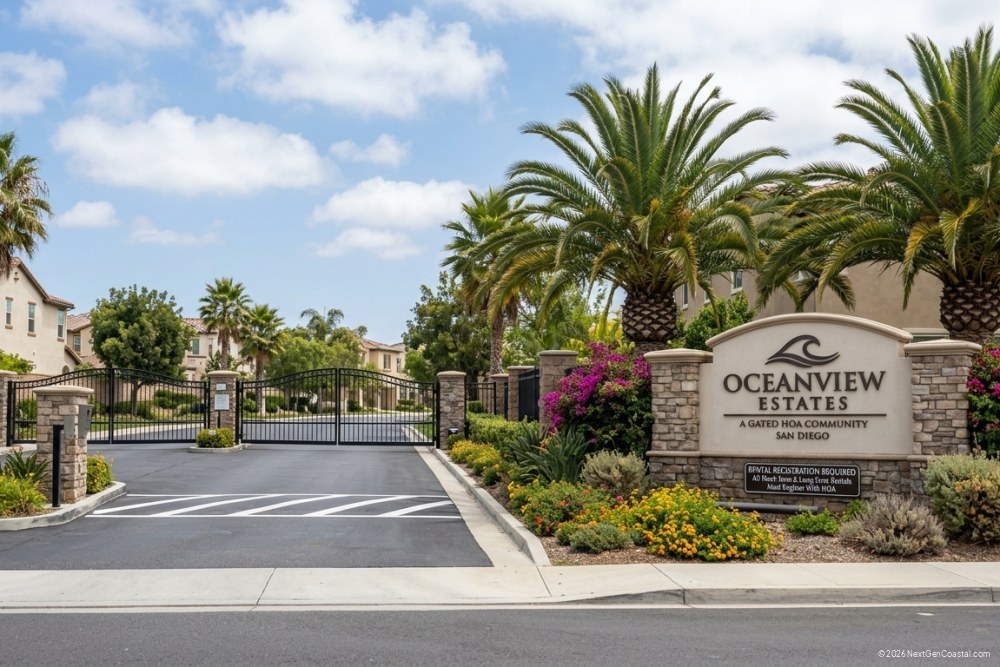
Enforcement rigor and cap stringency differ markedly by ZIP code. La Jolla and Del Mar associations impose the tightest restrictions, caps in the 10%–15% range are common, and board approval is required for every lease regardless of whether a slot is nominally available. Point Loma and Ocean Beach communities permit 20%–30% rental occupancy and tend to employ lighter procedural burdens. Coronado and Imperial Beach fall between these poles, with 25% caps prevailing but enforcement becoming materially more aggressive this year.
Master-planned developments in Carmel Valley and Torrey Highlands, geographically inland but behaviorally coastal, mirror the enforcement posture of true oceanfront associations. These communities are adopting the same compliance software and registration protocols, which means owners who assumed inland properties would escape scrutiny are discovering otherwise.
2026 Enforcement Mechanisms
Three tools dominate San Diego HOA enforcement in 2026: mandatory rental registration, quarterly compliance audits, and escalating financial penalties. Each mechanism operates differently, and misunderstanding any one can trigger cascading violations.
Mandatory Rental Registration
Registration is now compulsory in nearly every coastal association, and the process must be completed before a lease is executed. Landlords submit tenant data, lease terms, and proof of liability coverage; the association logs the submission and either approves or denies the application. Annual registration fees run $150–$500, with some boards charging additional per-tenant fees for multi-occupant units.
Deadlines matter. Most associations require 30 days' advance notice, though a subset demand 45 or 60 days to accommodate board review cycles. Miss the deadline and the board may refuse to consider your application until the next meeting, effectively delaying your lease start by a full month. A handful of La Jolla associations have deployed real-time online portals that display current rental cap utilization, allowing landlords to confirm slot availability before marketing the property.
- Tenant screening documentation is frequently mandatory; associations require credit reports, criminal background checks, and prior-landlord references as part of the registration packet.
- Lease term boundaries are enforced by some boards, leases shorter than 12 months or longer than 24 months may be rejected outright, forcing landlords to fit within those parameters.
- Occupancy caps are often stricter than municipal code allows; an association might enforce two persons per bedroom plus one, regardless of what the city permits.
- Pet policies applied to rentals can be more restrictive than those applied to owner-occupied units, including breed prohibitions and weight limits that don't appear in the CC&Rs' general pet section.
Regular Compliance Audits
Associations now conduct quarterly audits that cross-reference rental registrations against utility account transfers, parking permit issuances, and property tax records. They also scrape short-term rental platforms, Airbnb, VRBO, to identify unlisted vacation rentals, which violate both the CC&Rs and San Diego's municipal STR ordinance.
Audits frequently surface unregistered rentals. Landlords who assumed low visibility would protect them discover otherwise. When an unregistered rental is identified, the association calculates penalties retroactively from the lease start date, not from the date of discovery. In a 2025 Carmel Valley case I reviewed, a landlord who operated an unregistered rental for fourteen months faced $18,000 in accumulated fines by the time the audit flagged the property.

Escalating Financial Penalties
Penalty schedules have risen sharply. Initial violation fines now range from $500 to $1,500, with daily continuing penalties of $50–$200 accruing until the violation is cured. Some associations levy special assessments on non-compliant properties, effectively doubling or tripling monthly dues until compliance is restored.
The most severe remedy is forced lease termination. While procedurally complex and infrequently pursued, a handful of San Diego associations have obtained judicial orders requiring landlords to terminate non-compliant leases. Courts grant this relief in egregious cases, unregistered vacation rentals, properties that exceed occupancy limits by wide margins, or landlords with repeated violations who ignore cure notices.
In our experience advising coastal landlords, the cost of non-compliance now exceeds the cost of professional management in most San Diego markets. The 2026 enforcement posture demands that landlords treat HOA compliance as a core operational function rather than an administrative afterthought.
Notice Requirements and Approval Processes
San Diego associations impose layered notice obligations: pre-lease approval, tenant move-in notification, and ongoing reporting. Each requirement carries its own deadline and penalty structure.
Pre-Lease Approval Process
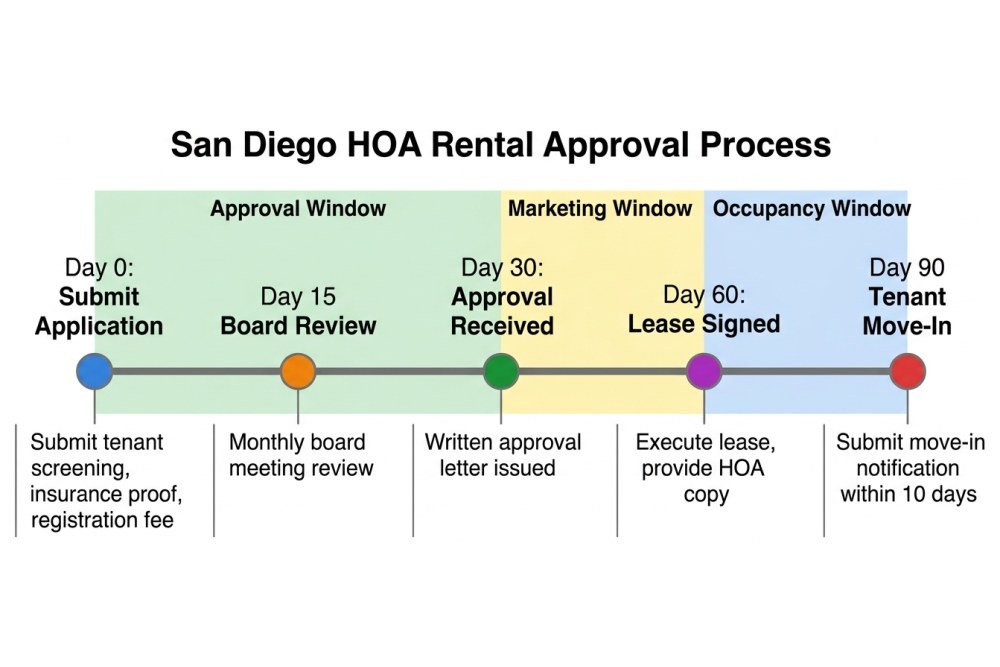
Written approval must be secured before lease execution. The approval cycle consumes 15–30 days on average, during which the landlord submits:
- A completed rental application on the association's form, detailing property address, proposed lease term, and tenant identification.
- Tenant screening results, including credit reports, criminal background checks, and rental history verification from prior landlords.
- Proof of landlord liability insurance with minimum $1 million coverage and the HOA named as additional insured.
- A draft lease agreement for board review, ensuring incorporation of HOA rules and CC&R compliance clauses.
- Payment of the registration fee, which is non-refundable regardless of approval outcome.
Board meetings occur monthly in most associations, so application timing determines total wait time. Submit three days before the scheduled meeting and you may wait 35–40 days for a decision, enough to lose qualified tenants who cannot defer their move-in date. Strategic landlords submit applications 60–90 days before anticipated lease commencement to ensure approval is secured before marketing begins.
Tenant Move-In Notification
Once the lease is signed, landlords must file move-in notification within 10–15 days. This notification includes tenant contact information, vehicle descriptions for parking permit issuance, and emergency contact numbers. Failure to notify triggers $250–$500 fines and may result in parking enforcement actions against the tenant.
Certain associations require landlords to deliver a welcome packet containing the CC&Rs, architectural guidelines, and community rules to the tenant, then certify in writing that delivery occurred. This creates a compliance record that protects both the landlord and the association if tenant conduct later becomes an issue.
Ongoing Reporting Obligations
Annual rental recertification is now standard. Landlords confirm that the property remains rented to the same tenant, update insurance certificates, and remit annual registration fees. Some associations treat lease renewals as new rental events requiring fresh registration within 30 days of renewal.
When a tenant vacates, move-out notification must be filed within 10 days. This notification releases the rental slot, allowing the next landlord on the waitlist to proceed. Delayed notification produces fines and, more consequentially, delays re-rental, as the board may decline to approve a new tenant until the prior tenant's departure is formally documented.
Violation Penalties and Enforcement Actions
Daily continuing fines account for the majority of total penalties, making early detection and cure critical to minimizing costs.
View chart data
| Category | Violation cost ($) |
|---|---|
| Initial Fine | $1,000 |
| Daily Fines (90 days) | $9,000 |
| Admin Costs | $250 |
| Total Penalty | $10,250 |
Penalties range from monetary fines to judicial relief compelling lease termination. The structure varies by association, but patterns are consistent across San Diego's coastal submarkets.
Monetary Fines
Fines are structured in two tiers: an initial violation assessment plus daily continuing charges. The typical schedule in coastal San Diego is:
- Initial fine: $500–$1,500 for the first offense.
- Daily continuing penalty: $50–$200 per day until the violation is cured.
- Repeat violation surcharge: A 2x–3x multiplier applied to second and subsequent violations within a twelve-month window.
- Administrative cost recovery: $150–$300 to reimburse the association for attorney review and compliance monitoring.
A landlord operating an unregistered rental for 90 days before detection could face $1,000 + ($100 × 90) = $10,000 in total penalties. These fines are typically secured by a lien recorded against the property, which must be satisfied before sale or refinance.
Special Assessments
Special assessments function as surcharges added to monthly HOA dues until the violation is resolved. Typical amounts are $500–$1,000 per month, creating immediate cash flow pressure that incentivizes rapid cure.
Assessments are easier to collect than one-time fines because they're treated as regular dues, and they create ongoing financial pain rather than a single lump-sum penalty. This structure is particularly effective at forcing compliance in cases where landlords might otherwise delay resolution.
Legal Action and Forced Lease Termination
Associations may file suit seeking injunctive relief, a court order compelling the landlord to terminate the non-compliant lease and cease rental operations until proper approval is obtained. Litigation is expensive for both sides, with HOA legal costs often exceeding $15,000–$25,000 for a contested matter, but California law permits prevailing associations to recover attorney fees from the landlord.
In a 2025 La Jolla case, a landlord operating an unregistered vacation rental was ordered to pay $32,000 in the association's attorney fees plus $8,000 in fines after losing at trial. The court granted the association's request for injunctive relief, requiring immediate lease termination.
Owner Remedies and Dispute Resolution
Landlords facing violation notices have several procedural remedies, from internal appeals to litigation. The key is matching the remedy to the violation type and pursuing it with appropriate urgency.
Internal Appeals Process
Most associations provide an internal appeals process where landlords challenge violation notices before the board. Written appeals must be submitted within 15–30 days of receiving the notice, accompanied by documentation demonstrating compliance or explaining the procedural lapse.
Appeals are most effective for technical violations where the landlord substantially complied but missed a procedural deadline, for example, submitting registration 25 days before lease commencement instead of the required 30. Boards often waive or reduce fines in these circumstances, particularly for first-time violations by landlords with otherwise clean records.
Alternative Dispute Resolution
California law requires associations to offer alternative dispute resolution before filing suit. ADR typically takes the form of mediation, where a neutral facilitator helps the parties negotiate a settlement. Mediation costs run $1,500–$5,000, split between the landlord and the association, making it far more economical than litigation.
Mediation works well in disputes involving ambiguous CC&R language or inconsistent enforcement patterns. If the association historically permitted similar arrangements without penalty, a mediator may broker a settlement allowing the current rental to continue while the board clarifies its rules prospectively.
Litigation and Judicial Review
When appeals and mediation fail, landlords may file suit challenging the rental restriction. Successful challenges typically rest on one of three arguments:
- CC&R ambiguity: The rental restriction language is contradictory or unclear, rendering enforcement arbitrary.
- Selective enforcement: The association enforces the cap against some owners but not others, violating equal-protection principles recognized under California common law.
- Unreasonable restriction: The cap is so stringent that it effectively prohibits all rentals, which California courts have found unreasonable in limited contexts.
Litigation costs $25,000–$75,000 for a contested case through trial, and outcomes are uncertain. California courts defer to HOA authority to regulate rentals, so landlords face an uphill evidentiary burden. In cases involving clear selective enforcement or procedurally defective CC&R amendments, however, litigation can succeed.
Hardship Exemptions
Some associations grant hardship exemptions allowing rentals despite cap limits. Recognized hardship categories include:
- Employment relocation where the owner must relocate for work and cannot sell in the current market.
- Financial hardship where the owner faces foreclosure or bankruptcy absent rental income.
- Medical necessity where the owner requires long-term care and must rent to fund medical expenses.
- Military deployment for active-duty service members receiving orders.
Hardship exemptions require detailed documentation, employment letters, financial statements, medical records, military orders, and are granted at the board's discretion. They're typically temporary, lasting 12–24 months, and require annual renewal with updated hardship evidence.
Compliance Best Practices for 2026
Systematic compliance practices eliminate most violation risk. The practices below require upfront investment but produce returns measured in avoided fines and preserved income.
Pre-Acquisition Due Diligence
Before acquiring property in an HOA community, conduct thorough rental-restriction diligence:
- Review the CC&Rs and all amendments, focusing on rental restriction sections and enforcement penalty schedules.
- Request written rental cap status from the HOA, confirming current occupancy percentage and whether slots are available.
- Examine board meeting minutes from the prior 12–24 months to identify enforcement trends and pending rule changes.
- Interview the HOA management company to understand enforcement priorities, common violations, and typical approval timelines.
Complete this diligence during the inspection contingency period so you can cancel the purchase if rental restrictions are more onerous than anticipated. In some transactions buyers negotiate seller-provided rental approval as a condition of closing, ensuring the property can be leased immediately post-acquisition.
Proactive Registration and Communication
Register with the HOA immediately upon acquisition, even if you don't intend to rent for several months. Early registration establishes rapport, demonstrates good faith, and ensures you receive all rule updates and enforcement notices.
Maintain ongoing communication throughout the tenancy. Respond promptly to inquiries, provide requested documentation within stated deadlines, and notify the board of lease changes, rent adjustments, renewals, tenant additions. This proactive posture builds goodwill and often results in more lenient treatment when minor violations occur.
Professional Property Management
Professional management has become the de facto compliance standard for San Diego coastal landlords. Managers familiar with local HOA requirements navigate registration, maintain compliance calendars, and respond to violation notices before they escalate.
Management fees run 8%–10% of monthly rent in San Diego, but a single unregistered rental violation can cost $5,000–$10,000, equivalent to 12–24 months of management fees. For landlords managing multiple properties or operating remotely, professional management is often the most cost-effective compliance strategy.
Legislative Developments and Future Outlook
California's legislative environment continues to evolve. AB 3182, introduced in 2025, would require associations to provide 90-day advance notice before implementing new rental restrictions, giving landlords time to adjust operations. The bill remains in committee as of this writing, but its introduction signals legislative awareness of the compliance burden rental caps impose.
San Diego County is considering a countywide rental registry ordinance that would require all landlords, including those in HOA communities, to register with the county. The ordinance would create a centralized database of rental properties, potentially streamlining HOA compliance but also expanding oversight capacity.
The trajectory is clear: rental restrictions are tightening, enforcement is intensifying, and compliance requirements are becoming more procedurally complex. Landlords who invest in compliance infrastructure now will be better positioned to preserve rental income as the regulatory environment continues to shift.
The landlords who succeed in San Diego's 2026 HOA environment treat compliance as a competitive advantage rather than a regulatory burden. Proactive registration, professional management, and strategic communication with boards separate operators who preserve cash flow from those facing chronic violations and margin erosion.
Frequently Asked Questions
What is the most common rental cap percentage in San Diego coastal HOAs?
How much advance notice do I need to provide before renting my property in an HOA?
What penalties can I face for operating an unregistered rental in a San Diego HOA?
Can I challenge an HOA rental restriction if I believe it's unfair?
Does professional property management help with HOA compliance?