Why Newport Beach HOA Rental Caps Matter Now
Proximity to John Wayne Airport, Fashion Island, and the harbor has long made Newport Beach a premium single-family rental market. Tenant demand remains robust. But the master-planned enclaves and gated communities that command those rents also impose some of the strictest homeowners association rental restrictions in coastal California.
Interactive Tool
Newport Beach HOA Rental Cap Calculator
Estimate your waitlist position and approval timeline

Total single-family homes within the association boundary.
Maximum percentage of homes that may be rented simultaneously.
Number of homes currently approved for rental by the HOA.
Your position on the rental waitlist (0 if not on waitlist).
Percentage of rentals that convert back to owner-occupancy each year.
 Built by NextGen Coastal
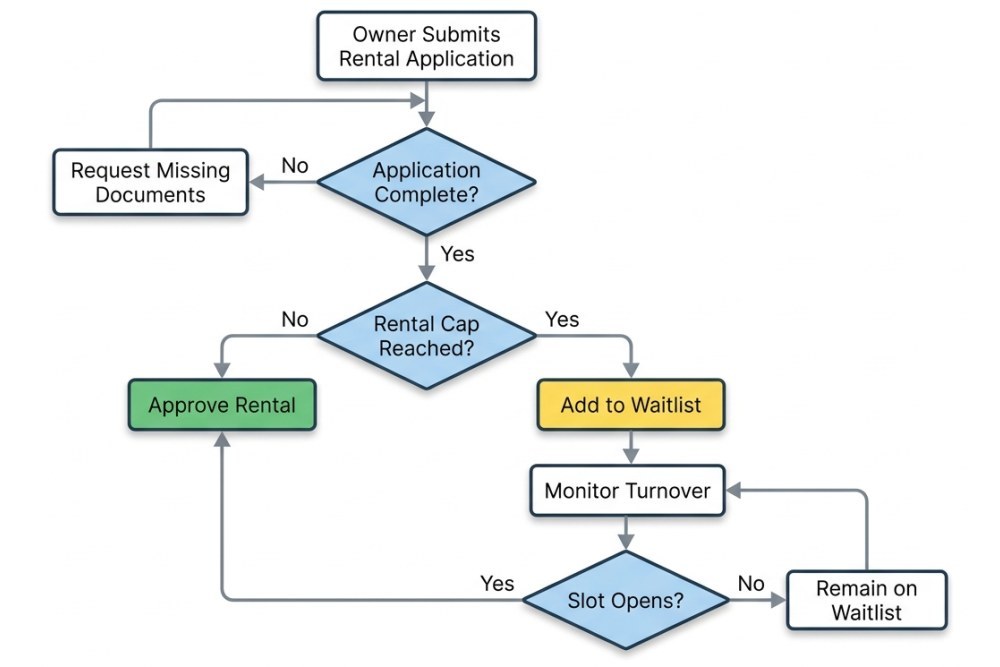
Beginning January 1, 2026, dozens of associations across the city are implementing or tightening percentage-based rental caps, in some cases limiting the share of homes that may be leased at any given time to thresholds as low as the high single digits. Once the cap is reached, new rental applications enter a waitlist. Approval depends on another owner vacating or converting back to owner-occupancy. The mechanism creates a zero-sum game.
Three factors drive the enforcement shift. Post-pandemic investor acquisition pushed rental concentrations above historical norms in several neighborhoods. Associations are responding to owner-occupant complaints about transient occupancy and perceived impacts on community character. California appellate courts have consistently upheld HOA rental restrictions as valid exercises of CC&R authority, giving boards confidence to enforce aggressively.
Rental approval is no longer automatic, and non-compliance carries real financial risk. Associations are levying fines, filing liens, and in extreme cases pursuing foreclosure on properties with chronic unapproved tenancies. For operators managing multiple Newport Beach SFRs, 2026 compliance is a portfolio-level priority.

How HOA Rental Caps Are Calculated
Understanding the math behind rental caps is essential for positioning your property and anticipating waitlist movement. Most Newport Beach associations use one of two calculation methods: fixed percentage of total units or percentage of eligible units.
Fixed Percentage Method
The simplest approach codifies a fixed share in the association's CC&Rs or in a board-adopted resolution: no more than X% of homes may be rented simultaneously. A 200-home community with such a cap allows the corresponding number of rental properties at any time. Once that threshold is reached, the next applicant joins the waitlist.
The denominator (total units) typically includes all single-family lots within the HOA boundary, regardless of whether they're currently occupied, vacant, or under construction. Some associations exclude developer-held inventory or lots in foreclosure, but that's the exception. The key point: the cap is static unless the CC&Rs are amended, which requires a supermajority vote of all owners.
Eligible Units Method
A more complex variant calculates the cap against eligible units, meaning homes that meet specific criteria such as minimum square footage, detached structure, or completion of a seasoning period (no rentals within the first two years of ownership, for example). This method is common in phased developments where the association wants to limit rentals in newer sections.
A community might allow a fixed percentage of eligible detached homes to be rented, but exclude attached townhomes and any property purchased within the prior 24 months. The denominator shrinks, the cap number drops, and waitlist dynamics become harder to predict because eligibility changes as homes age into the rental pool.
Tracking and Transparency
Associations track rental occupancy through a combination of owner self-reporting, property management company notifications, and periodic audits. Most require owners to submit a rental application before listing the property, including tenant screening results, lease term, and proof of landlord insurance. Once approved, the property is logged into the rental registry, and the owner receives written confirmation, often with an expiration tied to the lease term.
Transparency varies. Well-run HOAs publish current rental counts and waitlist positions in monthly newsletters or online portals. Others provide updates only upon request, leaving owners to guess where they stand. If your association doesn't publish occupancy data, request it in writing quarterly. You need visibility to plan lease renewals and portfolio moves.
Waitlist Mechanics and Positioning
When an HOA reaches its rental cap, new applicants are placed on a waitlist, typically in chronological order by application date. Approval is granted when an existing rental converts back to owner-occupancy or (rarely) when the cap is raised. Waitlist management is where enforcement gets operationally messy and where savvy landlords gain an edge.
Application Timing
Most associations require rental applications to be submitted within a window that falls 30 to 60 days before the proposed lease start date. Submitting earlier doesn't improve your waitlist position; submitting late can disqualify you for the current cycle. The clock starts when the HOA receives a complete application. Missing documents or unsigned forms reset the timer.
If you're on the waitlist, monitor turnover closely. Associations typically notify the next applicant within 10 to 15 business days of a rental slot opening. You'll have a narrow window (often 30 days) to finalize tenant placement and submit the lease. Miss the deadline, and you go to the back of the line.
Waitlist Priority Rules
Standard practice is first-come, first-served, but some associations grant priority to specific categories:
- Owner-occupants converting to rentals due to job relocation or financial hardship. Some CC&Rs allow a one-time hardship exemption outside the cap.
- Properties with prior rental approval that lapsed due to vacancy. Renewal applications may jump ahead of new entrants.
- Homes in specific phases or price tiers. A few master-planned communities allocate rental slots proportionally across neighborhoods to avoid concentration.
Review your CC&Rs and recent board minutes to identify any priority carve-outs. If your situation qualifies, document it thoroughly in your application cover letter.
Waitlist Communication
Associations are not required to provide regular waitlist updates, and many don't. Proactive landlords send a brief email to the HOA manager every 60 days requesting current position and estimated wait time. This serves two purposes: it keeps your application top-of-mind, and it creates a paper trail if the association later claims your application was incomplete or abandoned.
Waitlist positioning is a relationship game as much as a paperwork exercise. The landlords who maintain regular, professional contact with HOA management are the ones who get the courtesy call when a slot opens unexpectedly.
Compliance Documentation Requirements
Newport Beach HOAs require a standard packet of documents with every rental application. Missing or incomplete submissions are the most common reason for denial or delay. Here's the baseline checklist, drawn from CC&Rs across Big Canyon, Eastbluff, Newport Coast, and Harbor View communities:
- Completed rental application form, association-specific, available from the HOA manager or online portal.
- Copy of the proposed lease, which must include an HOA rules addendum and tenant acknowledgment of CC&R compliance obligations.
- Tenant screening report covering credit score, criminal background, and eviction history. Minimum credit score requirements vary by community.
- Proof of landlord insurance, specifically a certificate of insurance naming the HOA as additional insured, with appropriate liability coverage.
- Owner contact information, including current phone, email, and mailing address. If you use a property manager, include their contact details and a signed authorization for HOA communication.
- Application fee, non-refundable, covering administrative review and background checks.
Some associations add requirements such as a move-in/move-out inspection report, a pet addendum (even if no pets are present), or a parking plan showing compliance with guest parking limits. Read the application instructions carefully. Generic lease forms and boilerplate insurance certificates are frequent rejection triggers.
Lease Term Restrictions
Most Newport Beach HOAs impose minimum lease terms to prevent short-term rental activity. A few communities allow month-to-month tenancies after an initial fixed term, but many require board re-approval at each renewal. If your lease includes an automatic renewal clause, confirm that it doesn't violate the HOA's re-approval requirement. Associations can (and do) levy fines for unapproved holdover tenancies.
Tenant Conduct and Owner Liability
CC&Rs hold owners financially responsible for tenant violations of HOA rules, including parking infractions, noise complaints, architectural modifications, even late payment of HOA dues if the lease assigns that obligation to the tenant. Associations can fine the owner, place a lien on the property, and in severe cases pursue lease termination through the courts.
Your lease should include a thorough HOA compliance clause that:
- Incorporates CC&Rs by reference and requires tenant acknowledgment.
- Assigns financial responsibility for HOA fines to the tenant (while preserving your right to cure and seek reimbursement).
- Grants you the right to terminate the lease for material HOA violations.
- Requires tenant attendance at HOA hearings if a violation is disputed.
This clause is your first line of defense when the HOA comes after you for a tenant's guest-parking violation or unapproved patio furniture.
Enforcement Actions and Penalties
Material breaches carry fines up to 5× higher than administrative violations, with monthly accrual until cured.
View chart data
| Category | Maximum fine per violation ($) |
|---|---|
| Administrative (Tier 1) | $500 |
| Occupancy (Tier 2) | $2,500 |
| Material Breach (Tier 3) | $2,500 |
Newport Beach HOAs have broad enforcement authority under California Civil Code § 5850, which allows associations to impose monetary penalties for rule violations and pursue collection through liens and foreclosure. Rental-related violations fall into three tiers of severity, each with escalating consequences.
Tier 1: Administrative Violations
These are paperwork failures: renting without submitting an application, failing to update tenant contact information, or missing the lease renewal deadline. Fines typically begin in the low-to-mid hundreds and escalate with each repeated violation. Most associations offer a 15-day cure period before imposing the fine, but that's discretionary.
Cure strategy: respond immediately in writing, submit the missing documentation, and request a hearing if the fine seems disproportionate. Boards have discretion to waive first-time administrative fines if you demonstrate good faith and prompt correction.
Tier 2: Occupancy Violations
Renting while on the waitlist, exceeding the approved lease term without renewal, or allowing unauthorized occupants (subtenants, Airbnb guests) are occupancy violations. Fines accrue monthly until the violation is cured. The association may also demand immediate lease termination and refuse future rental applications from the owner.
These violations are harder to cure because they require tenant cooperation, either moving out or signing a compliant lease amendment. If the tenant refuses, you may need to pursue eviction to avoid ongoing fines and potential foreclosure.
Tier 3: Material Breaches
Operating a short-term rental in violation of CC&Rs, allowing commercial activity, or creating a nuisance that triggers neighbor complaints can be classified as material breaches. Associations may seek injunctive relief in superior court, demanding immediate cessation and awarding attorney's fees to the HOA. In extreme cases, the association can foreclose on the property to satisfy unpaid fines and legal costs.
Material breach cases are rare but devastating. If you receive a cease-and-desist letter or notice of intent to sue, engage an HOA attorney immediately. Self-representation in these disputes almost always ends badly for the owner.
Strategies for Maintaining Rental Approval
Once you secure rental approval, the operational challenge shifts to maintaining compliance and protecting your position within the cap. Here are the tactics that separate seasoned Newport Beach landlords from those who lose approval and end up on the waitlist.
Calendar Every Deadline
Set reminders for lease expiration, renewal application deadlines, insurance certificate renewals, and HOA annual meeting dates. Missing a renewal deadline by even a few days can forfeit your rental slot and send you to the back of the waitlist. Use a property management platform with automated deadline tracking, or maintain a dedicated compliance calendar with 30-day and 7-day advance alerts.
Over-Communicate with HOA Management
Notify the HOA manager in writing whenever there's a change in tenant occupancy, lease terms, property manager, or owner contact information. Err on the side of over-disclosure. Associations can't penalize you for providing too much information, but they will fine you for failing to report a material change.
If your tenant gives notice, inform the HOA immediately and confirm that your rental approval will carry over to the next tenant. (Most do, but some require re-application.) If you're planning a vacancy period for renovations, ask whether that pauses your rental approval or whether you need to re-apply when you're ready to lease again.
Tenant Selection and Onboarding
Screen tenants not just for creditworthiness and rental history, but for HOA compatibility. Review the CC&Rs with prospective tenants during the showing, highlight parking restrictions and architectural guidelines, and gauge their willingness to comply. A tenant who bristles at guest parking limits or asks about patio modifications is a red flag. They're likely to generate violations that come back to you as fines.
During move-in, provide tenants with a printed copy of the CC&Rs, a summary of the most commonly violated rules (parking, trash bins, noise), and the HOA manager's contact information. Require them to sign an acknowledgment that they've received and reviewed the rules. This document is critical if you later need to prove that the tenant was informed and that violations were willful.
Annual Compliance Audit
Once a year (ideally 90 days before lease renewal) conduct a compliance audit. Verify that your insurance certificate is current and lists the HOA as additional insured, confirm that the tenant contact information on file with the HOA matches your records, and review any violation notices or fines from the past 12 months. If there are unresolved issues, address them before the renewal application is due.
Landlords who treat HOA compliance as an annual event rather than an ongoing discipline are the ones who lose rental approval and spend months on the waitlist.
Navigating CC&R Amendments and Board Politics
Rental caps are not static. Associations can tighten restrictions through CC&R amendments (requiring a supermajority owner vote) or board resolutions (requiring only a board majority). Understanding the amendment process and engaging in HOA governance is essential for landlords with long-term holds in Newport Beach.
CC&R Amendment Process
Under California Civil Code § 4270, amending CC&Rs requires approval by owners holding at least a specified threshold of the voting power, depending on the association's governing documents. Proposed amendments must be distributed to all owners at least 15 days before the vote, and the ballot must include the full text of the change.
If your HOA circulates a proposal to reduce the rental cap or impose new restrictions, you have three options: vote no, organize opposition, or negotiate a compromise. Voting no is straightforward but often futile if the amendment has strong board support. Organizing opposition requires rallying other landlords and sympathetic owner-occupants, effective if rental owners represent a meaningful share of the community, less so if you're a small minority.
The compromise approach: propose a grandfather clause that exempts currently approved rentals from the new cap, or a phase-in period that delays enforcement. Boards are often willing to accept these concessions to secure passage, especially if the amendment is driven by a vocal minority of owner-occupants rather than a genuine community-wide consensus.
Board Elections and Advocacy
HOA boards are elected by the membership, and in many Newport Beach communities voter turnout is low. This creates an opportunity for engaged landlords to influence board composition and policy. If rental restrictions are a recurring agenda item, consider running for the board yourself or supporting a candidate who represents investor interests.
Even if you don't run, attend annual meetings, submit written comments on proposed rule changes, and build relationships with board members. Boards are more likely to consider landlord concerns when they know owners by name and see them participating in community governance. Invisible landlords get ignored; engaged landlords get a seat at the table.
Multi-Property Portfolio Considerations
Most Newport Beach HOAs cluster in the 15–25% range, with restrictive communities capping rentals at 10–15%.
View chart data
| Category | Rental cap percentage |
|---|---|
| Lenient (30%+) | 0% |
| Moderate (15–25%) | 0% |
| Restrictive (10–15%) | 0% |
Operators managing multiple Newport Beach SFRs face compounded compliance risk. A violation at one property can trigger scrutiny across your entire portfolio, and losing rental approval at multiple addresses simultaneously can crater cash flow. Here's how to manage HOA compliance at portfolio scale.
Centralized Tracking System
Maintain a master spreadsheet or property management software module that tracks HOA compliance status for every property: current rental approval status, lease expiration date, insurance certificate expiration, waitlist position (if applicable), and any open violations or fines. Update this tracker monthly and flag any property approaching a critical deadline.
If you manage a larger portfolio across multiple HOAs, consider hiring a part-time compliance coordinator whose sole job is HOA liaison: submitting applications, tracking deadlines, attending hearings, and maintaining documentation. The ROI is immediate in avoided fines and preserved rental slots.
Diversification Across HOAs
Concentration risk is real. If the bulk of your Newport Beach portfolio sits in a single master-planned community and that HOA slashes the rental cap, you could lose approval on multiple properties simultaneously. Diversify across HOAs, targeting a mix of communities with varying restriction levels, from lenient (higher caps or no caps) to moderate to restrictive.
This strategy also hedges against board politics. A single anti-rental board member can drive policy changes in a small HOA; in a large master-planned community with many homes, policy shifts require broader consensus and move more slowly.
Exit Planning
If an HOA adopts a rental cap that threatens your portfolio, model the financial impact of forced conversion to owner-occupancy or sale. In some cases, selling into a strong market and redeploying capital to less restrictive submarkets (Costa Mesa, Huntington Beach, or inland Orange County) yields better risk-adjusted returns than fighting a losing compliance battle.
Exit planning also includes lease structuring. If you anticipate tightening restrictions, avoid signing long-term leases that lock you into a property you may need to sell. Stick with shorter terms and include an early-termination clause that allows you to exit with notice if the HOA revokes rental approval.
2026 Outlook and What to Watch
The Newport Beach HOA rental environment will continue to tighten through 2026 and beyond. Three trends are worth monitoring closely.
First, expect more associations to adopt tiered caps that vary by property type or neighborhood phase. This allows boards to restrict rentals in premium sections (ocean-view lots, gated enclaves) while maintaining higher caps in entry-level areas. If your property is in a high-demand tier, anticipate stricter enforcement and longer waitlists.
Second, watch for technology-driven enforcement. Several Orange County HOAs are piloting software that cross-references property tax records, utility accounts, and online rental listings to identify unapproved tenancies. Automated violation notices and fines are coming; manual compliance tracking won't cut it much longer.
Third, legislative risk is rising. California lawmakers have introduced bills that would limit HOA rental restrictions in communities near transit or job centers, arguing that blanket caps exacerbate the housing shortage. If such a bill passes, it could override existing CC&Rs and force associations to raise caps. Conversely, a court ruling upholding aggressive enforcement could embolden more HOAs to adopt restrictive policies. Either outcome reshapes the playing field.
The landlords who thrive in this environment are the ones who treat HOA compliance as a core operational competency, not an afterthought. That means proactive application management, meticulous documentation, and ongoing engagement with association governance. The cost of non-compliance (fines, lost rental slots, legal fees) far exceeds the cost of getting it right the first time.

Frequently Asked Questions
Can an HOA deny my rental application even if I'm under the cap?
What happens if I rent my Newport Beach property without HOA approval?
How long does the HOA rental approval process take in Newport Beach?
Can I appeal an HOA rental denial or fine?
Do Newport Beach HOA rental caps apply to long-term tenants already in place?