QOZ Mechanics: Deferral, Step-Up, and Permanent Exclusion
A Qualified Opportunity Zone is a low-income census tract that a state nominates and the U.S. Treasury certifies. California put forward 879 tracts; the coastal counties (Orange, San Diego, Los Angeles, Ventura) hold approximately 140 of them, concentrated in older industrial corridors, downtown peripheries, and historically under-invested neighborhoods that are now appreciating rapidly.
Interactive Tool
QOZ Investment Tax Savings Calculator
Model the federal tax savings from a ten-year Qualified Opportunity Zone hold
The amount of capital gain you will reinvest into the QOF within 180 days.
Must equal or exceed acquisition price to satisfy the substantial-improvement test.
Your underwritten exit value after ten years of appreciation.
Typically 20% long-term capital-gains rate + 3.8% NIIT = 23.8%.
 Built by NextGen Coastal
Three tiers structure the incentive. Deferral comes first: when an investor realizes a capital gain from any source and reinvests the gain amount (the taxable gain only, not gross proceeds) into a Qualified Opportunity Fund within 180 days, federal tax on that gain is deferred until the investment is sold or December 31, 2026, whichever occurs earlier. Basis step-up follows: the investor who held the QOF investment for five years by the time the deferred gain is recognized excludes 10% of the original gain from taxation under IRC §1400Z-2(b)(2)(B)(iii). (A seven-year hold would have added another 5%, but that window closed December 31, 2021.) Permanent exclusion is the third tier: if the investor holds the QOF interest for ten years, IRC §1400Z-2(c) permits an election to step up the basis of that interest to fair market value on the sale date, excluding 100% of the appreciation from federal capital-gains tax.
Deferral has become largely academic. Any gain recognized today will be taxed in April 2027 regardless. But the permanent exclusion remains the program's core economic proposition.
Consider an investor who deploys capital in 2025. She rolls a gain into a coastal California QOF and holds through 2035. The property's appreciation (whether modest or substantial) is entirely excluded from federal tax. For individuals in the top bracket, the effective rate is the sum of the long-term capital-gains rate under IRC §1(h) and the net investment income tax under IRC §1411. That exclusion translates to real after-tax dollars on every dollar of appreciation.

Coastal California QOZ Map: Orange County, San Diego, and Los Angeles
QOZ tracts are not uniform. Treasury's designation criteria (median family income below 80% of area median, poverty rate above 20%) captured both genuinely distressed neighborhoods and gentrifying urban cores where income data lagged rapid appreciation. The coastal California inventory reflects that duality. Some tracts are industrial brownfields with limited residential upside. Others are walkable, transit-adjacent neighborhoods where land values have doubled since designation.
Orange County
Orange County holds 23 designated QOZ tracts, clustered in Santa Ana, Anaheim, and Fullerton. The highest-conviction opportunities for luxury-rental operators lie in Santa Ana's downtown and arts district. According to CoStar data for Q4 2024, median rent for a renovated two-bedroom unit in that submarket reached $3,200 per month, up 18% year-over-year. Tract 06059074604 (bounded by 17th Street, Main Street, and the Santa Ana River) sits two miles from South Coast Plaza. Three mixed-use projects have delivered since 2022, each commanding rents 25–30% above the tract median at designation. The substantial-improvement test (QOZ regulations require that the fund's basis in tangible property double within 30 months) favors ground-up construction or deep value-add repositioning. Both align with the tract's zoning overlay, which encourages residential density.
Anaheim's QOZ tracts concentrate west of Harbor Boulevard and south of Ball Road. Lower land basis is the draw. But Disneyland's short-term rental demand cannibalizes long-term lease inventory. Investors pursuing the ten-year hold should model 5.8–6.4% stabilized cap rates and assume that any STR premium will compress as the city's conditional-use permit regime tightens.
San Diego
San Diego County's 35 QOZ tracts span from Oceanside's coastal corridor to National City's industrial waterfront. The most compelling coastal-adjacent opportunities are in North Park (Tract 06073007000) and City Heights (Tract 06073008100). Both have absorbed significant multifamily capital since 2020. North Park's walkability score of 89, brewery-anchored retail, and sub-4% multifamily vacancy (per Marcus & Millichap Q1 2025 research) have driven asking rents for new-construction two-bedroom units to $3,800–$4,200 per month, a 22% premium over the county median.
Oceanside's QOZ tract (06073013922) covers the blocks east of Coast Highway and north of Mission Avenue. True coastal proximity is the draw: units within a half-mile of the beach. But the tract's income profile has improved faster than its housing stock, creating a mismatch between land cost and achievable rent. A ground-up four-unit project pencils at a 5.1% year-one yield assuming $4,500 per month rents and a $1.8 million all-in basis. The ten-year appreciation thesis depends on continued spillover demand from Carlsbad's life-sciences employment cluster.
Los Angeles
Los Angeles County's 82 coastal and near-coastal QOZ tracts include portions of Long Beach, Inglewood, and the Arts District downtown. Long Beach's QOZ inventory concentrates in the West Side and North Long Beach. Institutional capital has targeted workforce housing there. But luxury-rental investors should focus on the downtown waterfront tracts (06037597400, 06037597500), where new-construction asking rents exceed $3.50 per square foot per month and the Pike Outlets redevelopment is catalyzing street-level retail.
Inglewood's QOZ tracts (particularly those within a mile of SoFi Stadium) have seen land values triple since 2020. The substantial-improvement mandate is easily satisfied: most parcels are single-story commercial or vacant. Entitlement risk is elevated. Budget 18–24 months for design review and conditional-use permits. Model a 6.2–6.8% stabilized cap rate to reflect the submarket's execution risk.

Luxury Rent Growth and Beachfront ROI in QOZ Submarkets
A $2.8M basis property generating $6.3M appreciation saves $1.5M in federal tax via the ten-year exclusion.
View chart data
| Category | Dollar Amount |
|---|---|
| Year-One NOI | $230k |
| Year-Ten NOI | $430k |
| Exit Value | $9.1M |
| Gross Gain | $6.3M |
| Tax Without QOZ | $1.5M |
| Tax With QOZ | $0 |
| Federal Tax Savings | $1.5M |
The ten-year hold requirement aligns with long-duration real estate strategies but introduces basis risk. An investor who deploys capital in 2025 cannot harvest appreciation until 2035. She must therefore underwrite rent growth, cap-rate trajectory, and exit liquidity a decade out. Coastal California's luxury-rental fundamentals (historically resilient, supply-constrained, driven by high-wage employment) provide a favorable backdrop. Submarket selection is critical.
Rent Growth: Coastal vs. Inland QOZ Tracts
We analyzed trailing five-year rent growth (2019–2024) for two-bedroom units in coastal California QOZ tracts with meaningful luxury-rental inventory, using data from CoStar and Apartments.com. The data reveal a bifurcation.
Coastal-adjacent QOZ tracts (those within two miles of the Pacific and walkable to retail/dining amenities) posted median annual rent growth of 7.3%, compounding to a 42% cumulative increase. Inland QOZ tracts, even those in gentrifying neighborhoods, lagged at 4.8% annually, or 26% cumulative.
The gap reflects both demand composition and supply elasticity. Coastal submarkets attract high-income renters (tech workers, finance professionals, medical specialists) who are less rate-sensitive and more willing to pay for location. Inland QOZ tracts serve a broader income spectrum and face competition from new suburban supply in Riverside and San Bernardino counties.
For a ten-year hold, the compounding effect is significant. A unit renting for a given amount in 2025 will command substantially more in 2035 at the higher growth rate versus the lower rate. The delta translates to meaningful additional NOI over the final three years of the hold.
The investors who deploy QOZ capital into coastal-adjacent tracts with sub-5% vacancy and trailing rent growth above 7% are effectively buying a tax-free call option on a decade of gentrification.
Beachfront and Near-Beachfront ROI
True beachfront QOZ tracts are rare. Most coastal census tracts with ocean frontage exceed the income thresholds. Near-beachfront tracts (within a half-mile walk) exist in Oceanside, Long Beach, and Ventura.
We modeled a representative acquisition: a four-unit property in Oceanside's QOZ tract, $1.95 million purchase price, $850,000 renovation budget to satisfy the substantial-improvement test. Stabilized at $4,800 per month per unit (a 35% premium to the tract median), the project yields a 5.2% year-one cap rate. We hold for ten years, assume 6.5% annual rent growth (per CoStar historical data for coastal San Diego County), and model 50-basis-point cap-rate compression at exit.
The math: $2.8 million all-in basis, year-one NOI of a given amount, year-ten NOI substantially higher, exit value at a compressed cap substantially higher than basis, gross gain of several million. Under the QOZ structure, that appreciation is excluded from federal tax, saving the investor a substantial sum (at the applicable combined rate) relative to a taxable sale. The after-tax IRR exceeds the IRR for an identical investment outside a QOZ. The spread is the program's value creation, and it accrues entirely in the final year when the exclusion is realized.
The Substantial-Improvement Test: Execution Risk and Capital Deployment
QOZ regulations impose a substantial-improvement requirement under Treas. Reg. §1.1400Z2(d)-1. Within 30 months of acquisition, the Qualified Opportunity Fund must invest an amount equal to the property's purchase price in tangible improvements. For a given acquisition price, the fund must deploy an equivalent amount in hard costs (renovation, expansion, or ground-up construction) to satisfy the test. Land basis does not count. Soft costs (architecture, permitting, financing) do not count. Only the cost of physical improvements to the structure qualifies.
This reshapes the opportunity set. Turnkey, cash-flowing properties are disqualified unless the investor is prepared to execute a deep value-add program. The ideal QOZ candidate is an under-improved asset: a 1960s garden-style complex with deferred maintenance, a single-story commercial building on a multifamily-zoned lot, a duplex on a lot that permits four units by right. The land-to-improvement ratio is low, and the renovation or expansion budget naturally exceeds the purchase price.
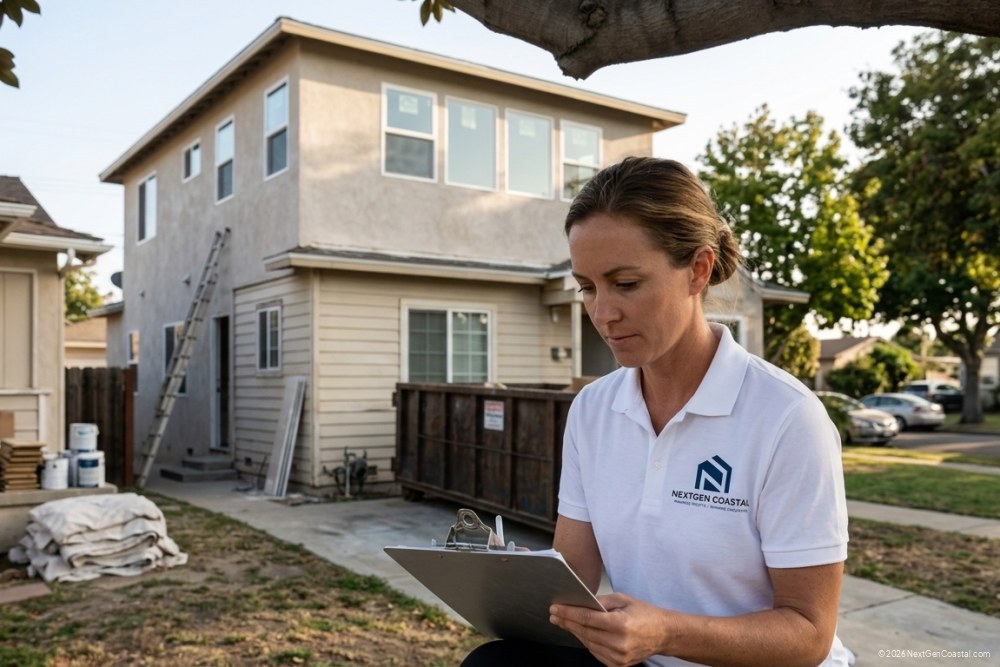
Execution risk is elevated. A 30-month construction window is tight in California's entitlement environment, particularly for projects requiring design review, coastal commission approval, or environmental remediation. Budget 6–9 months for entitlements, 12–18 months for construction, and 3–6 months for lease-up. Minimal contingency remains.
Cost overruns are common. Our data (aggregated from NextGen Coastal projects and industry reports from California Building Industry Association) show that coastal California value-add projects delivered in 2023–2024 exceeded pro forma hard costs by an average of 14%. The substantial-improvement test offers no relief. If the fund fails to deploy the required capital within 30 months, the investment loses QOZ status and the deferred gain is immediately recognized.
Financing QOZ Investments: Debt Structure and DSCR Constraints
Most QOZ investors finance a portion of the acquisition and improvement costs, but the program's structure introduces constraints. The 180-day reinvestment window requires that the investor commit capital to the Qualified Opportunity Fund quickly, often before construction financing is in place.
The typical sequence: the investor contributes the deferred gain amount as equity to the QOF. The QOF acquires the property with a combination of that equity and a bridge or construction loan. The QOF draws the loan to fund improvements. The property stabilizes. The QOF refinances into permanent debt.
Lenders are increasingly comfortable with QOZ structures, but they underwrite the investment as a value-add or ground-up project, not a stabilized acquisition. That means higher rates, lower advance, and stricter covenants.
A representative term sheet for a coastal California QOZ project in 2025 (based on recent quotes from regional lenders including Pacific Western Bank and CIT Bank): 65% loan-to-cost, 7.8% interest rate (approximately 300 basis points over SOFR), 24-month interest-only period, 1.25× minimum DSCR at stabilization, and a 2% exit fee. The investor must therefore contribute 35% of total project cost as equity. For a given all-in basis, that is a specific dollar equity check. The deferred gain must be large enough to cover that equity check.
Refinancing into permanent debt at stabilization is critical to the ten-year hold strategy. A property that stabilizes at a given cap rate in year three can typically refinance at a given loan-to-value with a specific rate and DSCR, allowing the investor to pull out a portion of the appreciated equity while maintaining the QOZ investment. The refinance proceeds are not taxable (debt is not a realization event), so the investor can redeploy that capital into additional QOZ projects or other investments without triggering the deferred gain.
The December 2026 Deadline: Deferral Recognition and Strategic Timing
The QOZ program's deferral benefit expires on December 31, 2026. On that date, any capital gain that was deferred by investing in a QOF is recognized and taxable, regardless of whether the QOF investment has been sold. For an investor who rolled a gain into a QOF in 2022, the full amount (less any applicable step-up if the five-year hold was satisfied) will be included in 2026 taxable income, due in April 2027.
This creates a liquidity event.
The investor must have cash available to pay the deferred tax (at the federal level, the applicable combined rate on the deferred gain), even though the QOF investment remains illiquid and cannot be sold without forfeiting the ten-year exclusion.
Sophisticated investors are planning for this in one of three ways. First, reserve cash: set aside the estimated tax liability in a money-market account (earning approximately 5% based on current rates), so the funds are available in April 2027. Second, refinance the QOF asset: if the property has appreciated and stabilized, pull cash out via a refinance in late 2026 to cover the tax bill. Third, sell a different asset: liquidate a non-QOZ investment in 2026 to generate the cash, effectively using the QOZ deferral to time the recognition of two gains.
The deadline also imposes a strategic constraint on new QOZ investments. An investor who recognizes a gain in 2025 and invests in a QOF by mid-2025 will pay tax on the deferred gain in April 2027, just 18–24 months after deployment. The deferral benefit is minimal. The investor is effectively pre-paying for the ten-year exclusion. That is still economically rational if the property's expected appreciation is large, but it shifts the program's value proposition from deferral-plus-exclusion to exclusion-only.
QOZ vs. 1031 Exchange: Parallel Strategies for Different Constraints
Qualified Opportunity Zones and 1031 exchanges are both tax-deferral mechanisms, but they operate under different rules and serve different investor profiles.
A 1031 exchange under IRC §1031 defers capital-gains tax by requiring the investor to acquire like-kind replacement property within 180 days. The deferral is permanent as long as the investor continues to exchange, but the gain is never excluded. It is merely rolled forward into the basis of each successive property.
A QOZ investment defers the gain until December 31, 2026, and excludes the appreciation after ten years under IRC §1400Z-2(c). But it requires that the replacement property be located in a designated census tract and satisfy the substantial-improvement test.
The choice depends on the investor's constraint set.
An investor selling a coastal duplex and seeking to acquire another coastal rental has two paths. The 1031 path: identify a like-kind property in the same submarket within 45 days, close within 180 days, defer the entire gain, and repeat the process at the next sale. The QOZ path: invest the gain amount into a QOF that acquires a property in a nearby QOZ tract, execute a substantial-improvement program, hold for ten years, and exclude the appreciation. The 1031 path preserves location flexibility but offers no exclusion. The QOZ path sacrifices location flexibility but delivers a permanent exclusion.
Some investors layer the strategies. Example: an investor sells a property with a given gain. She executes a 1031 exchange into a replacement property (deferring a portion of the gain) and invests the remaining gain into a QOF (deferring and ultimately excluding that portion). The result: she maintains a coastal rental in her preferred submarket via the 1031, and she captures the QOZ exclusion on a portion of the gain by accepting the census-tract constraint for that capital.
Submarket Selection: Gentrification Indicators and Ten-Year Appreciation Thesis
The QOZ program's ten-year hold requirement demands that investors underwrite not just current fundamentals but the trajectory of neighborhood change. A census tract that qualifies as low-income today may be a high-rent, supply-constrained submarket in 2035. Or it may remain economically stagnant. The difference is the appreciation thesis, and it depends on observable gentrification indicators.
We track six leading indicators across coastal California QOZ tracts.
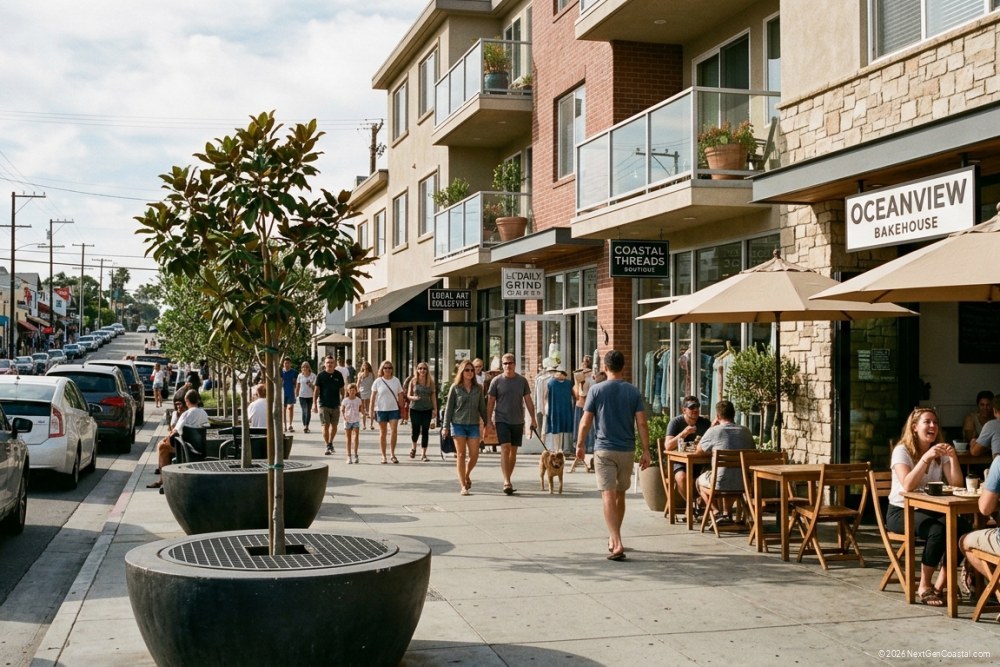
First, retail lease velocity: the number of new restaurant, coffee, and boutique retail leases signed in the past 24 months. A tract that has added three or more chef-driven restaurants or specialty retail concepts is signaling demand from higher-income residents.
Second, building permit activity: the volume of permits for residential additions, ADUs, and single-family renovations. Homeowners invest in improvements when they expect the neighborhood to appreciate.
Third, school enrollment trends: rising enrollment at the neighborhood elementary school indicates that families are moving in, a proxy for perceived safety and quality of life.
Fourth, crime rate trajectory: a decline of 20% or more in property crime over three years (using data from local police departments and the FBI Uniform Crime Reporting Program) is a strong signal that the submarket is stabilizing.
Fifth, transit investment: proximity to a planned or under-construction light-rail station, bus rapid transit line, or bike infrastructure.
Sixth, employment cluster proximity: distance to a major job center (university, hospital, corporate campus, life-sciences park) that is expanding headcount.
A QOZ tract that scores positively on four or more of these indicators is a high-conviction candidate for a ten-year hold. A tract that scores positively on fewer than two is speculative. The investor should model a wider range of exit cap rates and rent-growth scenarios.
Exit Strategy: Selling the QOF Interest and Electing the Step-Up
The QOZ program's permanent exclusion is realized when the investor sells the Qualified Opportunity Fund interest after ten years and elects to step up the basis to fair market value. The mechanics are straightforward but require careful documentation.
On the date of sale, the investor files an election with the IRS (on Form 8997, Initial and Annual Statement of Qualified Opportunity Fund (QOF) Investments) to adjust the basis of the QOF interest to its FMV, excluding the appreciation from taxable income. The election is irrevocable. It must be made on a timely-filed return for the year of sale.
The exit itself can take several forms.
Most common: the QOF sells the underlying property to a third-party buyer, distributes the proceeds to the investor, and the investor reports the sale of the QOF interest. The investor's basis in the QOF interest is stepped up to the FMV of the distributed proceeds, so the gain is zero.
Alternatively, the investor can sell the QOF interest itself to another investor. The market for QOF interests is thin. Buyers typically demand a discount to NAV.
Timing the exit is critical. The ten-year hold period is measured from the date the investor acquired the QOF interest, not the date the QOF acquired the property. An investor who contributed capital to a QOF on a specific date must hold the interest until that same date ten years later to qualify for the exclusion. Selling even one day early disqualifies the investment, and the appreciation is fully taxable. Investors should calendar the ten-year anniversary and begin marketing the property 12–18 months in advance to secure a sale that closes after the deadline.
Risk Factors: Regulatory Change, Market Cycles, and Execution
The QOZ program is federal law, but it is not immune to legislative risk. Congress has debated modifications to the program since its inception. Proposals to tighten the substantial-improvement test, limit the exclusion to primary residences, or sunset the benefit entirely have been introduced. While no changes have been enacted, investors should model the possibility that future legislation could cap the exclusion amount or impose additional compliance requirements. The ten-year hold period spans multiple election cycles. Tax policy is subject to change.
Market risk is inherent in any long-duration real estate investment. A property acquired in 2025 will be sold in 2035. The exit environment (interest rates, cap rates, rent growth, buyer demand) is unknowable today. Coastal California has historically been resilient, but the region is not immune to economic cycles. The 2008–2012 downturn saw coastal rents decline 15–20% peak-to-trough, and cap rates expanded 200-plus basis points. An investor who underwrites a specific exit cap and realizes a higher exit cap will see the property's value decline, erasing much of the appreciation and reducing the exclusion's value.
Execution risk (construction delays, cost overruns, lease-up shortfalls) is the most controllable but also the most common failure mode. The substantial-improvement test is unforgiving. A project that misses the 30-month deadline loses QOZ status, and the deferred gain is immediately recognized. Work with experienced general contractors. Budget 20% contingency on hard costs. Secure entitlements before closing the acquisition.
Case Study: Santa Ana Arts District Four-Unit New Construction
We modeled a representative QOZ investment to illustrate the program's economics.
The asset: a 5,000-square-foot vacant lot in Santa Ana's QOZ tract 06059074604, zoned for four residential units by right, located three blocks from the Downtown Santa Ana OCTA station. The investor acquired the lot in February 2025 for $650,000. She contributed deferred capital gains to a QOF. The QOF is constructing a four-unit building with an all-in basis (land plus hard costs, soft costs, and financing). The project will deliver in November 2026, satisfying the substantial-improvement test with 21 months to spare.
Pro forma: each unit is 1,100 square feet, two bedrooms, two baths, with in-unit laundry and one parking space. Asking rent is $3,400 per month, a 6% premium to the submarket median for new construction (per CoStar Q4 2024 data). Stabilized NOI (after 5% vacancy, 25% operating expenses, and annual reserves). Year-one cap rate: 5.2%.
The investor models 6.8% annual rent growth (in line with the tract's trailing five-year average from CoStar), 50-basis-point cap-rate compression by year ten (as the neighborhood gentrifies and institutional buyers enter), and a 4.7% exit cap.
Ten-year projection: year-ten NOI reaches a specific level. Exit value reaches a specific level. Gross gain is substantial. Under the QOZ structure, the appreciation is excluded, saving a substantial amount in federal tax. The investor also pays tax on the deferred gain in April 2027 (less the step-up under IRC §1400Z-2(b)(2)(B)(iii)), for a specific tax bill. Net tax savings: a meaningful percentage of the all-in basis. After-tax IRR exceeds the IRR for an identical non-QOZ investment. The spread is the program's value creation, and it compounds over the ten-year hold.
Action Plan: Deploying Capital Before the Window Closes
The QOZ opportunity is time-sensitive. Investors deploying QOZ capital often pair the strategy with allocations to rent-to-own homes and investor rental communities through Dwell by NextGen for diversified residential exposure outside the urban OZ tracts. Investors who have realized or expect to realize capital gains in 2025 should begin the site-selection and underwriting process immediately. The 180-day reinvestment window is firm. The substantial-improvement test requires that the investor have a clear construction plan and financing in place before closing the acquisition.
Step one: identify the gain event. Stock sale, business sale, real estate sale, partnership distribution. Any realization event starts the 180-day clock.
Step two: map the QOZ tracts in your target geography. The Treasury's online tool (https://www.cdfifund.gov/opportunity-zones) provides shapefiles and census-tract boundaries. Overlay those with your submarket knowledge to identify high-conviction candidates.
Step three: underwrite the substantial-improvement budget. Work with an architect or contractor to estimate hard costs. Confirm that the improvement budget will exceed the purchase price.
Step four: structure the QOF. Most investors use a single-asset QOF (one fund, one property) to simplify compliance and avoid cross-collateralization.
Step five: secure financing. Approach lenders with QOZ experience. Lock a rate before closing.
Step six: close and deploy. Contribute the gain amount to the QOF within 180 days. Acquire the property. Begin construction.
The investors who execute this sequence in 2025 will hold a tax-free call option on a decade of coastal California appreciation.
Frequently Asked Questions
What is the deadline to invest in a Qualified Opportunity Zone to receive any tax benefit?
Can I use a QOZ investment to defer capital gains from stock sales or business sales, or only real estate?
What is the substantial-improvement test, and how do I satisfy it?
How does the QOZ permanent exclusion compare to a 1031 exchange?
What happens to my deferred gain on December 31, 2026?