Understanding Coastal Zone Jurisdiction in LA County
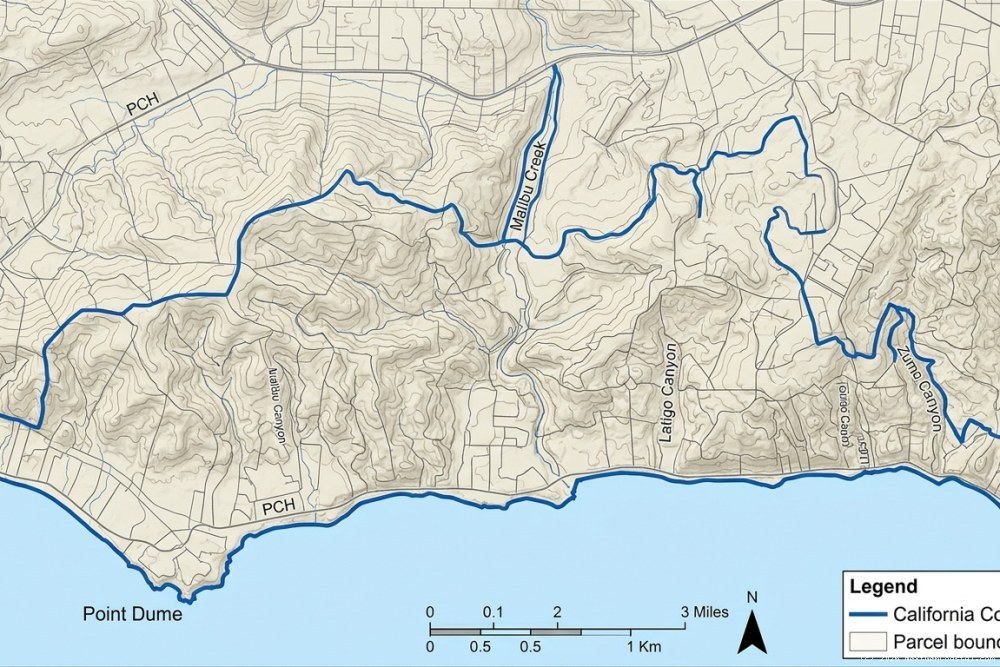
The California Coastal Zone extends inland at distances that shift with topography along LA County's 75 miles of shoreline. In Malibu and portions of the Palos Verdes Peninsula, the zone reaches over five miles from the water, pulling thousands of single-family lots under a dual-authority regime that doesn't map neatly to city boundaries or underlying zoning.
Cities within the coastal zone operate under a Local Coastal Program (LCP) that the California Coastal Commission has certified. When you file an ADU application, the city processes it first under AB 2221's ministerial framework, but the CCC holds appellate authority over projects that touch coastal resource questions. You move through local review, secure approval, then enter a ten-day window during which the Commission can pull jurisdiction if someone appeals.
Malibu, Santa Monica, the three South Bay beach cities (Manhattan Beach, Hermosa Beach, Redondo Beach), and the Peninsula municipalities (Palos Verdes Estates, Rancho Palos Verdes, Rolling Hills Estates) account for most of the coastal ADU volume in LA County. Each has layered local standards onto state law; each reads coastal setback policy through a different lens. Confirming which jurisdiction governs your parcel is the first task, and a zoning map won't always settle it.
How to Determine Your Property's Coastal Zone Status
Before you retain architects or pull permits, verify coastal zone status through three channels. Request a zoning verification letter from the city planning department (most coastal jurisdictions turn these around in five to ten business days for a small fee). Pull the CCC's online coastal zone boundary maps, which overlay parcel lines against the certified LCP limits. Order a preliminary title report that flags any coastal development restrictions or recorded deed notices.
Properties inside the zone carry one of three designations: subject to CCC appeal jurisdiction, located in an area of deferred certification, or outside the zone entirely. The appeal-jurisdiction label triggers the two-stage process. If your lot falls into that category, any approved ADU can be appealed to the CCC within 10 working days of local sign-off, potentially stretching your entitlement timeline by two to four months if an appeal lands.
AB 2221 and the Ministerial Approval Framework
AB 2221 marks the state's most direct effort to accelerate ADU approvals in coastal jurisdictions. Cities must process compliant applications ministerially (no discretionary review, no public hearing) even within the coastal zone, so long as the project meets objective development standards. Prior to 2021, many coastal cities routed ADUs through discretionary coastal development permits that invited design review and neighbor comment.
The ministerial mandate covers detached and attached ADUs up to 850 square feet (1,000 square feet if the unit includes more than one bedroom) and JADUs up to 500 square feet. A project that complies with local setback, height, lot coverage, and parking rules must be approved or denied within 60 days of submittal. Cities cannot layer on subjective design criteria, demand compatibility findings, or condition approval on coastal access improvements unless those requirements appear as objective standards in the certified LCP.
AB 2221 does not, however, strip the CCC of appellate authority. The city approves your compliant ADU ministerially, then the approval enters a ten-day appeal window during which any party can petition the Commission to review coastal resource impacts. You secure local approval quickly; you don't have final entitlement certainty until the appeal period closes or the CCC declines to hear the case.
The ministerial approval framework under AB 2221 moves you through the city, but it doesn't shield you from coastal appeals. In our experience, projects that trigger CCC review on oceanfront or bluff-top parcels add three to four months and require additional consultant work that wasn't budgeted at acquisition.
What Triggers CCC Appeals on ADU Projects
Not every coastal ADU draws an appeal. The CCC typically steps in when a project raises one of four concerns: public coastal access impacts, visual resource degradation from scenic corridors, environmentally sensitive habitat area (ESHA) encroachment, or geologic hazard exposure on bluff-top or steep-slope lots. Properties sitting more than 300 feet inland, outside mapped ESHA, and off designated scenic highways face materially lower appeal risk.
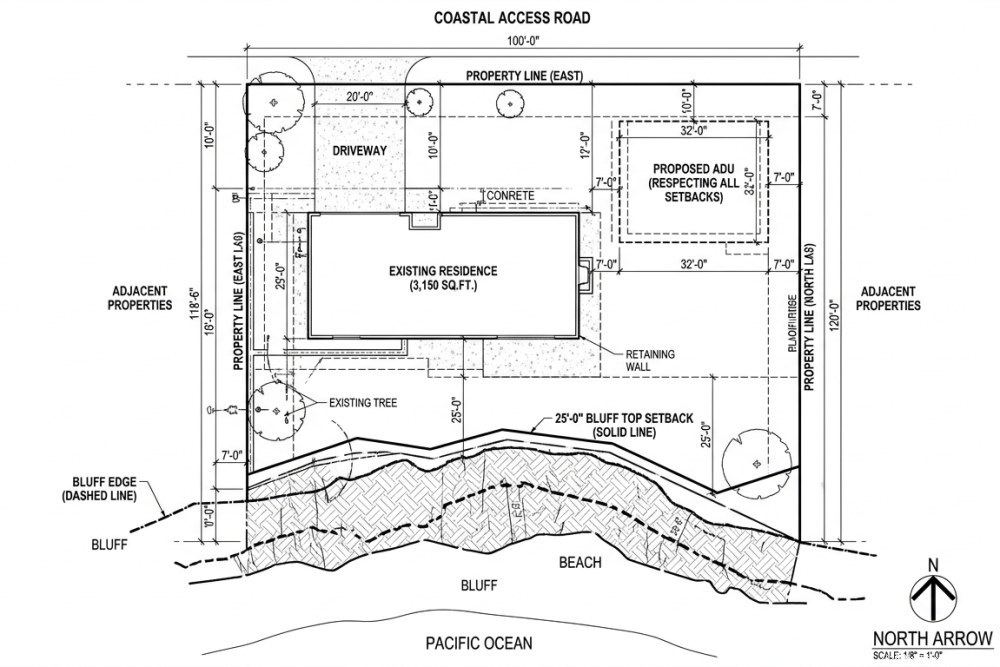
Oceanfront parcels receive the closest scrutiny. The CCC enforces a 25-foot bluff-edge setback policy for new construction in most LA coastal jurisdictions; ADUs that push into this buffer draw appeals with some regularity. Projects that obstruct public view corridors from Pacific Coast Highway or similar coastal routes trigger visual impact reviews. Commission staff review every approved coastal ADU during the appeal window and flag projects that appear inconsistent with LCP policies, even when the city approved them ministerially under state law.
City-Specific ADU Ordinances Across LA's Coast
Each coastal city in LA County has adopted ADU regulations that read state law through the filter of local coastal policies. You end up with a matrix of setback requirements, size caps, and design standards that shift across jurisdictional lines. A configuration approved ministerially in Manhattan Beach may require discretionary review in Malibu.
Malibu ADU Requirements and Coastal Overlays
Malibu operates under one of California's most restrictive LCPs, layering coastal resource protections onto state ADU mandates. The city permits detached ADUs up to 1,200 square feet on parcels over one acre but caps the maximum at 850 square feet on smaller lots. Standard setbacks run 20 feet at the front, 5 feet on sides, 10 feet at the rear, dimensions that compress on constrained hillside sites.
The coastal overlay imposes three additional requirements. ADUs on oceanfront or bluff-top parcels must include a coastal hazards analysis prepared by a licensed geologist demonstrating geotechnical stability. Projects within 100 feet of mapped ESHA require a biological assessment confirming no habitat impacts. Any ADU visible from Pacific Coast Highway undergoes visual impact review to verify the structure doesn't obstruct public coastal views, a requirement that often forces discretionary processing despite AB 2221's ministerial framework.
Malibu's ADU approval timeline typically runs 90 to 120 days for straightforward projects, stretching to six months or longer when coastal overlays apply. Plan check fees vary with project complexity; geotechnical and biological studies add consultant costs that weren't required for inland projects.
Santa Monica's ADU Framework and Parking Waivers
Santa Monica adopted ADU regulations in 2020 that hew closely to state law while preserving local design preferences. The city allows detached ADUs up to 850 square feet (1,000 square feet for two-bedroom configurations) on all single-family parcels, with ministerial processing for projects meeting objective standards. Setbacks mirror the underlying zone: 5 feet on interior sides, 15 feet on street-facing sides, 20 feet at the rear in most cases.
The city's parking waiver policy is developer-friendly. Santa Monica does not require replacement parking when an existing garage converts to an ADU, and it waives the one-space ADU parking requirement for properties within one-half mile of a Big Blue Bus stop, a threshold covering a substantial share of the city's single-family stock. JADU conversions become particularly attractive for older homes with detached garages in North of Montana and Sunset Park.
Santa Monica's coastal zone extends only to the first public street inland from the beach, limiting CCC jurisdiction to a narrow oceanfront band. Most ADU projects in interior neighborhoods face no coastal review, processing in 45 to 60 days.
South Bay Beach Cities: Manhattan, Hermosa, Redondo
The three South Bay beach cities have adopted similar ADU frameworks, creating regulatory consistency across the submarket. All three permit detached ADUs up to 850 square feet on parcels 5,000 square feet or larger, with reduced maximums (typically 650 square feet) on smaller lots. Setbacks are generally uniform: 4 feet on sides, 5 feet at rear, with front-yard ADUs prohibited.
Manhattan Beach imposes design standards requiring ADU architecture to align with the primary residence in roof pitch, siding material, and window proportions. The city's design review board retains authority to evaluate coastal-zone ADUs for visual compatibility even under ministerial processing, a provision that may extend approval timelines by 30 to 45 days. Hermosa Beach and Redondo Beach have eliminated design review for compliant ADUs, processing applications in roughly 60 days.
All three cities fall entirely within the coastal zone, but CCC appeals appear infrequent except on oceanfront parcels. The Commission has generally deferred to local ADU approvals in the South Bay, stepping in primarily when projects encroach on beach access pathways or violate bluff setback policies. Developers should anticipate a ten-day appeal window but can typically proceed with construction immediately after local approval.
Palos Verdes Peninsula: PVE, RPV, and Rolling Hills Estates
The Palos Verdes Peninsula cities operate under LCPs that prioritize viewshed protection and geologic stability. Palos Verdes Estates limits ADUs to 750 square feet on parcels over 10,000 square feet, with no ADUs permitted on smaller lots (a restriction that may conflict with state law). ADUs must be single-story, located in the rear half of the lot, and subject to Art Jury review.
Rancho Palos Verdes allows larger ADUs (up to 1,200 square feet) but enforces strict view corridor protections. Any ADU visible from Palos Verdes Drive or other designated scenic roads must undergo a view analysis demonstrating no obstruction of public coastal views. The city's geotechnical review is particularly rigorous: ADUs on parcels with slopes exceeding a threshold percentage require a soils report and foundation design by a licensed geotechnical engineer.
Rolling Hills Estates has adopted the Peninsula's most permissive ADU ordinance, allowing detached units up to 850 square feet with ministerial approval and no design review. The city's coastal zone coverage is limited; CCC appeals appear uncommon. Processing timelines typically run 60 to 75 days.
Coastal Setback Requirements and ESHA Buffers
Setback requirements in the coastal zone serve dual functions: they implement local zoning standards and protect coastal resources from development encroachment. The California Coastal Act requires adequate setbacks from bluff edges, wetlands, streams, and environmentally sensitive habitat areas, with specific distances determined by site conditions and resource sensitivity. These coastal setbacks often exceed the standard zoning setbacks that govern inland properties.
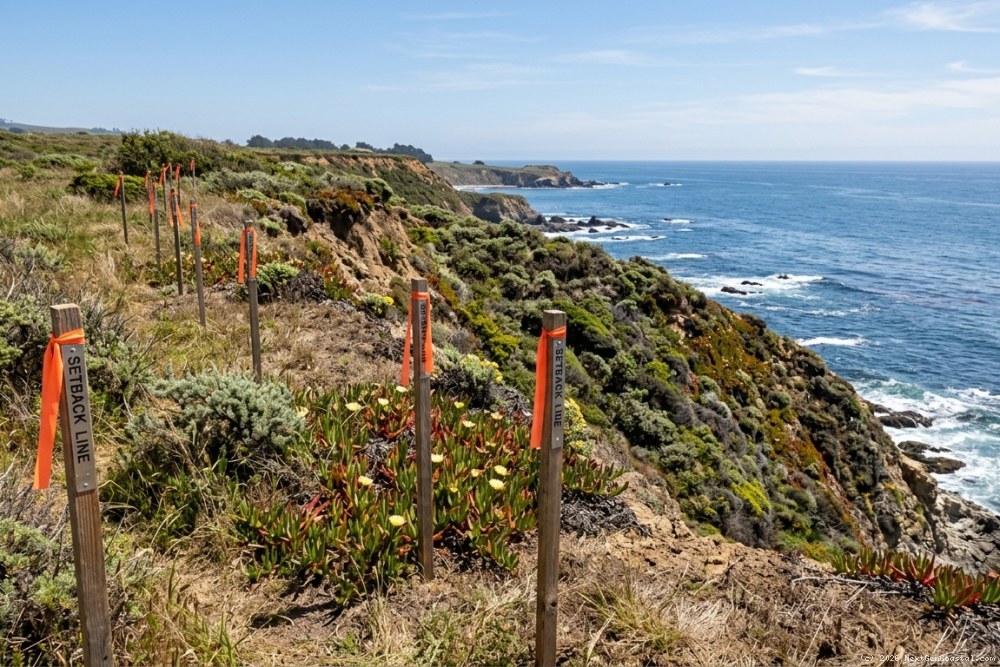
The CCC's default bluff-edge setback is 25 feet from the bluff edge or the landward extent of the bluff-top setback line, whichever is more restrictive. This applies to all new structures, including ADUs, on oceanfront or bluff-top parcels. Cities can adopt more restrictive setbacks in their LCPs; Malibu requires 30 feet in some areas, while Rancho Palos Verdes uses a sliding scale based on bluff retreat rates. The setback is measured from the current bluff edge, not from property lines, requiring a site-specific survey by a licensed land surveyor.
ESHA buffers add another constraint layer. Wetlands, riparian corridors, and native habitat areas mapped in the LCP require development setbacks ranging from 50 to 100 feet depending on resource type and sensitivity. ADUs proposed within these buffers trigger biological review and often demand project redesign or habitat mitigation. The CCC maintains a statewide ESHA database, but local LCPs may identify additional sensitive areas not shown on state maps.
When Geotechnical Stability Analysis Is Required
Coastal bluff properties and steep-slope parcels require geotechnical analysis demonstrating that ADU development won't accelerate erosion, increase landslide risk, or contribute to bluff retreat. The analysis must be prepared by a California-licensed geologist or geotechnical engineer and address four questions: Is the site currently stable? Will the proposed ADU alter site drainage or increase erosion potential? What is the expected bluff retreat rate over the structure's design life? Does the ADU foundation design account for seismic and soil conditions?
The geotechnical report typically includes subsurface exploration (borings or test pits), laboratory soil testing, and foundation recommendations. Properties with known landslide history or active ground movement require more extensive investigation. The CCC reviews these reports closely and frequently requires peer review by Commission staff geologists, potentially extending approval timelines by 30 to 60 days.
The Dual-Track Entitlement Process: City to CCC
Coastal ADU entitlement follows a sequential two-stage process. Stage one is local city review under AB 2221's ministerial framework. You submit a complete application with architectural plans, site plan, utility connections, and any required technical studies. The city has 60 days to approve or deny based on compliance with objective standards. If approved, the city issues a notice of final local action and posts the approval for public review.
Stage two begins immediately: the 10-working-day appeal period. The CCC posts all approved coastal ADUs on its online appeals database; any person can file an appeal alleging the project is inconsistent with the certified LCP or the Coastal Act. If no appeal is filed within ten days, the local approval becomes final and you can pull building permits. An appeal triggers CCC jurisdiction and the Commission schedules a hearing, typically 60 to 90 days out.
During CCC review, Commission staff analyze the project against Coastal Act policies and may request additional information, design modifications, or mitigation measures. The Commission can uphold the local approval, approve with conditions, or deny the project outright. Many ADU appeals result in conditional approval; the CCC allows the project to proceed with modifications such as increased setbacks, view corridor protections, or habitat restoration. Final CCC action adds 90 to 150 days to the total entitlement timeline.
Strategies to Minimize Appeal Risk
Developers can reduce CCC appeal probability through strategic project design and pre-application outreach. First, maximize setbacks beyond the local ordinance minimum. An ADU set back 30 feet from the bluff edge instead of the required 25 feet carries lower appeal risk. Second, minimize building height and use low-profile roof forms that reduce visual impact from public vantage points. Third, incorporate native landscaping and permeable paving to demonstrate coastal resource sensitivity.
Pre-application consultation with CCC staff is valuable for high-risk sites. The Commission offers informal project review before local submittal, providing feedback on potential coastal issues and suggesting design modifications that would avoid appeal. This consultation is typically free and occurs within 30 days of request. Developers who incorporate CCC staff recommendations into their local application appear to face lower appeal rates, even on oceanfront parcels.
Consider timing as well. What the data suggests is that coastal ADU appeal rates have been relatively low in recent years, with most appeals originating from organized environmental groups rather than neighbors. Projects that clearly comply with LCP policies, avoid ESHA encroachment, and preserve public views appear to have lower appeal rates. The dual-track process adds complexity, but it's manageable with proper planning and technical support.
JADU Conversions in the Coastal Zone
Junior accessory dwelling units offer a lower-risk entitlement pathway in coastal areas because they're created entirely within the existing primary residence footprint. JADUs convert existing space (typically a bedroom suite, bonus room, or attached garage) into an independent unit up to 500 square feet with a separate entrance, kitchenette, and bathroom. No new structure is built; no additional lot coverage is created. JADUs rarely trigger coastal resource concerns or CCC appeals.
AB 68 and AB 587 mandate that cities approve JADU applications ministerially within 60 days, with no parking requirements and minimal design review. In the coastal zone, this ministerial mandate holds even stronger because JADUs don't alter the building envelope or site configuration. The CCC has issued guidance indicating that JADU conversions within existing structures are generally exempt from coastal development permit requirements, eliminating the appeal window for most projects.
The economics favor JADUs in high-value coastal markets. A typical JADU conversion runs approximately 40 to 60 percent less than a comparable detached ADU, including kitchen and bathroom installation, separate entrance, soundproofing, and permits. Rental income potential is similar; measured on a per-square-foot basis, JADUs in Santa Monica and Manhattan Beach can deliver faster payback and lower entitlement risk. For coastal property owners seeking to add a rental unit without CCC jurisdiction, JADU conversion is often the cleaner strategy.
Garage Conversion JADUs: Parking and Coastal Access
Converting an existing garage to a JADU eliminates parking spaces, which can raise coastal access concerns in beach-adjacent neighborhoods where street parking is constrained. State law prohibits cities from requiring replacement parking for JADU conversions, and the CCC has generally deferred to this state mandate. The Commission's position is that parking impacts are a local land use issue, not a coastal resource issue, unless the project demonstrably blocks public beach access.
Garage conversion JADUs in coastal areas face scrutiny primarily when the property sits on a designated coastal access route or within 300 feet of a public beach entrance. In these locations, the CCC sometimes requires the property owner to record a deed restriction acknowledging that future parking demand cannot be met through on-street spaces in the coastal access corridor. This restriction doesn't prevent the JADU conversion, but it limits the owner's ability to claim parking hardship later.
Cities like Santa Monica and Hermosa Beach have adopted parking waiver policies that explicitly allow garage conversions without replacement parking, even in the coastal zone. These policies create a clear ministerial pathway: submit plans showing the garage conversion, demonstrate compliance with building and fire codes, receive approval within 60 days. No coastal development permit. No CCC review. No appeal window. For developers targeting coastal SFR value-add opportunities, garage conversion JADUs represent a lower-friction entitlement strategy.
Timeline and Cost Expectations for Coastal ADUs
Oceanfront parcels with CCC appeals add 6–9 months to standard 60-day processing timelines.
View chart data
| Category | Days from application to permit |
|---|---|
| Interior lot (Santa Monica/Redondo) | 68 |
| Oceanfront (no appeal) | 135 |
| Oceanfront (Malibu w/ overlays) | 165 |
| Any location (CCC appeal filed) | 285 |
Entitlement timelines for LA coastal ADUs vary with project complexity, city jurisdiction, and appeal risk. A straightforward detached ADU on an interior lot in Santa Monica or Redondo Beach processes in 60 to 75 days from application to permit issuance, with no CCC involvement. The same project on an oceanfront parcel in Malibu or Palos Verdes Estates stretches to 120 to 180 days when you account for geotechnical review, coastal overlays, and the appeal window.
If your project draws a CCC appeal, add 90 to 150 days for Commission review and hearing. Total entitlement timeline for an appealed coastal ADU can reach 270 to 330 days from initial application to final approval. This extended timeline carries holding costs: property taxes, insurance, and opportunity cost on capital that could be deployed elsewhere. I model a 12- to 15-month entitlement and construction cycle for coastal ADUs, compared to 8 to 10 months for comparable inland projects.
Hard costs for coastal ADU development run $350 to $550 per square foot depending on finishes, site conditions, and utility connections. An 850-square-foot detached ADU costs $300,000 to $470,000 all-in, including design, permits, and construction. Coastal premiums add 15 to 25 percent to baseline costs: geotechnical studies, biological assessments, coastal engineering for oceanfront sites, and extended soft costs during the longer entitlement period.
Permit fees vary by city but generally range from several thousand to over ten thousand dollars for plan check and building permits, plus separate coastal development permit fees if discretionary review is required. Impact fees are waived for ADUs under AB 1482 in most jurisdictions, but some coastal cities charge water and sewer connection fees. Budget 8 to 12 percent of total project cost for permits, fees, and entitlement consultants (higher than the 5 to 7 percent typical for inland ADUs).
Strategic Recommendations for Coastal ADU Developers
Successful coastal ADU development requires a different strategic approach than inland projects.
First, conduct thorough due diligence before purchasing a coastal property for ADU development. Order a preliminary title report, coastal zone verification, and ESHA map review to identify constraints before you're under contract. Properties with recorded coastal deed restrictions, active landslide areas, or ESHA buffers present significant development challenges.
Second, engage technical consultants early. Hire a geotechnical engineer and coastal land use attorney during the pre-application phase, not after you've submitted plans. These consultants can identify potential issues and design solutions before you've invested in architectural drawings. A pre-application feasibility study can help avoid significant costs in aborted design work and permit fees on challenging projects.
Third, design conservatively. Maximize setbacks, minimize height, incorporate coastal-friendly materials and landscaping. An ADU that exceeds minimum setbacks by 10 to 15 feet and uses natural wood siding instead of stucco faces lower appeal risk. The incremental cost of conservative design is modest compared to the cost and delay of a CCC appeal.
Fourth, consider JADU conversion as your first option. If your existing residence can accommodate a 500-square-foot JADU through garage conversion or interior remodel, you'll achieve 70 to 80 percent of the rental income at 50 to 60 percent of the cost and timeline of a detached ADU. JADUs avoid coastal appeals entirely and process ministerially in every LA coastal city.
Finally, build relationships with local planning staff and CCC coastal planners. Coastal entitlement is a relationship-driven process. Planners who know you and trust your team are more likely to support your project through discretionary reviews and less likely to flag it for appeal. Attend pre-application meetings, respond promptly to information requests, demonstrate genuine commitment to coastal resource protection. The goodwill you build on your first coastal ADU will pay dividends on subsequent projects.
Coastal ADU development isn't harder than inland projects; it operates under a different set of constraints. The developers who succeed in this space understand that coastal entitlement is measured on a longer timeline and model their pro forma around twelve-month cycles and cost premiums in the range of 20 percent. Rush a coastal ADU and you'll encounter appeals, denials, and cost overruns. Plan properly and you'll deliver a premium asset in a supply-constrained submarket.
Frequently Asked Questions
Does AB 2221 eliminate California Coastal Commission review of ADUs?
What is the typical timeline for ADU entitlement in LA's coastal zone?
Are JADUs exempt from California Coastal Commission jurisdiction?
What triggers a California Coastal Commission appeal on an ADU project?
How much does geotechnical analysis cost for a coastal ADU?
Can I convert my garage to a JADU in the coastal zone without replacing parking?