What Is a Reverse 1031 Exchange?
A reverse 1031 exchange inverts the traditional sequence: you acquire the replacement property before disposing of the relinquished property, while still deferring capital gains tax under IRC Section 1031. The IRS formalized reverse exchange procedures in Revenue Procedure 2000-37, creating a safe-harbor framework that allows up to 180 days to complete both legs of the transaction.
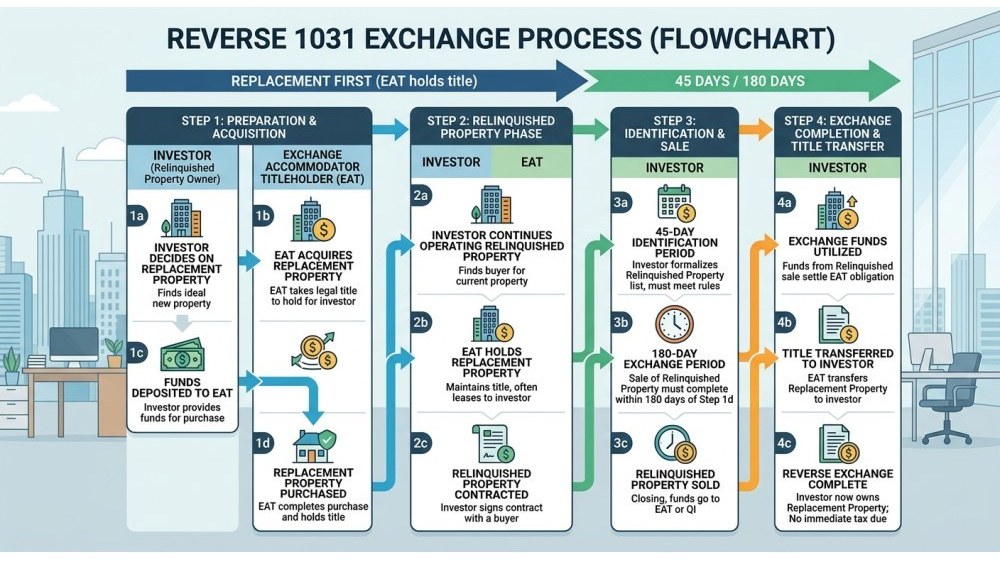
The core challenge is straightforward—Section 1031 prohibits an investor from holding legal title to both properties simultaneously. The solution is an Exchange Accommodation Titleholder (EAT), a qualified intermediary entity that temporarily parks one property (usually the replacement) while you complete the sale of the other. The EAT holds bare legal title; you retain all economic benefits, risks, and management control through a carefully structured parking arrangement.
Reverse exchanges represent a meaningful share of 1031 exchange activity nationally. In supply-constrained coastal markets where inventory scarcity drives timing pressure, reverse structures account for a notable portion of luxury single-family residence exchanges, reflecting the competitive intensity around beachfront and ocean-view properties.
Mechanics: Parking Arrangements and Title Holding
Revenue Procedure 2000-37 defines two parking configurations. In a reverse exchange parking arrangement, the EAT acquires and holds title to the replacement property while you retain ownership of the relinquished property and work toward its sale. In a reverse exchange improvement parking arrangement, the EAT holds the replacement property and funds construction or improvements before the exchange completes—useful when acquiring a teardown lot or value-add coastal asset requiring immediate capital investment.
The parking period cannot exceed 180 calendar days from the date the EAT takes title to the parked property. Within the first 45 days, you must identify in writing which property will be the relinquished property (if parking the replacement) or the replacement property (if parking the relinquished). This identification is submitted to the qualified intermediary and becomes irrevocable.
During the parking period, the EAT is the legal owner on record, but you bear all economic incidents of ownership. You fund the acquisition, pay property taxes, insurance, HOA dues, and any debt service. If the property generates rental income, that income flows to you. If the property declines in value, you absorb the loss. The EAT's role is purely administrative—it exists to satisfy the non-simultaneous ownership requirement of Section 1031.
Qualified Intermediary and EAT Relationship
The EAT is typically a single-purpose LLC established by your qualified intermediary specifically for your transaction. The QI manages the EAT, executes documents on its behalf, and ensures compliance with safe-harbor rules. You cannot serve as the EAT, nor can any disqualified person—your agent, attorney, accountant, employee, or family member within two years of the exchange.
The QI charges separate fees for reverse exchange services. These fees typically include a setup fee, monthly holding fees during the parking period, and legal documentation costs. These fees are in addition to standard QI exchange fees and reflect the added complexity, legal documentation, and liability the intermediary assumes by holding title to a significant asset.
Capital Requirements and Financing Constraints
Reverse exchanges demand significantly more liquidity than forward exchanges. You must fund the replacement property acquisition in full—either with cash or debt—while still owning the relinquished property. This dual-ownership period creates a capital bridge that many investors underestimate.
If you plan to finance the replacement property, understand that the EAT will be the borrower of record during the parking period. Most conventional lenders will not lend to a single-purpose LLC with no operating history, no balance sheet, and a 180-day dissolution timeline. As a result, reverse exchange financing typically requires one of three structures:
- All-cash acquisition by the EAT, with post-exchange refinancing. You wire funds to the EAT to close on the replacement property, then refinance in your own name after the exchange completes. This approach offers the cleanest title and fastest closing but ties up significant capital for up to six months.
- Bridge loan or line of credit in your name. You borrow against other assets (securities, unencumbered real estate, business equity) to fund the EAT's cash purchase, then pay down the bridge loan with proceeds from the relinquished property sale.
- Specialized reverse exchange lender. A limited number of portfolio lenders and private debt funds will lend directly to the EAT, typically at rates and loan-to-value caps that reflect the short-term nature and elevated underwriting risk of such loans. These loans are generally structured for 6–12 month terms.
For a significant replacement property acquisition in a coastal submarket, an all-cash parking arrangement requires the investor to deploy substantial liquid capital while simultaneously carrying the relinquished property (and its debt, if any) until sale. This represents a meaningful liquidity test even for high-net-worth portfolios.
Reverse exchanges are capital-intensive by design. The investors who succeed are those who model the bridge period as a cost of competitive advantage, not a financing inconvenience.
Timeline and Critical Deadlines
The 45-day identification window and 180-day total deadline create compressed timelines for selling the relinquished property.
The reverse exchange clock starts the moment the EAT takes title to the parked property. From that date, you have 180 calendar days to complete the entire exchange—sell the relinquished property, transfer sale proceeds to the QI, and exchange into the replacement property held by the EAT.
Within the first 45 days, you must formally identify which property is relinquished and which is replacement. This identification is binding. If you fail to sell the relinquished property within the 180-day window, the exchange fails, the EAT transfers the replacement property to you in a taxable transaction, and you recognize gain on the eventual sale of the relinquished property with no deferral.
Unlike forward exchanges, where the 45-day identification period creates urgency to find replacement property, reverse exchanges shift the pressure to the sale timeline of the relinquished asset. You must price, market, and close the relinquished property within a fixed window, often in a market where you have limited control over buyer behavior, financing delays, or inspection negotiations.
Strategic Timing Considerations
Savvy coastal investors use reverse exchanges to decouple acquisition timing from disposition timing, but they do not ignore disposition risk. Best practice is to have the relinquished property pre-marketed or under contract before initiating the reverse exchange. If you acquire the replacement property on day one and the relinquished property sits unsold on day 120, you face a 60-day sprint to close—often requiring price concessions, buyer incentives, or acceptance of suboptimal terms to preserve the exchange.
In practice, most successful reverse exchanges in the coastal single-family rental segment close the relinquished property sale within a reasonable timeframe after the EAT's replacement acquisition, leaving a buffer for unforeseen delays. Investors who wait until late in the 180-day window to secure a buyer routinely face challenges in closing in time, triggering taxable recognition and forfeiting the deferral benefit that justified the entire structure.

Coastal Market Applications: When Reverse Exchanges Make Sense
Reverse 1031 exchanges are not appropriate for every transaction. They are a precision tool for specific market conditions and investor circumstances. In coastal California, four scenarios drive the majority of reverse exchange activity among luxury rental portfolios.
Scenario One: Scarce Beachfront and Ocean-View Inventory
Luxury beachfront single-family rentals in markets like Corona del Mar, La Jolla Shores, Manhattan Beach, and Encinitas trade infrequently. When a premium oceanfront property hits the market, it often receives multiple offers within a short timeframe. Sellers expect clean, all-cash offers with short escrow periods and minimal contingencies.
An investor holding a relinquished property in an inland submarket cannot wait 45 days to identify a beachfront replacement, then hope it remains available while the relinquished property closes. A reverse exchange allows the investor to write a competitive offer on the beachfront property, close quickly via the EAT, and then market the relinquished property without time pressure from a forward-exchange identification deadline.
Coastal luxury single-family rental inventory in premium price bands remains constrained compared to historical levels. Median days on market for oceanfront properties is significantly shorter than for comparable inland luxury homes. In this environment, reverse exchanges are not exotic—they are a practical tool for serious buyers.
Scenario Two: Off-Market and Pocket Listing Opportunities
A significant share of coastal luxury transactions occur off-market, brokered through relationships between listing agents, wealth advisors, and repeat investor clients. These opportunities do not wait for your relinquished property to close. If a broker calls with an off-market opportunity and you need 90 days to sell your existing asset, the opportunity will be gone.
Reverse exchanges allow you to act immediately on off-market deals, locking in the replacement property while you execute a controlled, optimized sale of the relinquished asset. This is particularly valuable when the relinquished property is a tenant-occupied luxury rental where you want to time the sale to coincide with lease expiration, avoiding the valuation discount that occupied properties can command in the luxury single-family rental market.
Scenario Three: Value-Add Replacement Properties Requiring Immediate Work
Coastal investors frequently target dated luxury properties with value-add potential—a 1970s-era oceanfront home requiring full interior renovation, or a hillside view property with deferred maintenance and outdated systems. If you acquire such a property in a forward exchange, you lose months of the value-add timeline waiting for the relinquished property to close and the exchange to complete.
A reverse exchange lets you acquire the replacement property, begin design, permitting, and construction immediately, and complete the renovation while the relinquished property sale progresses. By the time the exchange closes and you take title, the property is rent-ready, allowing you to capture peak-season rental rates without delay. In coastal markets where short-term rental rates can be substantial for renovated beachfront homes, a head start on construction can generate meaningful incremental first-year net operating income.
Scenario Four: Portfolio Rebalancing Across Coastal Submarkets
Sophisticated coastal investors use reverse exchanges to rebalance geographic and asset-class exposure within their portfolios. An investor holding multiple inland properties may want to consolidate into fewer beachfront properties in premium coastal locations, improving rent growth trajectory and long-term appreciation potential.
Executing this rebalancing in a forward exchange requires selling all relinquished properties within a tight window, then identifying and closing on replacement properties within 180 days—a logistical challenge that often forces suboptimal pricing or acceptance of inferior replacement assets. A reverse exchange allows the investor to acquire the first replacement property when the right opportunity appears, then methodically sell the relinquished properties over the following months, optimizing sale price and timing for each asset individually.
Tax Compliance and Safe-Harbor Requirements
Revenue Procedure 2000-37 provides a safe harbor, not a requirement. You can structure a reverse exchange outside the safe harbor, but you assume the risk that the IRS may challenge the transaction and disallow deferral. Staying within the safe harbor requires strict adherence to five core rules.
First, the EAT must be a person (entity) that is not the taxpayer or a disqualified person. The EAT must hold qualified indicia of ownership—legal title recorded in the public records—at all times during the parking period. Second, the parking period cannot exceed 180 days. Third, you must identify the relinquished and replacement properties in writing within 45 days of the EAT's acquisition of the parked property. Fourth, the combined time period for both the parking arrangement and the subsequent exchange cannot exceed 180 days from the EAT's initial acquisition. Fifth, the property must be held for investment or business use, not personal use or dealer inventory.
The safe harbor also requires that the EAT hold the property in a manner consistent with normal commercial practices. This means the EAT should have a separate tax ID, maintain separate books and records, and file its own tax returns (typically a disregarded entity return). The EAT should not commingle funds with your personal or business accounts, and all expenses related to the parked property should flow through the EAT's accounts, even though you are the economic beneficiary.
Failure to comply with safe-harbor requirements does not automatically disqualify the exchange, but it shifts the burden to you to prove that the transaction meets the general requirements of Section 1031—a significantly higher bar and a litigation risk most investors prefer to avoid.
Cost Analysis: Fees, Carrying Costs, and Break-Even Thresholds
Opportunity cost of capital and financing typically dwarf direct QI and legal fees in reverse exchange transactions.
Reverse exchanges are more expensive than forward exchanges, both in direct fees and in opportunity cost of capital. A full cost analysis for a significant coastal replacement property typically includes:
- QI reverse exchange setup fee: Varies by intermediary and transaction complexity
- Monthly EAT holding fee: Charged during the parking period
- Legal documentation (EAT formation, parking agreement, exchange agreement): Varies by jurisdiction and complexity
- Title insurance for EAT acquisition and subsequent exchange: Varies by county and property value
- Financing cost (if using bridge debt or specialized reverse lender): Depends on loan structure, amount, and term
- Opportunity cost of capital: If you deploy significant capital for several months, there is an opportunity cost relative to alternative uses of those funds
Total costs for a typical coastal reverse exchange vary based on transaction size, financing structure, and holding period. The break-even question is straightforward: does the ability to acquire the replacement property now, rather than waiting or losing the opportunity, justify these costs? In a market where luxury coastal inventory is scarce and rent growth is meaningful, the answer is often yes. Missing a premium beachfront property that appreciates significantly in the 12 months you spend searching for an alternative can represent substantial foregone equity—potentially far more than the reverse exchange fees.
Common Pitfalls and How to Avoid Them
Reverse exchanges fail for predictable reasons. The most common pitfall is underestimating the relinquished property sale timeline. Investors acquire the replacement property on day one, assume the relinquished property will sell quickly, and find themselves on day 140 with no buyer and no backup plan. The solution is to pre-market the relinquished property, secure a backup buyer, or price aggressively enough to ensure a sale within a reasonable timeframe.
The second common failure is inadequate liquidity planning. Investors structure reverse exchanges assuming they can secure conventional financing for the replacement property, only to discover that lenders will not lend to the EAT. By the time they pivot to a cash acquisition or bridge loan, they have burned weeks of the 180-day window and face compressed timelines on both ends of the transaction.
A third pitfall is misunderstanding the identification requirement. In a forward exchange, you identify replacement properties. In a reverse exchange, you identify the relinquished property—the asset you will sell. If you own multiple properties and fail to identify the correct relinquished property within 45 days, or if you later attempt to substitute a different property, the exchange fails.
Finally, investors occasionally violate safe-harbor rules by taking title to the replacement property in their own name before the exchange completes, or by directing the EAT to transfer the property to them outside the formal exchange process. Any deviation from the safe-harbor structure—no matter how minor—can disqualify the entire transaction.
Strategic Integration with Coastal Portfolio Management
Reverse 1031 exchanges are not standalone transactions—they are portfolio management tools. The most sophisticated coastal investors integrate reverse exchange capability into their annual acquisition and disposition planning, maintaining liquidity reserves and lender relationships specifically to enable opportunistic moves when the right replacement property appears.
This means running a rolling 12-month acquisition pipeline, tracking off-market opportunities, maintaining relationships with brokers who specialize in luxury coastal listings, and pre-qualifying for bridge financing or reverse exchange lender programs before you need them. It also means stress-testing your relinquished property sale assumptions—modeling potential price adjustments or extended listing periods—to ensure you can still close within the 180-day window if market conditions soften.
For investors managing substantial coastal rental portfolios across multiple submarkets, reverse exchange capability is a competitive advantage. It allows you to act on the best opportunities when they appear, rather than waiting for your existing assets to sell. In markets where premium coastal properties command higher rent growth than inland alternatives, the ability to upgrade into superior assets without timing constraints can compound to meaningful portfolio performance differences over time.
The investors who built dominant coastal portfolios in the 2010s were the ones who could move when opportunity appeared, not the ones who waited for perfect timing.
Reverse vs. Forward: Choosing the Right Structure
Not every exchange should be a reverse exchange. Forward exchanges remain the default structure for most transactions, and they are simpler, cheaper, and less capital-intensive. The decision framework is straightforward.
Choose a forward exchange when: (1) you have confidence you can identify suitable replacement property within 45 days, (2) the replacement property market has adequate inventory and reasonable days-on-market, (3) you do not face competitive bidding pressure that requires all-cash offers or rapid closings, and (4) you prefer to minimize upfront capital deployment and exchange fees.
Choose a reverse exchange when: (1) you have identified a specific replacement property that will not wait for your relinquished property to sell, (2) you are competing in a supply-constrained market where inventory turns quickly, (3) you are pursuing an off-market or pocket listing opportunity, (4) the replacement property requires immediate construction or value-add work, or (5) you want to decouple acquisition timing from disposition timing to optimize pricing on both ends.
In coastal California's luxury single-family rental market, the calculus increasingly favors reverse structures. Inventory in premium beachfront segments remains constrained compared to historical levels, median days on market for top-tier properties is relatively short, and the share of all-cash offers in luxury transactions is substantial. In this environment, the ability to close quickly and compete with cash buyers is often the difference between acquiring a generational asset and watching it sell to someone else.
How NextGen Coastal Supports Reverse Exchange Investors
Reverse 1031 exchanges require flawless execution across multiple workstreams—property management continuity during the parking period, tenant communication if the relinquished property is occupied, coordination with QIs and title companies, and financial reporting that separates EAT activity from your personal books. NextGen Coastal manages these details for coastal investors executing complex exchange strategies.
Our team coordinates with your qualified intermediary to ensure the EAT receives all rental income, pays all operating expenses, and maintains separate accounting records during the parking period. We handle tenant notifications, lease assignments, and vendor transitions so that property operations continue without interruption while title is held by the EAT. And we provide the financial transparency and documentation your CPA needs to substantiate safe-harbor compliance and support your tax filings.
For investors managing substantial coastal portfolios across multiple submarkets, this operational support is not a convenience—it is a requirement. A single missed rent payment, a commingled expense, or a documentation gap can jeopardize safe-harbor status and expose you to IRS challenge. NextGen Coastal's platform ensures that every transaction, every payment, and every record is exchange-compliant from day one.
Frequently Asked Questions
What is the main difference between a reverse 1031 exchange and a forward 1031 exchange?
How much does a reverse 1031 exchange cost?
Can I get a mortgage for the replacement property in a reverse 1031 exchange?
What happens if I can't sell the relinquished property within 180 days?
When does a reverse 1031 exchange make sense for coastal California investors?