Pre-2017 Baseline: Discretionary Review and the Parking Trap
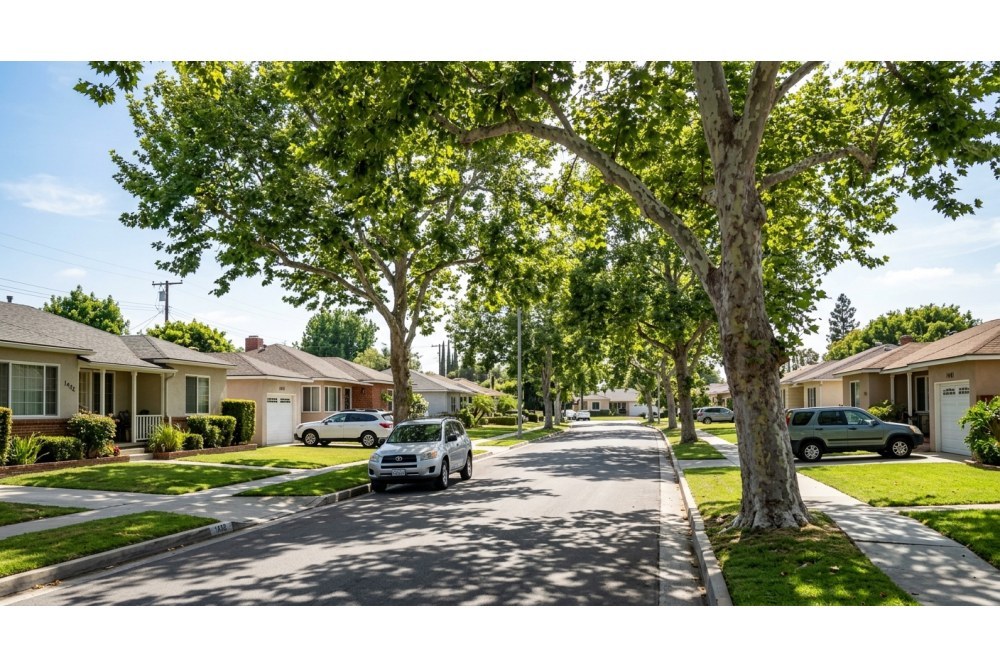
Before California's statewide ADU reforms took effect, Costa Mesa treated accessory dwelling units as conditional-use permits subject to full discretionary review. A landlord proposing a 600-square-foot detached unit in the backyard of a single-family rental faced a multi-month planning process: neighborhood notification, design-review board hearings, and a parking requirement that often killed the project before it started. The city's baseline zoning code demanded one covered parking space per bedroom for the ADU, plus retention of the primary dwelling's existing parking (a standard that left many older Costa Mesa lots with insufficient driveway width or garage depth to comply).
Interactive Tool
Costa Mesa ADU Construction Cost & Rent Yield Calculator
Estimate all-in cost, monthly rent, and gross annual yield for your accessory dwelling unit project

Costa Mesa caps ADUs at 1,200 sq ft or 50% of primary dwelling, whichever is less.
Engineered hardwood or tile, quartz counters, mid-tier appliances.
Measure from ADU site to nearest electric panel, gas meter, water lateral, and sewer cleanout.
Verify current Costa Mesa ADU rents with a local broker or property manager before finalizing your proforma.
 Built by NextGen Coastal
Owner-occupancy was not yet mandated by the city, but the discretionary nature of approval meant that planning commissioners could (and did) impose it as a condition on individual permits. Processing timelines stretched to six to nine months, and denial rates hovered near 30 percent for projects that triggered neighbor opposition or failed to meet subjective design criteria. For property managers, the pre-2017 regime made ADUs a niche play, feasible only on oversized lots with cooperative neighbors and deep-pocketed clients willing to absorb entitlement risk.
Parking as the Poison Pill
The single biggest barrier was parking. Costa Mesa's municipal code required that the ADU's parking be covered and tandem-accessible, meaning a narrow side yard couldn't simply be paved for an uncovered stall. Older neighborhoods platted in the 1950s and 1960s (where lot widths ran 50 to 60 feet) lacked the geometry to add a second garage bay or carport without demolishing existing structures. As a result, most pre-2017 ADU applications came from properties that had already converted a detached garage into living space and were now seeking to legalize it retroactively, rather than from landlords proactively adding new rental inventory.
2017–2019: State Mandates Arrive, Local Resistance Lingers
Applications nearly tripled after 2020 reforms eliminated discretionary review and parking mandates.
View chart data
| Category | ADU permit applications |
|---|---|
| 2017 | 35 |
| 2018 | 42 |
| 2019 | 47 |
| 2020 | 118 |
| 2021 | 125 |
| 2022 | 130 |
| 2023 | 115 |
California's first wave of ADU reform (AB 2299 (2016) and SB 1069 (2016), effective January 1, 2017) forced Costa Mesa to adopt ministerial approval for compliant ADU applications and capped parking requirements at one space per unit (not per bedroom). The state also prohibited owner-occupancy mandates in most cases and set a 120-day outer limit on permit processing. On paper, the changes were transformative. In practice, Costa Mesa's initial implementing ordinance (adopted in mid-2017) layered on enough local restrictions to preserve much of the old discretionary flavor.
The city's 2017 ADU ordinance imposed four-foot side and rear setbacks for detached units (versus the three-foot minimum allowed under state law), capped ADU size at 1,200 square feet or 50 percent of the primary dwelling (whichever was less), and required design compatibility review for any unit visible from the street. Parking relief was technically available, but only if the property sat within one-half mile of a transit stop, a threshold that excluded most of Costa Mesa's residential core. The result: applications increased modestly in 2017 and 2018, but processing times remained stuck at four to six months, and many projects still required multiple rounds of plan revisions to satisfy design-review staff.
AB 68 and SB 13: The 2020 Game-Changers
The second wave (AB 68, AB 881, SB 13, all effective January 1, 2020) closed the loopholes Costa Mesa had exploited. Key provisions included truly non-discretionary ministerial approval (design review limited to objective standards such as height, setback, and lot coverage, with no subjective aesthetic criteria), elimination of parking mandates across most single-family zones, setback reductions to zero for ADUs built in the footprint of an existing accessory structure, an outright ban on owner-occupancy requirements through December 31, 2024 (later extended to 2030), and creation of a separate ministerial track for JADUs (junior ADUs, units carved out of existing interior space up to 500 square feet).
Costa Mesa adopted a conforming ordinance in March 2020. The impact was immediate. Permit applications for new ADUs jumped from 47 in 2019 to 118 in 2020, according to city planning data. Processing timelines compressed to 60–90 days for straightforward detached units and as little as 30 days for garage conversions that met all objective criteria.
The 2020 reforms didn't just streamline approval. They flipped the default assumption. Pre-2020, an ADU application was a discretionary ask that the city could deny. Post-2020, it became a ministerial right that the city could only block for code violations.
2021–2023: Implementation, Enforcement, and the SB 9 Overlay
With ministerial approval in place, the operational questions shifted from whether an ADU could be built to how quickly and what happens when things go wrong. Costa Mesa's building division hired two additional plan-check staff in 2021 to handle the ADU surge, but even so, the queue for initial review stretched to six to eight weeks during peak summer months. For property managers coordinating tenant move-outs and construction schedules, that front-end delay became the new friction point, especially when a single plan-check correction (a missing shear-wall callout, an undersized beam) could reset the clock by another three weeks.
SB 9 and the Lot-Split Calculus
In January 2022, SB 9 added a new dimension: the ability to split a single-family lot into two parcels and build up to two units on each resulting parcel (four total units where one home previously stood). Costa Mesa adopted an SB 9 ordinance in mid-2022 that imposed objective design standards (16-foot minimum lot width per parcel post-split, 800-square-foot minimum lot area per unit, architectural variation between units) but could not block ministerial approval for compliant applications.
For landlords, SB 9 opened a path to dramatic densification on high-value lots near the city's commercial corridors (17th Street, Harbor Boulevard, Newport Boulevard). A 7,500-square-foot R-1 lot that previously maxed out at one primary dwelling plus one ADU could now theoretically support four fee-simple units, each separately financeable and saleable. In practice, the economics proved challenging. Lot-split surveys, separate utility laterals, and fire-separation walls added substantial soft costs, and lenders remained wary of financing attached duplexes on newly created parcels. Through the end of 2023, Costa Mesa recorded only nine SB 9 lot splits, versus more than 300 ADU permits issued in the same period. The takeaway for operators: SB 9 is a tool, not a mandate. Feasibility hinges on lot geometry, construction cost, and exit strategy.
Enforcement and Compliance: What Happens When an Unpermitted ADU Surfaces
The flip side of streamlined entitlement is heightened enforcement. As ADU awareness grew, so did the number of unpermitted units discovered during property sales, refinances, and tenant complaints. Costa Mesa's code-enforcement division opened 63 ADU-related cases in 2022 (triple the 2019 figure), most triggered by neighbor reports of illegal conversions (garage turned into a studio without permits) or short-term rental violations (ADU listed on Airbnb in violation of the city's 30-day minimum-stay rule).
The penalty structure is straightforward but punitive. An unpermitted ADU that meets current code can often be legalized through an after-the-fact permit, but the city assesses double permit fees plus administrative penalties. If the unit fails to meet setback, height, or fire-separation requirements, the owner faces a choice: bring it into compliance (often requiring partial demolition and reconstruction) or remove it entirely.
For property managers inheriting a portfolio with legacy unpermitted units, the 2020–2023 window represented a brief amnesty of sorts. State law's elimination of owner-occupancy and parking requirements meant that many older conversions could finally be permitted without major rework. That window is now closing as cities tighten enforcement and as lenders increasingly require ADU permits as a condition of cash-out refinances.
Short-Term Rental Prohibition
Costa Mesa's ADU ordinance explicitly prohibits short-term rentals (stays under 30 days) in accessory units, aligning with the city's broader STR regulations. Violation triggers a $1,000 first-offense fine, escalating to $2,500 for repeat offenses, and can result in revocation of the ADU's certificate of occupancy. For landlords managing coastal properties where STR income might otherwise pencil attractively, this is a hard constraint: ADUs in Costa Mesa are long-term rental inventory only. The city's code-enforcement team cross-references Airbnb and VRBO listings against ADU permit records quarterly, and platform hosts are required to provide city business-license numbers, a system that has proven effective at catching violators.
2024–2025: Current State and Emerging Trends
As of early 2025, Costa Mesa's ADU entitlement process is as streamlined as it has ever been. A detached unit on a standard R-1 lot, meeting the four-foot setback minimum, capped at 1,200 square feet, with no parking provided, can move from application submittal to issued permit in 60 days if plans are complete and code-compliant on first review. Garage conversions and JADUs often clear in 30–45 days. The city's online permit portal allows applicants to track plan-check status in real time, and the building division has published a 16-page ADU submittal checklist that eliminates most common correction cycles.
Permit volume has plateaued at around 110–130 ADU applications per year, suggesting that the initial wave of low-hanging-fruit projects (oversized lots, existing garage conversions) has largely been harvested. The marginal ADU projects now coming through the pipeline tend to be more complex: two-story detached units pushing the 1,200-square-foot cap, conversions of non-conforming accessory structures requiring variances, and SB 9 lot splits with attached ADUs on each resulting parcel.
Financing and Appraisal Hurdles
One under-discussed constraint is appraisal methodology. Fannie Mae and Freddie Mac updated their guidelines in 2022 to allow ADU rental income to be counted toward qualifying income for cash-out refinances and investment-property loans, but appraisers remain conservative in assigning value to newly constructed units. Construction cost might add only a fraction of that amount to appraised value if the appraiser cannot find sufficient comparable sales with similar ADU improvements. For landlords financing construction through a HELOC or cash-out refi, this appraisal gap can leave them underwater on the improvement, collecting rent but unable to extract equity until the broader market catches up.
The operators who have handled this successfully tend to do two things. First, they pull comps from adjacent cities (Newport Beach, Irvine, Huntington Beach) where ADU sales data is more developed. Second, they work with appraisers who specialize in investment properties and understand how to underwrite rental income as a value component rather than treating the ADU as a pure cost-approach addition.

Utility Connections and the Separate-Meter Question
Costa Mesa requires that ADUs have separate utility connections for electricity and gas, but allows water and sewer to remain on the primary dwelling's meter if the property owner installs a sub-meter and bills the ADU tenant separately. In practice, I find most landlords opt for full separation (separate electric, gas, water, and sewer laterals) to avoid the administrative burden of sub-metering and to create clean cost allocation for tax and accounting purposes.
The cost delta is significant. A shared water lateral with sub-meter runs in the low four figures installed. A new dedicated water lateral from the street costs substantially more, depending on distance and whether the city's main requires upsizing to serve the additional connection. For properties on older infrastructure (pre-1970s cast-iron mains), the city may require a main upgrade as a condition of the ADU permit, pushing costs higher. Sewer laterals face similar variability: a short run to an alley cleanout might cost a fraction of what a 60-foot trench to the street main would require.
For property managers advising clients on ADU feasibility, utility connection cost is often the line item that tips a marginal project into the red. The rule of thumb: if the ADU site is more than 40 feet from existing utility stubs, budget an extra layer of connection expense and factor that into the rent-versus-cost analysis before breaking ground.
Design, Permitting, and Construction: Realistic Timelines for 2025
Mid-range finishes dominate the market, balancing tenant appeal with investment returns.
View chart data
| Category | Cost per sq ft (midpoint) |
|---|---|
| Economy build | $300 |
| Mid-range build | $370 |
| High-end build | $460 |
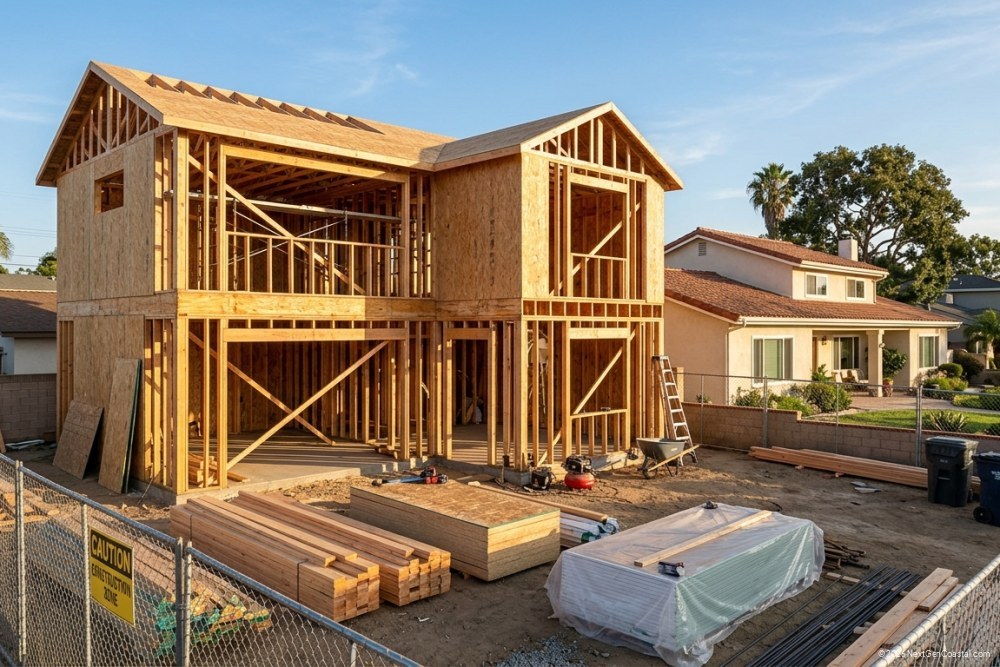
A landlord starting from scratch today (no plans, no contractor, no permit) should expect the following timeline for a detached ADU in Costa Mesa. Design and engineering typically consume 6–10 weeks for architectural plans, structural calcs, Title 24 energy compliance, and civil/survey work if the lot has grading or drainage issues. Permit submittal and plan check take 6–8 weeks; first review typically requires 3–4 weeks, and the correction cycle adds another 2–3 weeks if revisions are needed. Permit issuance to construction start runs 1–2 weeks for contractor schedules, material ordering, and pre-construction site prep. Construction itself stretches 4–6 months; framing and rough-in move quickly (8–10 weeks), but finish work (drywall, tile, cabinetry, fixtures) stretches longer due to subcontractor availability and inspection hold points. Final inspection and certificate of occupancy require 2–3 weeks, as building, electrical, plumbing, and mechanical finals must all clear before the city issues the CO.
Total elapsed time: 10–14 months from concept to tenant move-in.
The projects that compress this timeline are those using pre-approved plan sets (several ADU-focused architects in Orange County offer stock plans that have already cleared Costa Mesa's plan check) and design-build contractors who can overlap permitting and procurement. The projects that stretch beyond 14 months are typically those that encounter unforeseen conditions: shallow groundwater requiring a deeper foundation, a non-compliant sewer lateral that must be replaced, or a neighbor dispute that triggers a code-enforcement hold.
Cost Benchmarks: What ADUs Actually Cost in Costa Mesa
Construction cost per square foot for a detached ADU in Costa Mesa as of Q1 2025 varies by finish level. Economy builds with basic finishes and minimal site work (vinyl plank flooring, laminate counters, builder-grade fixtures, simple stucco exterior) run in the low-to-mid range per square foot. Mid-range builds with quality finishes and moderate site work (engineered hardwood or tile, quartz counters, mid-tier appliances, fiber-cement siding or board-and-batten accents, basic landscaping) occupy the middle band. High-end builds with custom finishes and significant site work (hardwood floors, stone counters, high-efficiency HVAC, contemporary metal-and-glass facade, retaining walls, mature landscaping) command the upper tier.
A typical 600-square-foot detached unit in the mid-range band thus costs in the low-to-mid six figures all-in (construction plus permits, utility connections, and soft costs). At a monthly rent that reflects current Costa Mesa market conditions for a one-bedroom ADU in the city's residential core, that pencils to a gross yield in the mid-to-high teens before property tax, insurance, and maintenance. For landlords with existing equity in the primary dwelling, that return is compelling. For those financing the full construction cost at current HELOC or investment-property cash-out refi rates in early 2025, the cash-on-cash return compresses substantially, making the ADU a long-term appreciation play rather than an immediate cash-flow generator.
Tenant Management and Lease Structuring for ADUs
Once the ADU is built and permitted, the operational questions shift to tenant selection, lease terms, and ongoing management. Costa Mesa ADUs occupy a unique niche in the rental market: they offer single-family privacy and yard access at a price point below a standalone house, but they lack the anonymity and amenity package of a large apartment complex. The ideal tenant profile skews toward young professionals, small families, and empty-nesters who value outdoor space and a quiet neighborhood setting over proximity to nightlife or walkable retail.
Lease structuring requires clarity on three points. First, utility responsibility: if the ADU has separate meters, the lease should explicitly assign all utility accounts to the tenant; if water/sewer remains on a shared meter with sub-metering, the lease must specify the billing methodology and payment due date. Second, yard and common-area use: most Costa Mesa ADUs share a side yard or rear patio with the primary dwelling, so the lease should define which areas are exclusive to the ADU tenant, which are shared, and what restrictions apply (no storage of personal items in shared areas, no grilling on shared patios without prior approval, etc.). Third, parking: even though the city no longer requires ADU parking, tenants expect it; if the property has only one driveway and the primary dwelling's tenant parks there, the ADU tenant will need to park on the street, a potential friction point in neighborhoods where overnight street parking is tight; the lease should address this upfront.
For property managers, the ADU tenant relationship often requires more hands-on communication than a typical single-family lease, especially in the first 90 days as both tenants (primary and ADU) learn to coexist. The operators who handle this well schedule a joint walk-through at move-in, provide a written guide to shared-space etiquette, and make themselves available for quick mediation if disputes arise. The alternative (letting tenants sort it out themselves) tends to result in one or both parties giving notice at lease end.
Looking Ahead: What the Next Five Years Hold for Costa Mesa ADUs
The regulatory environment is unlikely to tighten. California's housing crisis remains acute, and the state legislature has shown no appetite for rolling back ADU reforms. If anything, future bills will likely push further: expanding ministerial approval to two-story ADUs, allowing ADUs on multifamily lots, or preempting local design standards that exceed objective minimums. Costa Mesa will continue to implement state mandates with minimal local overlay, and permit processing will likely improve as the building division's ADU-specific staff gain experience.
The economic environment is more uncertain. Construction costs have plateaued after the 2021–2023 spike, but labor remains tight and material lead times for windows, appliances, and HVAC equipment still stretch 8–12 weeks. Interest rates (while off their 2023 peak) remain elevated relative to the 2010s, compressing cash-on-cash returns for projects financed with debt. The landlords moving forward with ADU construction in 2025 are those with low-cost capital (existing home equity, cash reserves, or access to portfolio lines of credit at favorable rates) and a long hold horizon (a decade or more to amortize soft costs and capture appreciation).
For property managers, the ADU opportunity is less about new construction and more about portfolio optimization: identifying which clients have feasible sites, connecting them with vetted design-build teams, and then managing the resulting units as part of a broader single-family rental strategy. The operators who built that muscle over the past five years (who can read a site plan, estimate utility connection costs, and structure a lease that keeps both tenants happy) are the ones capturing incremental management fees and client retention as the ADU wave matures.
The shift from discretionary review to ministerial approval didn't just change the rules. It changed the operator skill set. The property managers who thrive in the next decade are those who can handle entitlement, construction, and tenant relations with equal fluency.
- Ministerial approval became truly non-discretionary. Design review was constrained to objective standards, height, setback, lot coverage, with no subjective aesthetic criteria permitted.
- Parking requirements were slashed. No parking could be required for an ADU within one-half mile of transit or located in a historic district or part of an existing residence conversion or in an area where on-street parking permits are required. For Costa Mesa, this eliminated parking mandates across an estimated 70–80 percent of the city's single-family zones.
- Setbacks dropped to zero for ADUs built in the footprint of an existing accessory structure (garage, shed, pool house). For new detached construction, the state floor became four feet, and cities could not impose more without findings of public health or safety necessity.
- Owner-occupancy requirements were banned outright through December 31, 2024 (later extended to 2030 by subsequent legislation).
- JADUs (junior ADUs), units carved out of existing interior space, up to 500 square feet, with no new exterior entrance required, became a separate ministerial track with even lighter requirements.
- Design and engineering: 6–10 weeks. Architectural plans, structural calcs, Title 24 energy compliance, and civil or survey work if the lot has grading or drainage issues.
- Permit submittal and plan check: 6–8 weeks. First review typically takes 3–4 weeks; correction cycle adds another 2–3 weeks if revisions are needed.
- Permit issuance to construction start: 1–2 weeks. Contractor schedules, material ordering, and pre-construction site prep.
- Construction: 4–6 months. Framing and rough-in move quickly (8–10 weeks), but finish work, drywall, tile, cabinetry, fixtures, stretches longer due to subcontractor availability and inspection hold points.
- Final inspection and certificate of occupancy: 2–3 weeks. Building, electrical, plumbing, and mechanical finals must all clear before the city issues the CO.
- Economy build (basic finishes, minimal site work): $280–$320/sq ft. Vinyl plank flooring, laminate counters, builder-grade fixtures, simple stucco exterior.
- Mid-range build (quality finishes, moderate site work): $340–$400/sq ft. Engineered hardwood or tile, quartz counters, mid-tier appliances, fiber-cement siding or board-and-batten accents, basic landscaping.
- High-end build (custom finishes, significant site work): $420–$500/sq ft. Hardwood floors, stone counters, high-efficiency HVAC, contemporary metal-and-glass facade, retaining walls, mature landscaping.
- Utility responsibility. If the ADU has separate meters, the lease should explicitly assign all utility accounts to the tenant. If water or sewer remains on a shared meter with sub-metering, the lease must specify the billing methodology and payment due date.
- Yard and common-area use. Most Costa Mesa ADUs share a side yard or rear patio with the primary dwelling. The lease should define which areas are exclusive to the ADU tenant, which are shared, and what restrictions apply (no storage of personal items in shared areas, no grilling on shared patios without prior approval, and the like).
- Parking. Even though the city no longer requires ADU parking, tenants expect it. If the property has only one driveway and the primary dwelling's tenant parks there, the ADU tenant will need to park on the street, a potential friction point in neighborhoods where overnight street parking is tight. The lease should address this upfront.
Frequently Asked Questions
How long does it take to get an ADU permit in Costa Mesa in 2025?
Can I use my Costa Mesa ADU as a short-term rental?
Do I need to provide parking for my ADU in Costa Mesa?
What does it cost to build a 600-square-foot ADU in Costa Mesa?
Can I build an ADU if I don't live in the primary dwelling?